Reconciling high “inflation” and low bond yields

November 16, 2021

[This blog post is a slightly modified excerpt from a TSI commentary published last week]

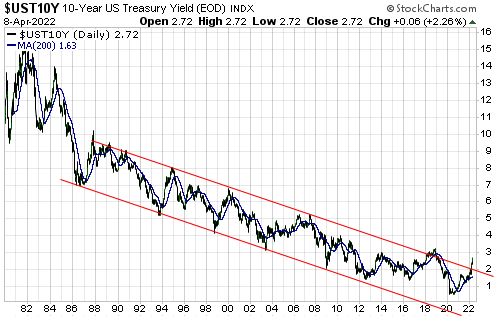
The US government just reported a 6.2% year-over-year increase in the CPI (refer to the following chart). This was the largest increase since 1990 and the second-largest increase since 1982. Furthermore, nobody in their right mind believes that the CPI overstates the pace of US$ depreciation. How can this be happening in parallel with a yield of about 1.5% on the US 10-year T-Note and a yield of about 1.9% on the US 30-year T-Bond?

There’s a two-part answer to the above question, the first part of which is that the bond market expects the CPI to average only 2.7% over the next ten years. We know this is the case because 2.7% is the annual CPI increase factored into the current price of the 10-year TIPS. In other words, the bond market is anticipating a substantial pullback in the “inflation” rate from its current level. However, even a 2.7% rate of increase in the CPI is inconsistent with a current 10-year T-Note yield of around 1.5%. Based on today’s inflation expectations, the 10-year T-Note currently should be yielding at least 3.5%.

The other part of the answer is that the financial markets expect the Fed to do whatever it takes to cap the yields on US government bonds at well below the rates that would be consistent with the official “inflation” rate.

Given its unlimited ability to purchase assets with money that it creates out of nothing, the Fed is capable of keeping government bond yields pegged at unrealistically low levels for a long time. However, doing so would have very bearish implications for the US$ and very bullish implications for most US$-denominated prices. In particular, Fed policy that involved capping US government bond yields at low levels in the face of obvious evidence of high “inflation” would be extremely bullish for the US$ gold price.

Official Fed policy that involves capping bond yields at low levels in the face of persistently high “inflation” is not likely to be introduced over the next six months, but I suspect that it will become a major driver of market prices during 2023-2024.

Setting the stage for the 2022 bust

November 9, 2021

[This blog post is an excerpt from a commentary posted at speculative-investor.com about two weeks ago]

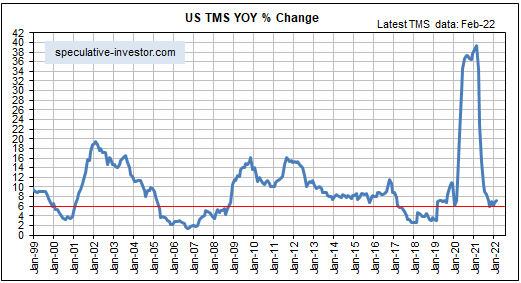
The US financial system currently has an abundance of ‘liquidity’. We know that this is the case because US credit spreads are close to multi-decade lows. The probability of a liquidity crisis or crunch with credit spreads near their narrowest levels in decades is not just low, it is zero. However, the money-supply growth trend warns that a boom-to-bust transition could begin as soon as the first half of 2022, potentially setting the stage for a major financial-market event/crisis during the second half of 2022.

The US money-supply growth trend is illustrated by the following chart. The chart shows that the year-over-year rate of growth in US True Money Supply (TMS) peaked at almost 40% early this year and has since collapsed to around 7%.

We thought that the TMS growth rate would level out during September, but instead it extended its steep decline. The reason is that the Fed, via its Reverse Repo (RRP) program, removed $330B from the financial system over the course of the month. To put it another way, for every dollar the Fed added via its QE program during September it removed almost three dollars via its Reverse Repo program.

If not for the Fed’s additions to its RRP program in September, the TMS growth rate would have ended the month at 8.7% (slightly above the end-August level) instead of 7.0%. Furthermore, if not for all the money removed by the Fed via RRP’s since the program was initiated in March of this year, the TMS growth rate would now be 14.5% as opposed to 7.0%.

As an aside, the Fed hasn’t removed a lot of money ($1.43 trillion at the time of writing) from the US financial system over the past seven months in an effort to tighten monetary conditions; it has done so to address a problem that can be aptly described as a surplus of dollars. There has been a huge quantity of dollars ‘sloshing around’ the financial system looking for a zero-risk, temporary home with a small positive yield. The Fed’s RRP program has provided such a home.

All of the money removed by the Fed via RRP’s will be returned to the US financial system at some point (probably next year). However, the US TMS growth rate has fallen far enough to suggest that the next trend reversal in credit spreads from narrowing to widening will mark the start of a boom-to-bust transition rather than just an interruption to the boom.

By the same token, until the credit-spreads trend reversal happens it will be reasonable to assume that the boom is intact and that there won’t be anything more bearish than moderate corrections in the senior equity and commodity indices.

Looking at oil from different perspectives

October 25, 2021

[This blog post is a modified excerpt from a commentary published at TSI about two weeks ago. We’ve updated the charts and prices to reflect the current market situation.]

Today we’ll take a brief look at oil through three different lenses: The long-term price-action lens, the physical supply-demand lens and the macro-economic lens.

The following chart shows the significance of the US$76-$77 price level above which oil has moved over the past few weeks. This price level acted as support during large downward corrections in 2011-2012 and capped the 2016-2018 rally.

The move above major resistance is not a short-term buy signal, because the market is ‘overbought’ (which, by the way, doesn’t guarantee that the price will fall, but does mean that the risk of new buying is relatively high). However, it is a reward for those who added to their oil exposure when the commodity and the related equities were ‘oversold’ at various times over the past three months and is consistent with our view that the cyclical advance will extend into 2022.

oil_251021

With regard to likely future performance, of far greater importance than the break above long-term resistance is that the physical supply situation remains unusually ‘tight’. We know this is the case because strong backwardation (meaning: nearer-dated contracts are priced well above later-dated contracts) prevails in the oil futures market. This is evidenced by the downward slope on the following chart. Strong backwardation can only arise and be sustained in the oil market during a period when the demand for oil is high relative to the currently available supply.

The most recent data on the following chart is for the situation at 14th October 2021, but the futures curve continues to have a steep downward slope. For example, at the time of writing oil for delivery in December of this year is priced at $84.55, whereas oil for delivery in December-2022 is priced at $72.58 and oil for delivery in December-2023 is priced at only $66.56.

Note that the prices of oil futures are NOT forecasts of where the spot price will be in the future. Instead, the futures price relative to the spot price reflects the cost of storage. Since the cost of storage is always above zero, the futures price will always be higher than the spot price unless there is a current shortage of the physical commodity.

oilfuturescurve_251021
Chart source: https://www.erce.energy/graph/wti-futures-curve/

Our last chart shows that the oil price and the Inflation Expectations ETF (RINF) usually trend in the same direction. This positive correlation is part and parcel of a broader positive correlation between commodity prices (as represented by indices such as GNX) and inflation expectations.

Both oil and inflation expectations have resumed their cyclical upswings following corrections during the second and third quarters of this year.

oil_RINF_251021

At the moment, the price action, the supply-demand fundamentals and the macro-economic backdrop (as reflected by inflation expectations) are saying the same thing. They are all saying that we should expect the oil price to continue its upward trend.

US Recession/Expansion Watch

October 11, 2021

[This blog post is a brief excerpt from a recent TSI commentary]

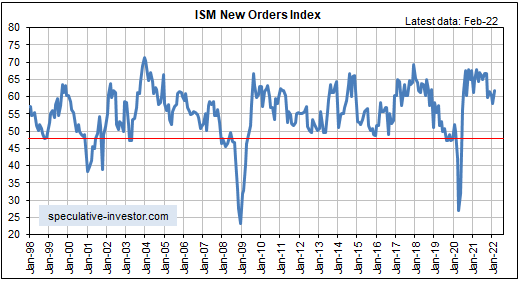
The latest leading economic data indicate that the US recovery/expansion is intact and that US GDP will continue to grow at an above-average rate for at least two more quarters, albeit not as quickly as it grew during the first half of this year. Of particular relevance, the following monthly chart shows that the ISM Manufacturing New Orders Index (NOI), one of our favourite leading economic indicators, remains near the top of its 20-year range. The ISM NOI leads Industrial Production by 3-6 months.

Note that the GDP growth number for Q3-2021, the preliminary calculation of which will be reported late this month, could reveal substantial deceleration from the 6%-7% growth that was reported for the first two quarters of this year. In fact, it could be as low as 2%. However, the financial markets are aware of this and went at least part of the way towards discounting the slowdown over the past few months. More importantly, there’s a good chance that US economic activity will re-accelerate late this year and into the first quarter of next year. This will be partly due to inventory building but mainly due to millions of people re-entering the workforce (millions of people who were paid by the government NOT to produce are going to become productive due to the expiry, early last month, of the federal government’s $300/week unemployment subsidy).

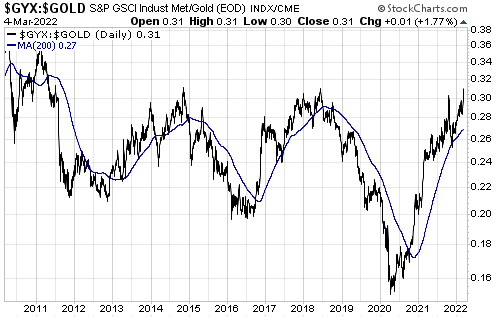
The performances of leading and coincident economic indicators show that the US economy remains in the boom phase of the boom-bust cycle, meaning that the economic landscape remains bullish for industrial commodities relative to gold. Consequently, the major upward trend in the commodity/gold ratio (GNX/gold) evident on the following chart should extend into next year.

In conclusion and as stated in previous commentaries over the past few months, the probability of the US economy re-entering recession territory prior to mid-2022 is extremely low, although current money-supply trends warn that a boom-to-bust transition and an equity bear market could begin as soon as the first half of 2022. This would suggest the second half of 2022 for the start of the next US recession, but there’s no point trying to look that far ahead. Our favourite leading indicators should give us ample warning.