The bullish case for commodities remains intact

April 24, 2026

[This blog post is an excerpt from a recent commentary at https://speculative-investor.com/]

In January of last year, we presented a list of items that would support the coming bull market in commodities. We subsequently reiterated and added to this list. Due to the events of the past two months another addition is appropriate, but to refresh memories here are the points mentioned previously:

1) Investments in AI-related datacentres and the associated infrastructure (power plants, pipelines, transmission lines, transportation services) will add significantly to commodity demand for years to come, even if the stock prices of the biggest spenders (the so-called “hyperscalers”) have reached their peaks. This is based on the datacentres already under construction and planned to commence construction.

This AI-related investment continues to have a very significant effect on the US economy. It is, in fact, the main reason that the US economy continues to grow.

2) The commercial demand for commodities will be boosted by the rebuilding of Ukraine, the rebuilding of Gaza and the construction of the massive Yarlung Tsangpo Hydroelectric Project in China.

3) Government trade policy is likely to put upward pressure on commodity prices in some parts of the world, most notably in the US, by making the trading of commodities less efficient. For example, whereas previously it would have made sense to import a commodity rather than produce it locally, due to tariffs it could make more sense to produce locally. However, it generally takes several years to build a new mine and the mine-building process itself consumes large quantities of commodities.

4) The combination of a weaker US$ and increased government spending around the world will both support the commercial demand for commodities and boost the speculative demand for commodities as an inflation hedge. The buying of commodity futures and physical commodities to hedge against currency depreciation contributed to the commodity bull market of the 1970s.

5) Even though investment in ‘renewable’ energy such as solar and wind is now being de-emphasised or actively discouraged by the US government, there continues to be massive investment in these forms of energy around the world and especially in China. This will boost the commercial demand for industrial metals.

6) The gold bull market that began in late-2022 projected a subsequent commodity bull market (commodity bull markets are just gold bull markets that have broadened). We have conclusive evidence in the price action that a commodity bull market began last year, and cyclical bull markets in commodities usually last at least two years.

The above points remain valid, and we can add the US-Israel-Iran war to the List. This war will fuel the commodity bull market in these ways:

a) Due to the damage it has caused to oil and LNG production facilities, the prices of oil and LNG will be higher than otherwise would have been the case over the next 1-2 years.

b) There will be increased commodity demand associated with massive rebuilding works in Iran and the rectification of the energy infrastructure that has been damaged throughout the Gulf region.

c) By creating a temporary shortage of fertiliser and raising the price of fertiliser, it will result in less fertiliser being used this year, leading to lower crop yields and higher agricultural commodity prices next year.

d) By reducing the supply of sulphur and thus boosting its price, the costs of fertiliser production, mining and petroleum refining have increased. This will lead to higher prices for grains, industrial metals and petroleum products.

e) The need to replenish the missiles, bombs and other weapons/equipment used by the armed forces will significantly add to demand for some commodities, chief among them being Rare Earth Elements (REEs).

f) US government spending will be hundreds of billions of dollars more than otherwise would have been the case. In essence, the US government has broken a lot of windows and over the coming year will spend a lot of money to get back to where it was prior to the war. This non-productive public-sector spending will elevate prices and increase the private sector’s desire to own commodities or the stocks of commodity producers as a hedge.

Further to the above, the commodity bull market is very much intact and looks set to extend into 2027-2028. Consequently, significant corrections in the stocks of commodity-related equities should be viewed as buying opportunities.

Gold versus Oil

April 15, 2026

[This blog post is an excerpt from a recent commentary at www.speculative-investor.com]

In inflation-adjusted terms and relative to the monetary commodity (gold), commodities tend to become cheaper over the long haul. Another way of saying this is that over the very long-term, gold tends to increase in value relative to commodities in general. This is due to technological progress that enables the production of more for less, as evidenced by the fact that the percentage of the US workforce involved in farming has decreased from over 50% in the 1860s to less than 2% today in parallel with a large increase in per-capita agricultural production. Historically, however, oil has held its ground relative to gold. Why is that and will it continue?

When we say that oil has held its ground, we don’t mean that the gold/oil ratio has been stable. On the contrary, over the 150+ year period covered by the following monthly chart there clearly have been huge swings in the price of oil relative to the price of gold. What we mean is that after a huge move in one direction or the other, in the past the ratio eventually retraced the move.

Of particular interest, the chart shows that since the 1890s there have been four rises in the gold/oil ratio to 80 or above, with the latest one occurring recently, and that each of these previous dramatic upward moves was followed by a decline to below 40 within the ensuing few years. Will it be the same story this time around, that is, should we expect the gold/oil ratio to be back below 40 within a few years?

Before attempting to answer the above question we’ll posit that the oil price has held its ground relative to the gold price over the very long term because artificial barriers have been created to limit oil production and thus cause the long-term average oil price to be higher, in real terms, than would be the case if market forces were allowed to operate unhindered. The most important of these artificial barriers is OPEC, which was created in 1960.

Furthermore, we have just witnessed the creation of another artificial barrier in the form of deliberate destruction of oil production facilities in the Middle East. Even if the US-Israel-Iran conflict has peaked and the current fragile truce evolves into a lasting peace arrangement, due to what already has happened the global production of oil will be lower, and the average price of oil will be higher, during 2026-2027 than it otherwise would have been.

So, as to whether the gold/oil ratio returns to below 40 within the next few years, a lot of will depend on what artificial barriers are placed in the way of oil production growth. This is not knowable, as the determining factor will be political decisions that often are not rational if the goal is to maximise living standards.

That being said, the next monthly chart indicates that a major change in the performance of oil relative to gold may have occurred in 2008.

For decades prior to 2008 the gold/oil ratio oscillated within a wide horizontal range, but in 2008 it commenced an upward trend that has resulted in a move to well above the top of this multi-decade range. This upward trend was ‘kicked off’ by the Global Financial Crisis, but it’s likely that it was sustained in part by the shale revolution that began to have a significant effect on oil production in the early-2010s. Due to the shale revolution, US oil production increased from a low of around 5M barrels/day in 2008 to its current level of around 13.6M barrels/day. This large rise in US production put downward pressure on the oil price and reduced the influence on the oil market of the artificial barrier known as OPEC.

Further to the above, it’s possible that oil is now about 18 years into an ultra-long-term (multi-decadal or even multi-generational) downward trend relative to gold, but a lot will depend on the actions taken by governments to limit the supply of oil.

More Tariff Turmoil

February 24, 2026

[This blog post is an abbreviated excerpt from a recent commentary published at www.speculative.investor.com]

On Friday of last week the Supreme Court of the United States (SCOTUS) ruled against the tariffs imposed by Trump under the International Emergency Economic Powers Act (IEEPA). What will be the financial-market and economic effects?

Based on the financial world’s initial reaction, the effects will be relatively minor. For example, the following weekly chart shows that the iShares 20+ Year Treasury ETF (TLT) consolidated last week but held the preceding week’s upside breakout. Also, the currency market did very little in response to the news.

The small initial market reaction probably stems from the fact that the Trump Administration intends to replace the tariff revenues lost through the inability to use the IEEPA with tariff revenues gained through other avenues, such as “Section 122”. In fact, Trump already has stated that he will use Section 122 to impose a global 15% (initially 10% but raised to 15% one day later) tariff on US imports. This would keep total tariff revenue at around the same level, but it would change substantially the distribution of the tariffs. For example, the average tariff on imports from China would be reduced, but the average tariff applied to imports from Canada would increase.

The single biggest problem associated with Trump’s use of tariffs has been the uncertainty resulting from the sudden changes. The uncertainty remains, because there will be many changes to product tariff rates in response to last Friday’s SCOTUS ruling, necessitating changes to many business plans. Furthermore, the President’s authority under Section 122 only enables the imposition of tariffs for up to 150 days. What happens after that?

Trump has been fortunate in that the business investment that has been curtailed/delayed by his many tariff-related threats and policy flip-flops has coincided with a massive increase in investment associated with AI — investment that would have happened regardless of who was in the White House. As illustrated by the following quarterly chart, Real Gross Private Domestic Investment (RGPDI) in the US has dropped from its Q1-2025 all-time high, but not by much. Moreover, with at least US$1 trillion of AI-related investment slated to occur during 2026 in an economy with a current RGPDI run-rate of about US$4.4 trillion, there’s a good chance that RGPDI will make a new all-time high within the next three quarters despite the uncertainty caused by the tariffs.

Unfortunately, this AI-related investment binge won’t do anything for average Americans other than increase their electricity costs and make their jobs less secure.

Summing up, last Friday’s ruling on Trump’s tariffs has removed a ‘known unknown’, but it has created new unknowns and hasn’t prompted a change to our outlook for any market. Currently, the ‘known unknown’ with the largest potential short-term market impact is the US-Iran situation.

REE prices are making new highs

February 9, 2026

[This blog post is an excerpt from a recent commentary at www.speculative-investor.com]

The stock prices of companies focussed on Rare Earth Elements (REEs) rallied well in advance of the underlying commodities during May-October of last year, but recently the prices of the commodities have gone up a lot while the REE sector of the stock market has been in correction mode. This actually is normal for some commodity sectors, chief among them being REEs and lithium, during cyclical bull markets. First the equities make big up-moves while the commodities do very little, after which the equities correct/consolidate while commodity prices catch up. Then the cycle repeats, with the equities rallying anew.

The following daily charts illustrate what we just described. The first chart shows that there was a massive rally in the stock price of MP Materials (MP), a proxy for the REE equity sector, from a low in May to a peak in October of last year, at which point a substantial correction began. The second chart shows that during May-October there was only a moderate advance in the price of Neodymium (Nd), a proxy for REEs, but that over the past two months there has been a parabolic rise to well above the October high.

Based on the historical pattern, we expect that the Nd price will level off within the coming month or so and that at around the same time the REE equities will commence new intermediate-term upward trends.

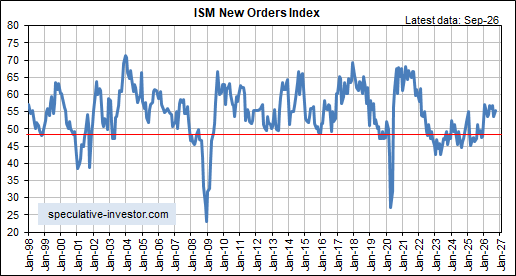
Upward pressure on the prices of many industrial commodities, including REEs, lithium, copper, tin, nickel and natural gas, will be maintained for at least another 12 months due to the on-going datacentre buildout, which not only is continuing but accelerating. Just four companies (Alphabet, Amazon, Meta and Microsoft) are together anticipating capital spending of around US$650B this year, up from the already-substantial amount of US$360B in 2025. These spending plans could explain January’s large rise in the ISM Manufacturing New Orders Index.