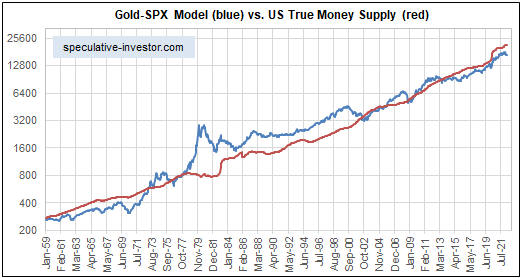
Shift from boom to bust could begin soon

February 15, 2022

[This blog post is an excerpt from a commentary published at TSI about 1.5 weeks ago]

The latest leading economic data indicate that the US expansion is intact. This is the case even though the following monthly chart reveals that in January-2022 the ISM Manufacturing New Orders Index (NOI), one of our favourite leading economic indicators, dropped to its lowest level since June-2020. The reason is that it’s normal for the rate of improvement — which is what the NOI is measuring — to decline while the economy remains in the expansion phase. That being said, there are signs that the pace of economic activity will slow markedly during the first half of this year.

Note that the NOI would have to drop below 55 to stop being a positive influence on the US stock market and below 48 to warn of a recession. We won’t be surprised if it drops below 55 within the next two months, but a decline to below 48 is probably at least 2-3 quarters away.

Regarding the pace of US economic growth, in our previous four “US Recession/Expansion Watch” monthly discussions we wrote that we expected US economic activity to re-accelerate during the final months of 2021 and the early part of 2022 due to inventory building and millions of people returning to the workforce. That happened (for exactly the reasons expected*) and was confirmed by the preliminary estimate of annualised GDP growth coming in at 6.9% for Q4-2021. It was also confirmed by Real Gross Private Domestic Investment (RGPDI), a quarterly statistic that acts as a leading indicator of recession starts and a coincident indicator of recession ends. As illustrated below, RGPDI rose sharply to a new all-time high in the fourth quarter of last year.

Note that the vertical red lines on the following chart mark official recession start dates.

However, the financial markets don’t care what happened months ago; they care what’s going to happen over the months/quarters ahead and there is evidence that the GDP growth rates reported for the first two quarters of this year will be MUCH lower than the rate reported for the final quarter of last year. In fact, due to “inflation” remaining near its cycle peak while the pace of economic activity slows, the “real” GDP growth rate during the first quarter of this year could be close to zero.

The preponderance of evidence from leading economic indicators and confidence indicators points to the H1-2022 economic slowdown occurring within the context of an economic boom, although a pronounced slowdown within a boom and the early part of a boom-to-bust transition can be indistinguishable.

Money-supply trends warn that a boom-to-bust transition could begin as soon as the first half of this year, but the start of a boom-to-bust transition usually precedes the start of an official recession by at least a few quarters and leading economic indicators are a long way from issuing recession warnings. Therefore, the next US recession probably won’t begin any earlier than Q4-2022.

*We noted at the time they were announced that the initial BLS estimates for jobs growth in November and December of last year had massively understated the strength of the US labour market. The latest monthly employment report, which was issued on Friday 4th February, contained revisions to previous months that corrected the errors. The corrections resulted in a combined increase of 709K to the November-December jobs growth total. As a consequence, the employment data now show that the US economy added 1.83M jobs in Q4-2021 and 2.3M jobs over the past four months.

It may be ‘one and done’ for the Fed

January 31, 2022

[This blog post is an excerpt from a commentary published at TSI last week]

After the FOMC meeting on Wednesday 26th January, the Fed — via a post-meeting statement and a press conference — made it clear that it plans to end its bond monetisation (QE) program in early-March and hinted strongly that it will make its first rate hike of the cycle in mid-March (the time of the next FOMC meeting). The Fed also discussed its intention to significantly reduce its balance sheet.

What the Fed expects to do and what it ends up doing are often very different. Currently the Fed expects to hike its official interest rate targets in March-2022 as part of a rate-hiking campaign that will entail four rate hikes this year and more rate hikes next year. However, we suspect that the March-2022 hike will turn out to be this year’s only hike, because by May-June it will be clear to the backward-looking Fed that both “inflation” pressure and US economic growth peaked in 2021.

Moreover, we are confident that the Fed will never significantly reduce its balance sheet. It may well start to reduce its balance sheet over the remainder of this year by not replacing maturing debt securities, but it will react to the next serious economic decline the way it has reacted in the past. As a result, its balance sheet probably will be much larger in 18 months’ time than it is today.

The insurmountable problem faced by the Fed is that once an investment bubble of sufficient magnitude to affect a large part of the economy has been inflated, there is no way to let the air out of the bubble without wreaking economic havoc. To postpone the politically unacceptable economic havoc that would result from genuine deflation, every downturn must be met by progressively larger floods of new money. The endgame is hyperinflation and/or a reset involving the establishment of a new monetary system.

We think that the endgame is still many years away. In the meantime, be prepared for more waves of monetary inflation leading to increasingly obvious price inflation, interrupted by the occasional deflation scare.

Understanding the yield curve

January 28, 2022

The yield curve is said to be steepening when the gap between long-term interest and short-term interest rates is increasing, but the meaning of the steepening is different depending on whether it is being driven by rising long-term interest rates or falling short-term interest rates. Also, the yield curve is said to be flattening when the gap between long-term interest and short-term interest rates is decreasing, but the meaning of the flattening is different depending on whether it is being driven by falling long-term interest rates or rising short-term interest rates. The two possible yield curve trends (steepening or flattening) and the two main ways that each of these trends can come about results in four different yield curve scenarios as outlined below.

1) A steepening curve driven by rising long-term interest rates (that is, a steepening of the curve along with flat or rising short-term interest rates).

This is indicative of rising inflation expectations. It tends to be bullish for commodities, cyclical sectors of the stock market and relatively high-risk equities and credit. It is bearish for long-dated treasuries.

2) A steepening curve driven by falling short-term interest rates.

This is indicative of declining liquidity and a general shift away from risk. It is bullish for all treasury securities (especially short-dated treasuries) and gold. It is bearish for almost all equities and especially bearish for cyclical and relatively high-risk equities. It is also bearish for commodities and high-yield credit.

3) A flattening curve along with rising short-term interest rates.

This is indicative of an increasing urgency to borrow short to lend/invest long and a general shift towards risk. It tends to be bullish for most equities and high-yield credit. It is bearish for gold and short-dated treasury securities.

4) A flattening curve driven by falling long-term interest rates (that is, a flattening of the curve along with flat or falling short-term interest rates).

This is indicative of declining inflation expectations and increasing aversion to risk. It tends to be bullish for gold, long-dated treasuries and relatively low-risk equities. It tends to be bearish for cyclical stocks and high-yield credit.

In general, scenarios 1 and 3 arise during economic booms, scenario 2 is a characteristic of an economic bust and scenario 4 occurs during a boom-to-bust transition.

The top section of the following chart shows that the 10yr-2yr yield spread, which is one of the most popular measures of the US yield curve, has been declining (indicating a flattening yield curve) since March of 2021. The bottom section of the same chart shows that the yield-curve flattening has occurred in parallel with a rising 2-year yield, meaning that for the past several months we have had yield curve scenario 3. This is evidence that the boom continues. However, a shift to yield curve scenario 4 (indicating a boom to bust transition) could happen soon.

yieldcurve_blog_280122

The inflation peak is in the rear-view mirror

January 18, 2022

[This blog post is a brief excerpt from a TSI commentary published last week]

It was reported on Wednesday 12th January that the year-over-year growth rate of the US CPI hit a new post-1982 high of 7% in December-2021. However, garnering less attention was the fact that the month-over-month CPI growth rate peaked in June-2021, made a slightly lower high in October-2021 and in December-2021 was not far from its low of the past 12 months. The first of the following charts shows the month-over-month change in the US CPI. Of greater importance for financial market participants, the second of the following charts shows that inflation expectations (the rate of CPI growth factored into the Treasury Inflation Protected Securities market) is well down from its November-2021 peak and actually fell on Wednesday 12th January in the wake of the horrific headline CPI news.

We were very bullish on “inflation” back in April of 2020 when deflation fear was rampant; not because we were being contrary for the sake of being contrary but because central bank and government actions pretty much guaranteed that the CPI would be much higher within 12 months. Now, with inflation fear rampant, we expect to see increasingly obvious signs over the quarters ahead that the inflation threat has abated, not because we are being contrary for the sake of being contrary but because the monetary and fiscal situations stopped being pro-inflation many months ago.

It’s likely that the next round of accelerating inflation will emerge during 2023-2024.