Time to build up cash

June 22, 2026

[This blog post is a slightly modified excerpt from a commentary published at https://speculative-investor.com/ last week]

Assuming that the US-Iran Memorandum of Understanding (MOU) remains in effect and the Strait of Hormuz (SOH) reopens as agreed, the prices of equities, industrial metals and gold could have an upward bias for a few more weeks. If so, it would be reasonable to view this period of relative buoyancy as an opportunity to reduce portfolio risk by building up cash. Doing so would result in an opportunity cost if prices were to continue trending upward, but it would both mitigate the financial consequences of sizable corrections and enhance the ability to take advantage of future price weakness. After all, it’s always easier to buy low if you previously sold higher.

The overarching issue right now is that financial market liquidity is ebbing while high-profile inflation indicators such as the CPI are poised to stand in the way of decisive actions by central banks to bolster liquidity, potentially paving the way for meaningful price weakness within the next few months. We note, in particular, that currently all the world’s most influential central banks are either actively tightening monetary conditions or on hold*, while the gold and crypto markets have been warning for some time about declining liquidity. Also worth noting is that massive IPOs will in effect be shifting demand from the stock market to real assets. For example, the SpaceX IPO transferred US$75B from stock market investors to the company — money the company will now spend on building datacentres, rockets, etc. The same thing happens when instead of spending money on stock buybacks, companies such as Microsoft, Alphabet, Meta Platforms, Oracle and Amazon spend the money on AI-related infrastructure.

Furthermore, it’s likely that the markets have gone a long way towards pricing-in the best-case outcome for the conflict in the Middle East, leaving far more scope for a negative surprise than a positive one.

With regard to industrial commodities, our concern is solely about the short-term, because much higher prices remain likely over the coming 1-2 years. In fact, an implication of the intentions outlined in the US-Iran MOU is that the future demand for many industrial commodities will receive a significant new boost. The boost will come from a privately financed US$300B development fund that will be established to rebuild Iran and that will, if implemented as envisaged, help to integrate Iran into the global economy. This aspect of the deal has been widely criticised, but it is extremely positive. The greater the amount of trade with Iran and the more that foreign companies/investors are involved in Iran’s reconstruction, the lower the probability of another war.

*The Fed is on hold with regard to interest rates, but the new Fed Chair is considering a balance sheet reduction. At the same time, a substantial monetary tightening is underway in China and both the ECB and the BOJ are hiking interest rates.

Demand for critical minerals will surge

June 15, 2026

[This blog post is an excerpt from a recent commentary at https://speculative-investor.com/]

To promote last week’s IPO of SpaceX, some extraordinary forecasts were made. For example, SpaceX founder Elon Musk said that by 2030 the company could be deploying 100 gigawatts of solar-powered artificial-intelligence datacentres into orbit every 12 months. According to the IPO prospectus, this “will require thousands of launches per year and the transport of approximately one million metric tons to orbit annually”. While these prognostications are far from realistic, they do indicate that massive spending on datacentres will continue. Rather than being built at a huge cost in space to take advantage of free energy from the sun, they probably will be built at a small fraction of the cost in Alberta to take advantage of cheap natural-gas-generated power. However, the point is that they will be built. If so, the demand for some commodities will rise substantially over the years ahead, resulting in much higher prices in order to incentivise additional supply.

Of the commodities for which there should be large increases in demand associated with the building of datacentres, up to now we have focussed on REEs, lithium, tin, copper and natural gas. We also are interested in vanadium, which currently is used mainly for hardening steel but probably will be used increasingly for stationary energy storage. For lithium and natural gas there is the potential to ramp-up supply in response to higher prices, limiting the magnitudes and/or durations of bull markets, but that’s not the case for REEs (especially Heavy REEs (HREEs)), tin and copper. Tin, in particular, is at risk of a significant supply disruption due to the Ebola outbreak and political instability in the Democratic Republic of Congo (DRC), the country with the world’s 5th largest production of the metal.

At the moment we are intermediate-term bullish on many commodities, because a broad bull market in commodities is underway and probably will continue for another 1-2 years. However, we suggest being particularly alert to opportunities to purchase the shares of companies involved in the production, or the development of new production, of HREEs, tin and copper. That’s because these are metals that will be integral to the datacentre buildout and for which it will be very difficult or time-consuming to ramp-up supply. Currently, the TSI Stocks List has exposure to HREEs via Aclara Resources (ARA.TO), European Lithium (EUR.AX, EULIF) and Neo Performance Materials (NEO.TO), exposure to copper via Cyprium Metals (CYM.AX), US Gold Corp. (USAU) and Vizsla Copper (VCU.V), and exposure to tin via Metals X (MLX.AX).

The US cannabis sector is nearing a major event

June 10, 2026

[This blog post is a brief excerpt from a recent commentary at https://speculative-investor.com/]

A major market-moving event for the US cannabis sector will arrive soon. We are referring to the upcoming administrative hearing to determine whether recreational marijuana will follow in the footsteps of medical marijuana and be moved from Schedule 1 to Schedule 3 under the Controlled Substances Act. The hearing will start on 29th June and finish no later than 15th July, potentially paving the way for a decision by the end of August. We expect the result to be positive, that is, we expect that recreational marijuana will be moved to Schedule 3, thus completely eliminating the excess federal taxation on state-legal cannabis sellers and propelling the associated stock prices to much higher levels. However, a positive outcome is not guaranteed.

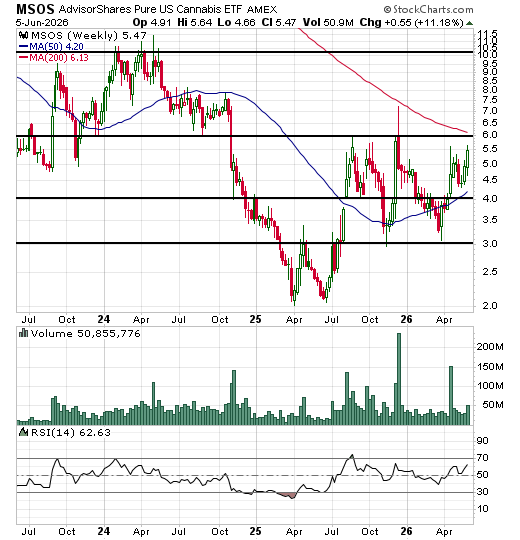
The following weekly chart shows that the US Cannabis ETF (MSOS) gained more than 11% last week. Part of this gain would have been related to anticipation of a positive rescheduling decision, but the bulk of it was due to a surge in the price of a single stock: Trulieve Cannabis (TCNNF). The price of TCNNF, one of MSOS’s two largest holdings, rocketed upward late last week in reaction to news that it would soon up-list onto the NYSE. This means that Trulieve will be the first US cannabis company to list on a major US exchange.

Note that the TSI Stocks List has indirect exposure to TCNNF via MSOS.

Trulieve has achieved its up-listing by restructuring its business to separate medical sales from recreational sales. Other US cannabis companies could follow suit, but we expect that most of them will wait for the outcome of the above-mentioned hearing. The reason is that there will be no need to restructure in order to up-list if recreational cannabis is moved to Schedule 3.

We continue to expect that if cannabis is fully rescheduled, MSOS will rise quickly to the US$9-$10 area. In the meantime, resistance at US$6.00-$6.50 probably will limit the upside.

A top for the gasoline price

June 4, 2026

[This blog post is a brief excerpt from a commentary published at speculative-investor.com on 31st May]

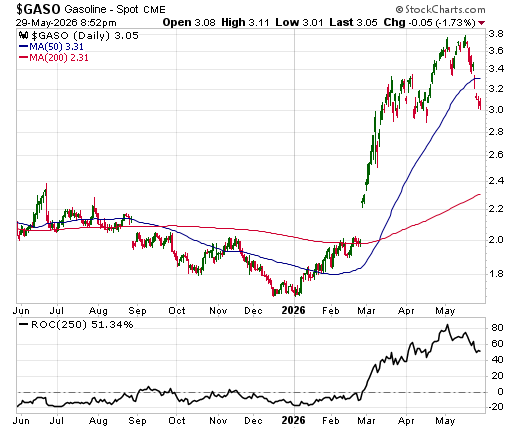
In the 27th April Weekly Update we noted that the oil price had peaked in March and probably was in a downward trend, but that the gasoline price was still rising. We went on to write that if the oil price continued to trend downward (as expected), then the gasoline price would follow. The gasoline price extended its upward trend until mid-May, but it has since begun to follow the oil price downward and last week generated evidence of an intermediate-term top by breaking below its 50-day MA. What’s likely to happen from here?

What happens in the near-term will be determined to a large degree by developments in the Middle East, which remain unpredictable. However, while there is a risk that re-escalation will push the gasoline price back up to near its May peak within the next few weeks, it’s likely that the May peak will turn out to be the peak for the year and that the price will be much lower by the final quarter.

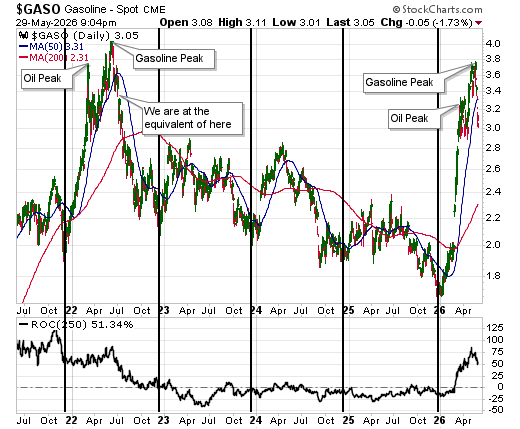
Interestingly, oil and gasoline prices are adhering closely to the 2022 price pattern that was a consequence of the Russia-Ukraine war. As noted on the following daily chart, in 2022 the gasoline price initially peaked in March with the oil price but then made a new high in June before commencing a major decline. In 2026 we have essentially the same pattern.

By the way, there is a strong tendency for the gasoline market to make a seasonal low late in the year. The vertical lines on the chart indicate these seasonal lows.

In summary, our base-case scenario is that the gasoline price in the US is now in an intermediate-term downward trend that should lead to much lower prices within the next seven months.