The consequences of US$ weakness

August 24, 2020

[This is an excerpt from a commentary published at TSI on 16th August 2020. The message remains applicable.]

The US$ commenced a cyclical decline in March of this year and probably will trade well below current levels during the first half of 2021. From the perspective of our investing and trading, the main consequences of this weakness in the senior currency are:

1) Broad-based strength in the commodity markets. As illustrated below, the S&P Spot Commodity Index (GNX) has been trending upward since shortly after the US$ peaked.

2) Strength in emerging market equities, especially the equities that are based in emerging economies that rely heavily on commodity exports. For example, Brazilian equities. Despite the debilitating effects on Brazil’s economy of virus-related lockdowns, the following chart shows that the iShares Brazil ETF (EWZ) has done well since the US$ began trending downward.

Note that it could make sense to buy EWZ if there’s a pullback to US$26-$28 within the next several weeks.

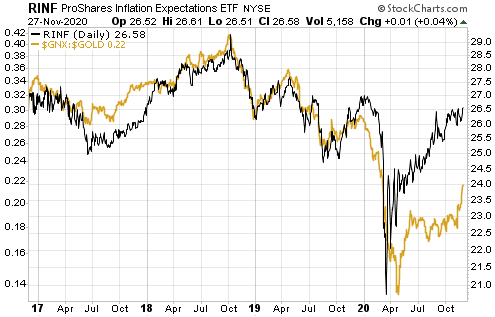
3) Rising US inflation expectations. As illustrated below, the US 5-Year Breakeven Rate (the annual CPI increase that the market expects the US government to report over the next few years) has been trending upward since the US$ peaked.

The above consequences have been apparent over the past few months and should become more pronounced within the next 12 months, especially during the first half of next year. However, we think that in the short-term the focus of investors/speculators should be on the potential for a US$ rebound.

It’s possible that the Dollar Index (DX) will become more stretched to the downside before it commences a meaningful countertrend rally, but once a US$ rebound begins in earnest the prices that have been elevated over the past few months by US$ weakness, which means the prices of almost everything, will fall.

It does not make sense to exit all anti-US$ trades in anticipation of a short-term US$ rally. Doing so would be risky because these trades would make large additional gains if the US$ rebound were to be postponed for a month or two. Also, making a complete exit would create the problem of having to time the re-entry. However, it would make sense to hedge against a short-term US$ recovery while maintaining core exposure in line with the dollar’s longer-term weakening trend.

Speculative froth in gold and silver trading

August 17, 2020

Gold market sentiment is complicated at the moment. There are signs of speculative froth, but at the same time the total speculator net-long position in Comex gold futures is close to its low for the year despite the US$ gold price recently hitting an all-time high. A likely explanation is that large speculators are focusing more on gold ETFs than on gold futures.

The price of a gold ETF that holds physical gold will track the gold price automatically. Therefore, there never will be an increase in the amount of gold held by such an ETF unless bullish speculators become sufficiently enthusiastic to push the market price of the ETF above its net asset value (NAV). When this happens it creates an arbitrage opportunity for the ETF’s Authorised Participants (APs), which results in the addition of gold bullion to the ETF’s inventory.

The following charts from http://www.goldchartsrus.com/ show large gains in the amounts of physical gold held by GLD and IAU, the two most popular gold ETFs. Specifically, the charts show that about 400 tonnes (12M ounces) of gold was added to the combined GLD-IAU inventory over the past few months. This actually isn’t a huge amount within the context of the global gold market, but it points to aggressive buying of the ETFs.

In other words, the evidence of gold-related speculative froth is in the stock market rather than the futures market.

GLDINV_170820

IAUINV_170820

The next chart shows that the silver story is similar. Specifically, the chart shows that about 7,000 tonnes (220M ounces) of physical silver have been added to the inventory of the iShares Silver ETF (SLV) since the March-2020 price low, including about 1,900 tonnes (60M ounces) during the three-week period culminating at the early-August price high.

SLVINV_170820

The fundamental backdrop remains supportive for gold and silver, but sentiment suggests that a multi-month price top was put in place in early-August or will be put in place via a final spike within the next three weeks.

The big differences this time

August 5, 2020

Many things have happened in 2020 that have never happened before, so in some respects it certainly is different this time. The most important of these differences, four of which are discussed below, revolve around the policy responses to the COVID-19 pandemic.

In the context of human history and in terms of the amount of death that it has caused, the COVID-19 pandemic is not particularly unusual. On average, there have been about two major pandemics every hundred years going back several centuries. Over the past hundred or so years, for example, there was the “Spanish Flu” in 1918 and the “Asian Flu” in 1958. Almost everyone has heard about the Spanish Flu and its horrific death toll, but the Asian Flu is less well known. Suffice to say that the death toll per million of global population resulting from the Asian Flu was about four times the current death toll per million of global population resulting from COVID-19.

The big difference this time is not the disease itself but the reaction to the disease. In particular, never before have large sections of the economy been shuttered by the government in an effort to limit the spread of the disease. Now, however, it has become accepted practice that as soon as the number of COVID-19 cases in an area moves beyond an unspecified low level, the orders go out for many businesses to close and for the public to stay home.

If locking down large sections of the economy is the optimal response to a pandemic, why wasn’t it tried before? Why did it take until 2020 to figure this out?

The answer is associated with the fact that COVID-19 is the first major pandemic to strike under the monetary system that came into being in the early-1970s. Under this system there is no limit, except perhaps an arbitrary level of increase in an arbitrary indicator of “inflation”, to the amount of money that can be created out of nothing. Previously there were limits to money creation imposed by some form of gold standard.

If there were rigid limits to the supply of money, the sort of economic lockdown implemented by many governments this year would cause immediate and extreme hardship to the majority of people. Therefore, it wouldn’t be an option. It is an option today because the ability to create an unlimited amount of money out of nothing presents the opportunity for the government to alleviate, or even to completely eliminate, any short-term pain for the majority of people. It should be obvious that this is an exchange of short-term pain for greater pain in the long-term, but hardly anyone is thinking about the long-term. In fact, the short-term fix that involves showering the populace with money is being advocated as if it didn’t have huge long-term costs.

Another difference between the current pandemic and earlier pandemics is the availability of information. For the first time ever during a major pandemic, almost everyone has up-to-the-minute data regarding the number of cases, hospitalisations and deaths. The widespread fixation on the cases/deaths data has fostered the general belief that getting the numbers down takes precedence over everything, long-term consequences be damned.

The third difference is linked to the first difference, that is, to the ability to create an unlimited amount of money out of nothing. This ability has existed for almost half a century, but 2020 is the first time it has been used by the government to provide money directly to the public. Prior to this year it was used exclusively by the central bank to manipulate interest rates and prop-up prices in financial markets. A consequence WILL be much more traditional “inflation” next year than has occurred at any time over the past decade.

The fourth and final difference that I’ll mention today is also linked to the money-creation power. It is that in 2020 some developed-world governments, most notably the US government, have stopped pretending to be concerned about their own indebtedness. Previously they made noises about prudently managing deficits and debts, as if the debt eventually would have to be repaid. However, this year they have tacitly acknowledged the reality that there has never been any intention to pay off the debt, and, therefore, that the debt can expand ad infinitum.

2020 certainly has been a watershed year.

Permanent shifts in gold ratios

July 27, 2020

[This blog post is an excerpt from a TSI commentary published on 19th July]

Sometimes, financial market relationships that have applied for a very long time stop working. This usually happens because the monetary system undergoes a major change or because the economy is altered in a permanent way by government and/or central bank intervention. It also can happen due to a major technological change that, for example, permanently reduces the demand for a commodity.

As a result of increasing central bank manipulation of money and interest rates, for the past 12 years gold has been getting more expensive relative to commodities that are consumed*. This is because the manipulation has been a) making it more difficult to earn a satisfactory return on investment and b) reducing the appeal of saving in terms of the official money. As central banks reduce the returns available from investing in productive enterprises and punish anyone who chooses to save cash, the demand for a store of value that central banks can’t depreciate naturally rises.

A knock-on effect is that some gold/commodity ratios appear to have been permanently elevated to higher ranges. There still will be periods when gold falls in value relative to these commodities, but the former ceilings no longer apply. In fact, in some cases it may be appropriate to view the former ceilings as the new floors. The two long-term monthly charts displayed below are cases in point.

The first chart shows the gold/platinum ratio. From the early-1970s through to 2015, gold was always near a long-term peak relative to platinum whenever the ratio moved up to 1. However, in 2015 the ratio broke above 1 and continued to trend upward.

A few years ago we speculated that gold/platinum’s former ceiling near 1 had become the new floor, that is, that the gold price would never again make a sustained move below the platinum price. The probability that this is so has since increased, although it’s likely that gold/platinum made an important high in March-2020 and is in the early stages of a 1-2 year decline.

The second chart shows the gold/oil ratio. From 1970 through to the start of 2020, gold was always near a long-term peak relative to oil whenever the ratio moved up to 30. However, during March-April of this year the gold/oil ratio reached a multiple of its previous long-term peak.

As is the situation with the gold/platinum ratio, it’s likely that the gold/oil ratio is in the process of establishing a higher long-term range that involves the former ceiling (30) being the new floor. As is also the situation with the gold/platinum ratio, it’s a good bet that the gold/oil ratio made an important high in April-2020 and is in the early stages of a 1-2 year decline.

It could be a similar story for the gold/silver ratio, although to a lesser degree. It’s likely that the gold/silver ratio has been permanently elevated, but not to the extent where the former ceiling (80-100) is the new floor. Our guess is gold/silver’s new floor is 50-60.

*That’s right, central banks are inadvertently manipulating the gold price upward, not deliberately manipulating it downward.