The World Gold Council’s gold market analysis is useless

May 30, 2017

A few weeks ago the World Gold Council (WGC) published its “Gold Demand Trends” report for the first quarter of 2017. These reports actually provide no information about gold demand and in my opinion are useless. In fact, they are worse than useless because they are misleading.

It is axiomatic that at any given time the total demand for gold equals the total supply of gold, which, in turn, equals the total aboveground gold inventory. The total aboveground gold inventory is somewhere between 150K and 200K tonnes, so at any given time the total demand for gold lies somewhere between 150K and 200K tonnes.

When new buyers enter the market they draw from the existing aboveground supply. These new buyers cannot possibly increase the total demand, because the increased demand on the part of people who add to their gold ownership will always be exactly offset by the decreased demand on the part of people who reduce their gold ownership.

A balance is maintained by the changing price. For example, if there are more buyers than sellers at a particular price or the buyers are more motivated than the sellers then the price will rise to establish a new balance. Therefore, a price rise is irrefutable evidence of a momentary rise in demand relative to supply and a price decline is irrefutable evidence of a momentary fall in demand relative to supply.

Importantly, the change in price is the ONLY reliable indication of an attempt by demand to rise or fall relative to supply. Any statement to the effect that a price rise was accompanied by reduced demand or that a price decline was accompanied by increased demand is therefore ludicrous.

The effect of the gold-mining industry is to increase the total aboveground gold supply by about 1.5% every year. Actually, as the result of gold mining both the total supply and the total demand increase by about 1.5% every year, since demand and supply must always be equal with price changing to maintain the balance.

Although gold miners are adding new gold to the total supply, the newly-mined gold is no more capable of satisfying current demand than gold that was mined in the distant past. Consequently, gold miners are similar to any other sellers. The one significant difference is that a gold miner will generally take whatever price is on offer, whereas most other owners of gold will have a price in mind at which they will sell (and below which they will not sell). In some cases this price will be a great distance above the current price and in other cases the owner of gold will intend to hold indefinitely regardless of how high the price rises. All of these intentions by the existing holders of gold contribute to the performance of the gold price.

Getting back to the WGC reports, what is being referred to as gold demand is actually just the sum of some easy-to-identify gold flows. In effect, these reports confuse trading volume with demand. Furthermore, they don’t even come close to accounting for all trading volume. What they essentially do is begin with the wrongheaded assumption that the total supply of gold equals the amount of annual mine production plus recycled gold plus producer hedging, or an amount of around 4,000 tonnes. They therefore begin with the assumption that the total supply of gold is about 1/50th of its actual amount. They then come up with a bunch of so-called (but not actual) demand figures, including the amount of gold moving into bullion ETFs and the amount of gold sold in jewellery form, that add up to about 4,000 tonnes.

As an aside, there will usually be a positive correlation between the gold price and the amount of gold moving into gold ETFs, but that’s only because the ETF inventory often FOLLOWS the price. I’ve discussed this in previous blog posts.

Summing up, the gold supply/demand reports put out by the WGC are based on numerous logical errors and misconceptions, such as ignoring the dominant role played by the aboveground gold stock, treating transfers from some sellers to some buyers as indicative of changing overall demand, and assuming that shifts in demand can be determined independently of price. Due to these deficiencies they are worse than useless.

Why bad economic theories remain popular

May 26, 2017

Ludwig von Mises and Friedrich Hayek, the most prominent “Austrian” economists of the time, anticipated the 1929 stock market crash and correctly predicted the dire consequences of government attempts to artificially stimulate economic growth in the aftermath of the crash. John Maynard Keynes, on the other hand, was totally blindsided by the stock market crash and the economic disaster of the early 1930s. And yet, Keynes’s theories gained enormous popularity during the 1930s whereas the work of Mises and Hayek was largely ignored. Why was it so?

Keynes became popular because he told the politically powerful what they wanted to hear. In particular, he provided power-hungry politicians with intellectual support for the schemes they not only already had in mind, but in many cases were already putting into practice. Despite being riddled with errors, Keynes’ theories also appealed to many economists because the implementation of these theories would confer a lot more influence upon the economics fraternity. The fact is that in a free economy there wouldn’t be much for an economist to do other than teach economics. He/she would certainly never have the opportunity to be involved in the ‘management’ of the economy.

The points outlined in the above paragraph, along with Keynes’ charisma and salesmanship, explain why “Keynesian” economic theories became dominant, but it doesn’t explain how they managed to stay dominant in the face of an ever-growing mountain of evidence indicating that they result in long-term economic decline.

As far as I can tell, the theories have stayed popular for three  main reasons. First, not only do they mesh with the personal goals of almost all current politicians, but also there is now a huge government apparatus in place that depends upon the continued application of these theories. In other words, a large chunk of the population now has a vested interest in perpetuating the myth that the government should ‘manage’ the economy. Second, it usually isn’t possible to disprove an economic theory using data, because the same data can usually be interpreted in different ways and used to justify opposing theories. The hard reality is that in the science of economics you must start with the correct theory in order to correctly interpret the data. Third, Keynesianism is more like a stream of anecdotes than a coherent theory, in that under this so-called theory most things are ‘explained’ by unforeseeable events and unpredictable shifts in “animal spirits”. It is impossible to invalidate an intellectual position that is constantly changing.

A good example of how the same data can be interpreted in different ways in order to support conflicting theories is provided by the 1937-1939 collapse of the US economy. According to the “Austrians”, the fact that the US federal government propped up prices, drastically increased its spending, inflated the money supply, began interfering with many industries and generally did whatever it could to prevent the corrective process from running its course following the 1929 stock market crash guaranteed that all signs of economic recovery would quickly disappear as soon as the artificial support was scaled back. The mistake, according to the “Austrians”, was to provide the artificial support. According to the “Keynesians”, however, the mistake was to remove the artificial support prematurely. They argue that the government and the Fed should have continued to do whatever was needed to postpone a collapse, the idea being that with enough government assistance in the form of new money, new regulations, handouts, price controls and job-creating public works projects the economy would eventually gain enough strength to become self-supporting.

Unfortunately, when throwing ‘Keynesian stimulus’ in the form of more government spending, more credit and more monetary inflation at an economic downturn doesn’t lead to a self-sustaining recovery, the followers of Keynes will always have two comebacks. They can always assert that the stimulus would have worked if only it had been done more aggressively and/or that as bad as the economy has performed it would have performed even worse if not for the stimulus.

You can’t argue with that. At least, it’s an assertion that can never be unequivocally invalidated because it is never possible to go back in time and show what would have happened with different policies.

What is a bull market?

May 22, 2017

[This post is a slightly-modified excerpt from a recent TSI commentary]

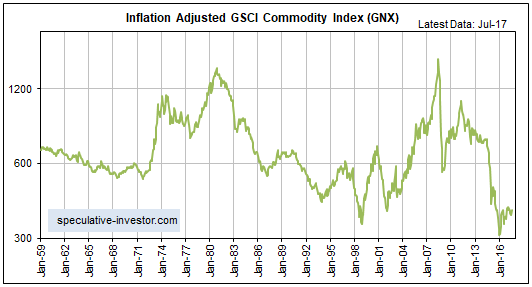
A reasonable definition of a bull market must be practical. This means that it must take into account the fact that what people really want from an investment is an increase in purchasing power, not just an increase in price. Figuring out whether or not an investment is in a bull market is therefore not as straightforward as observing its long-term trend in nominal currency terms.

Here’s a great example of why looking only at nominal price change doesn’t necessarily indicate whether or not something is in a bull market: Ten years ago, the price of everything in the world was in a powerful upward trend when price was expressed in terms of the Zimbabwe dollar. Obviously, it was far more reasonable in this case to say that the Zimbabwe dollar was in a bear market than to say that everything else was in a bull market.

The Zimbabwe example is extreme, but the fact is that all of today’s official currencies are losing purchasing power (PP). They are losing PP at different rates and some are losing PP quite slowly at the present time, but not one of them is likely to be a good measuring stick over a long period.

Unfortunately, determining whether or not an investment is gaining value in real terms is problematic due to the impossibility of coming up with a single number that reflects the economy-wide PP of money. We have a method of adjusting for the effects of monetary inflation that should be ‘in the right ballpark’ over periods of more than 5 years, but our method could be wildly inaccurate over periods of less than 2 years. Inflation-adjusting using the official CPI, on the other hand, is likely to be inaccurate over all periods and wildly inaccurate over the long-term.

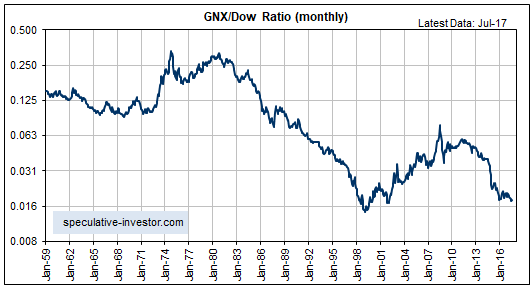
In a world where the official currencies make poor measuring sticks due to their relentless and variable depreciation, looking at the relative performances of different investments is probably the best way to determine which ones are in bull markets. Furthermore, because they are effectively at opposite ends of an investment seesaw, with one doing best when confidence in money, central banking and government is rising and the other doing best when confidence in money, central banking and government is falling, this is a concept that works especially well for gold bullion and the S&P500 Index (SPX).

There will be times when both gold and the SPX are rising in US$ terms, but it should be possible to tell the one that is in a genuine bull market because it will be the one that is the stronger. More specifically, if the SPX/gold ratio is in a multi-year upward trend then the SPX is in a bull market and gold is not, whereas if the SPX/gold ratio is in a multi-year downward trend then gold is in a bull market and the SPX is not. There will naturally be periods of a year or longer when it will be impossible to determine whether a multi-year trend has reversed or is consolidating (we are now in the midst of such a period), but there is a moving-average crossover* that can be used to confirm a reversal in timely fashion.

In conclusion, it is reasonable to say that an investment is in a bull market if it is in a multi-year upward trend in nominal currency terms AND relative to its main competition.

*Crosses of the 200-week moving average by either the SPX/gold ratio or the gold/SPX ratio have confirmed bull-bear transitions with only two false signals since the early-1970s.

Inflation/deflation and the desire to avoid short-term pain

May 16, 2017

The desire to avoid short-term pain is a powerful motivator. Even in cases where it is known that the steps taken to avoid pain in the short-term will lead to greater pain in the distant future, people will often choose the path that entails lesser short-term pain. Also, there’s often the hope that if pain is postponed for long enough then something will spring up to circumvent the need to experience the pain. The relevance to the inflation-deflation issue is that the long-term cure for an economy suffering from the bad effects of high monetary inflation involves stopping the inflation, but stopping the inflation always results in short-term pain.

Nowadays, people look back at the devastating inflation that occurred in Germany in the early 1920s and think: “How could the central bankers of that era have been so stupid? There’s no way that the stewards of today’s major currencies would make the same mistakes!” In real time, however, the gross stupidity of the German central bank’s actions was only apparent to a small number of economists. At each step along the way to total monetary collapse, the pain involved in stopping the money-printing was weighed against the cost of continuing the inflation and it always appeared to make sense to continue the inflation for just a little longer.

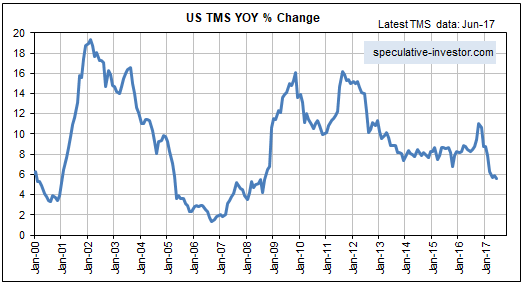
It’s very unlikely that a hyperinflationary collapse will happen in any of the major industrialised economies within the next two years, but having watched the Bernanke-Yellen Fed, the Draghi ECB and the Kuroda BOJ in action it is not hard for me to imagine such a collapse eventually happening. I cite, for instance, the fact that ECB chief Mario Draghi is arguing the need to sustain an aggressive monetary “stimulus” program even though it should be clear to anyone with eyes and a modicum of economics knowledge that the “stimulus” implemented to date has been an abject failure. I also cite the very popular and yet completely wrongheaded tendency to measure the success of a policy by the stock market’s response to the policy. By this measuring stick, pumping new money into the economy will usually look smart. Lastly, I cite the widely-held conviction that it is up to the central bank and the government to do something ‘stimulative’ whenever signs of economic weakness emerge, despite the mountain of evidence that earlier attempts to ‘do something’ resulted in bad unintended consequences. The sad truth is that the framers of monetary and fiscal policies are strongly influenced by faulty economic theory and short-term thinking, and that’s not going to change anytime soon.

The day might come when the costs of continuing the inflation are so widely understood that there exists the political will to bring the money-depreciating policies to an end, but don’t hold your breath waiting for that day. If the day does come it will likely be years from now. In the mean time, the desire to avoid short-term pain will reign supreme.