The Coming Great Inflation

October 8, 2019

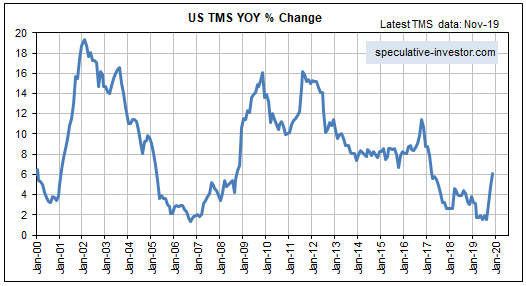
The events of the past 10 years have fostered the belief that central banks can create a virtually unlimited amount of money without significant adverse consequences for the purchasing power of money. Since the law of supply and demand applies to money similarly to how it applies to every other economic good, this belief is wrong. However, the ‘failure’ of QE programs to bring about high levels of what most people think of as inflation has generated a false sense of security.

The difference between money and every other economic good is that money is on one side of almost every economic transaction. Consequently, there is no single number that can accurately represent the price (purchasing power) of money, meaning that even the most honest and rigorous attempt to calculate the “general price level” will fail. This doesn’t imply that changes in the supply of money have no effect on money purchasing power, but it does imply that the effects of changes in the money supply can’t be explained or understood via a simple equation.

Further to the above, the Quantity Theory of Money (QTM) is not a valid theory. Ludwig von Mises thoroughly debunked this theory a hundred years ago and I summarised its basic flaws in a blog post two years ago. Unfortunately, QTM’s obvious inability to explain how the world works has strengthened the belief that an increase in the supply of money has no significant adverse effect on the price of money.

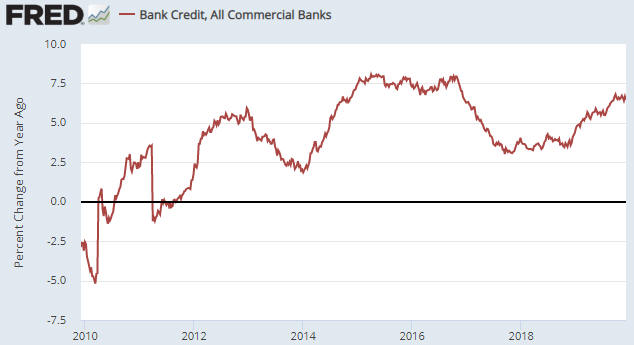
The relationship between an increase in the money supply and its economic effects is complicated by the fact that the effects will differ depending on how and where the new money is added. Of particular relevance, the economic effects of a money-supply increase driven by commercial banks making loans to their customers will be very different from the economic effects of a money-supply increase driven by central banks monetising assets. In the former case the first receivers of the new money will be within the general public, for example, house buyers/sellers and the owners of businesses, whereas in the latter case the first receivers of the new money will be bond speculators (Primary Dealers in the US). Putting it another way, “Main Street” is the first receiver of the new money in the former case and “Wall Street” is the first receiver of the new money in the latter case. This alone goes a long way towards explaining why the QE programs of Q4-2008 onward had a much greater effect on financial asset prices than on the prices that get added together to form the Consumer Price Index (CPI).

Clearly, the QE programs implemented over the past 11 years had huge inflationary effects, just not the effects that many people expected.

A proper analysis of the effects of the QE programs has not been done by central bankers and the most influential economists. As a result, there is now the false sense of security mentioned above. It is now generally believed that substantially increasing the money supply does not lead to problematic “inflation”, which, in turn, lends credibility to monetary quackery such as MMT (Modern Monetary Theory).

Due to the combination of the false belief that large increases in the supply of money have only a minor effect on the purchasing power of money and the equally false belief that the economy would benefit from a bit more “price inflation”, it’s a good bet that central banks and governments will devise ways to inject a lot more money into the economy in reaction to future economic weakness. As is always so, the effects of this money creation will be determined by how and where the new money is added. If the money is added via another QE program then the main effects of the money-pumping again will be seen in the financial markets, at least initially, but if the central bank begins to monetise government debt directly* then the “inflationary” effects in the real economy could be dramatic.

The difference between the direct and the indirect central-bank monetising of government debt is largely psychological, but it is important nonetheless. When the central bank monetises government debt indirectly, that is, via intermediaries such as Primary Dealers, it is perceived to be conducting monetary policy (manipulating interest rates, that is). However, when the central bank monetises government debt directly it is perceived to be financing the government, thus eliminating any semblance of central bank independence and potentially setting in motion a large decline in monetary confidence.

According to the book Monetary Regimes and Inflation, ALL of the great inflations of the 20th Century were preceded by central bank financing of large government deficits. Furthermore, in every case when the government deficit exceeded 40% of expenditure and the central bank was monetising the bulk of the deficit, a period of high inflation was the result. In some cases hyperinflation was the result.

In summary, growth in the money supply matters, but not in the simplistic way suggested by the Quantity Theory of Money. There’s a good chance that this fact will be rediscovered within the next few years, especially if legislative changes enable/force the Fed to monetise government debt directly.

*In the US this would entail the Fed paying for government debt securities by depositing newly-created dollars into the government’s account at the Fed. The government would then spend the new money. Currently the Fed buys government debt securities from Primary Dealers (PDs), which means that the newly-created dollars are deposited into the bank accounts of the PDs.

Banks versus Gold

September 30, 2019

One of the past month’s interesting stock-market developments was the strength of the banking sector in both nominal terms and relative to the broad market. The strength in nominal dollar terms is illustrated by the top section of the following weekly chart, which shows that the US Bank Index (BKX) is threatening to break out to the upside. The strength relative to the broad market is illustrated by the bottom section of the chart, which reveals a sharp rebound in the BKX/SPX ratio since the beginning of September.

BKX_SPX_300919

Bank stocks tend to perform relatively well when long-term interest rates are rising in both absolute terms and relative to short-term interest rates. This explains why the banking sector outperformed during September and also why bank stocks generally have been major laggards since early last year.

Valuations in the banking sector are depressed at the moment, as evidenced by relatively low P/Es and the fact that the BKX/SPX ratio is not far from a 25-year low. This opens up the possibility that we will get a few quarters of persistent outperformance by bank stocks after long-term interest rates make a sustained turn to the upside.

On a related matter, the relative performance of the banking sector (as indicated by the BKX/SPX ratio) is an input to my “true fundamentals” models for both the US stock market and the gold market. However, when the input is bullish for one of these markets it is bearish for the other. In particular, relative weakness in the banking sector is considered to be bullish for gold and bearish for general equities.

Until recently the BKX/SPX input was bullish in my gold model and bearish in my equity model, but there was enough relative strength in the banking sector during the first half of September to flip the BKX/SPX input from gold-bullish to equity-bullish. As a consequence, during the second week of September there was a shift from bullish to bearish in my Gold True Fundamentals Model (GTFM). This shift is illustrated on the following weekly chart by the blue line’s recent dip below 50.

The upshot is that the fundamental backdrop, which was supportive for gold from the beginning of this year through to early-September, is now slightly gold-bearish. My guess is that it will return to gold-bullish territory within the next two months, but in situations like this it is better to base decisions on real-time information than on what might happen in the future.

GTFM_300919

Gold and the ‘Real’ Interest Rate

September 10, 2019

[This blog post is an excerpt from a commentary published at TSI on 1st September 2019.]

It’s well known that the US$ gold price often trends in the opposite direction to the US real interest rate. This relationship is illustrated by the following chart in which the real interest rate is represented by the yield on the 10-year TIPS (Treasury Inflation Protected Security).

Notice that the 10-year TIPS yield has just gone negative and that the previous two times that this proxy for the real interest rate went negative the gold price was at an important peak. Specifically, the real interest rate going negative in August-2011 coincided with a long-term top in the gold price and the real interest rate going negative in July-2016 coincided with an intermediate-term top in the gold price. If gold tends to benefit from a lower real interest rate, why would the gold price reverse downward shortly after the real interest rate turned negative?

Considering only the 2016 case the answer to the above question seems obvious, because in July-2016 the TIPS yield reversed course and began trending upward soon after it dipped into negative territory. In other words, the downward reversal in the gold price coincided with an upward reversal in the real interest rate. However, in 2011-2012 the real interest rate continued to trend downward for more than a year after the gold price peaked.

We think there are two reasons why the gold price didn’t make additional gains in 2011-2012 after the real interest rate turned negative. First and foremost, the real interest rate is just one of several fundamental gold-price drivers (the 10-year TIPS yield is one of seven inputs to our Gold True Fundamentals Model), and after August-2011 the upward pressure exerted by a falling real interest rate was counteracted by the downward pressure exerted by other fundamental influences. Second, in August-2011 a further significant decline in the real interest rate had been factored into the current gold price.

The risk at the moment is that on a short-term basis the bullish fundamental backdrop, including the potential for a further decline in the ‘real interest rate’, is fully discounted by the current price. This risk is highlighted by the fact that the total speculative net-long position in Comex gold futures is very close to an all-time high. It is also highlighted by the fact that the RSI displayed in the bottom section of the following weekly chart is almost as high as it ever gets.

The market leads the Fed…sort of

August 27, 2019

The relationship between short-term market interest rates and the interest rates set by the Fed is a complicated one. The market makes predictions about what the Fed is going to do and moves in anticipation, but at the same time the Fed’s interest-rate settings are influenced by what’s happening to market interest rates. Also, market interest rates are determined by factors other than what the Fed is doing or expected to do to its official rate targets, and as a result there are times when the market and the Fed seem to be at odds with each other.

At the moment there is no doubt that the market is leading the Fed. In particular, the Fed has been swayed towards rate cutting partly by the fact that the market has discounted rate cuts. This can be established by comparing recent movements in market interest rates with changes in the Fed’s interest rate targets, which I’ll get to shortly. It can also be established by referring to the Fed’s own statements. For example, the minutes of the July FOMC meeting included the following assessment:

Participants observed that current financial conditions appeared to be premised importantly on expectations that the Federal Reserve would ease policy to help offset the drag on economic growth stemming from the weaker global outlook and uncertainties associated with international trade as well as to provide some insurance to address various downside risks.

In essence, the Fed has admitted here to being worried that if it doesn’t cut rates like the market expects then financial conditions could get a lot worse. The implication is that if the market expects the Fed to cut rates, then to avoid disappointing the market (and risking the deterioration of financial conditions) the Fed will cut rates.

I mentioned above that the market’s current leadership can be established by comparing recent movements in market interest rates with changes in the Fed’s interest rate targets. Displayed below is a chart that makes this case. The chart shows the performance of the 2-year Treasury yield and indicates the last two interest-rate changes made by the Fed. Notice that:

1) The 2-year market interest rate began trending downward in early-November of 2018.

2) The Fed made its last rate hike during the second half of December 2018, that is, the Fed was still in rate-hiking mode six weeks after a short-term market interest rate began trending downward.

3) The Fed made its first rate cut at the end of July 2019. By that time, the 2-year market interest rate had been trending downward for almost 9 months.

UST2Y_270819

It’s reasonable to assume that additional Fed rate cuts are on the way. Bear in mind, however, that a few additional rate cuts have already been factored into market prices, so market prices won’t necessarily respond in the obvious way to future Fed rate cuts. Also bear in mind that market interest rates probably will begin trending upward while the Fed and other central banks are still in rate-cutting mode.