Gold and the US Constitution

January 25, 2017

The US Constitution is often held up as an ideal to be aspired to, but it is actually far from ideal.

One reason it is far from ideal is that the section setting out the powers of Congress (Article 1 Section 8) is too general. For example, it gives Congress the power to “lay and collect Taxes, Duties, Imposts and Excises, to pay the Debts and provide for the common Defence and general Welfare of the United States.” The terms “Taxes” and “general Welfare” had different (much narrower) meanings back then, but it’s not hard to understand how this statement could be construed to justify much of the growth in the federal government over the ensuing 200+ years. Another example concerns money. The Constitution gives Congress the power to “coin Money [and] regulate the Value thereof.” It’s not hard to understand how the words “coin Money” could be interpreted to mean “create Money”, since “coin” and “create” (in reference to money) were effectively the same thing when the Constitution was penned.

It is often claimed that the Constitution requires money to be gold or silver coin, but this is not the case. The only mention of gold or silver is in the section that sets out the limitations on the powers of individual states (Article 1 Section 10). This section prohibits any State from making “any Thing but gold and silver Coin a Tender in Payment of Debts”, but imposes no restrictions on the power of Congress to coin money and regulate the value thereof.

Should the Constitution have been much clearer in defining money as gold and/or silver?

The answer is no, because the government should not have the right to determine what is and isn’t used as money by private individuals. The Constitution should simply have forbidden the government from having anything to do with money. In particular, rather than empowering the government to coin money and regulate the value thereof it should have prohibited the government from exerting any influence over the supply or value of money.

What is/isn’t money should be chosen by ‘the market’. It’s likely that the market would choose gold and/or silver if it were free to make the choice, but the freedom to choose something other than a precious metal should always be available. That’s why a “Gold Standard” is not a worthwhile objective. The government doesn’t have the legitimate right to impose gold as money any more than it has the legitimate right to impose pieces of paper as money.

The US Constitution opened the door to much of what happened later. It’s therefore likely that if the writers of the Constitution had the chance to do it over again knowing what is known today, they would cobble together a very different document.

Casey’s Financial Chaos Prediction

January 23, 2017

Doug Casey recently predicted that we are heading for financial chaos. Should this prediction be taken seriously? The answer is no, but not because Doug Casey doesn’t know what he’s talking about or is necessarily wrong.

Doug Casey has been right about enough trends/events in the past to have become wealthy and is one of my favourite writers. Also, throughout his career he has fought the good fight against government coercion, the fake information that’s routinely put forward to ‘justify’ bigger government, and the political-correctness tyranny. However, he is ALWAYS predicting financial chaos and/or economic collapse and/or a crash in the stock market or the bond market.

I have no problem with Doug Casey’s crisis predictions. I understand his bias in this area and can take it into account when reading his opinions/analyses. I do, however, have a problem with the way that Doug’s predictions are used to promote the Casey Research service.

This post was prompted by an email from Casey Research that appeared in my inbox last week. The email contained something along the lines of: “Doug Casey correctly predicted the Dot.com crash of 2000 and the financial-market crash of 2008. Given this amazing forecasting record, you won’t want to miss Doug’s latest prediction. Click the link below to find out what it is.”

I didn’t click the link so I don’t know the specific prediction that is currently being used to attract new subscribers, but I cringed at the misleading way that the forecasting record was portrayed. It’s certainly true that Doug Casey correctly predicted the market crashes of 2000 and 2008, but if you are always predicting a crash then of course you will be right every year the market crashes. And you will be wrong every year the market doesn’t crash.

Betting on a crash year after year after year is actually a viable speculative strategy. It’s the strategy that has been used by Nassim Taleb with success over the past few decades. Taleb bets on a market crash every year with a small portion of his investment portfolio while keeping the rest of his portfolio in cash or cash-like securities. The result is that he makes a small loss in the vast majority of years and a huge profit once or twice per decade.

I’m only guessing, but Doug Casey has probably applied a similar approach to good effect.

The Taleb approach is not suited to most people, though. This is because most people do not have the required combination of knowledge, patience and nerve, and even if they do there are ways to generate excellent long-term returns without having to go 5-10 years between pay-offs.

Getting back to the main point of this post, there is some chance that Doug Casey’s recent prediction of financial chaos will be correct in 2017, but it shouldn’t be taken seriously. The reason it shouldn’t be taken seriously is that regardless of whether or not it pans out this year, there will be a similar prediction for next year and the year after and so on. The prediction is bound to be right…eventually.

The “war on cash” has nothing to do with fighting crime

January 17, 2017

Don’t be hoodwinked by the relentless propaganda into believing that the efforts being made to eliminate physical cash are motivated by a desire to reduce crime and corruption. Fighting crime/corruption is just a pretext.

The logic behind the propaganda goes like this: Criminals often use physical cash in their dealings, therefore cash should be eliminated. This makes as much sense as saying: Criminals often use cars, therefore cars should be banned. From an ethical standpoint, the fact that criminals use an item will never be a good reason to prevent law-abiding citizens from using the item.

That being said, the anti-cash propaganda is not just wrong from an ethical standpoint; it is also wrong from a utilitarian standpoint if we assume that the stated reasons (to reduce the amount of crime and strengthen the economy) are the real reasons for wanting to eliminate physical cash. This is because neither logic nor historical data provide any basis for believing that forcibly reducing the use of physical money will reduce crime or boost the economy.

With regard to the crime-fighting claim, yes, criminals often use cash due to cash transactions being untraceable, but no criminal is going to change his ways and ‘go down the straight and narrow’ in response to physical money becoming obsolete. If physical money were eliminated then genuine criminals would find some other way of doing their financial transactions. Perhaps they would start using gold, which would give governments a pretext for the banning of gold. Or perhaps they would use Bitcoin, which would give governments a pretext for the banning of Bitcoin. The point is that there will always be many media of exchange that could be used by genuine criminals to conduct their business. The banning of cash would only be a short-lived and relatively-minor inconvenience to this group.

The economy-strengthening claim stems from the crime-fighting claim, in that all else being equal a change to the monetary system that resulted in less genuine crime (the only genuine crimes are those that result in the violation of property rights) would lead to a stronger economy. Since there is neither a logical reason nor a reason based on the historical record to expect that banning physical cash would lead to less genuine crime, the economy-strengthening claim is baseless.

On a side note, if the elimination of physical cash would actually provide a benefit to the overall economy, that is, if it would result in a higher average standard of living, then it is something that would happen without government intervention. In general, a greater amount of government economic intervention is only ever required when the desired change will NOT create a net benefit for the overall economy.

The reasons being put forward for the elimination of cash are therefore bogus. What, then, are the real reasons?

The main real reason is to maximise tax revenue. If all transactions are carried out electronically via the banking system then every transaction can be monitored, making it more difficult to avoid tax. In other words, the main reason that governments are very keen to eliminate physical cash is that by doing so they increase the amount of money flowing into government coffers. Unless you believe that the government generally uses resources more efficiently than the private sector you must acknowledge that this would result in a weaker rather than a stronger economy.

There is, however, an important secondary reason for the forced shift towards a cashless society, which is that it would help the banks in two ways.

First, it would help the banks by ensuring that 100% of the economy’s money was always in the banking system. Currently about 90% of the money in developed economies is in the banking system, with a physical float (currency in circulation outside the banking system) making up the remaining 10% of the money supply. The move to eliminate physical cash can therefore be thought of as the banking industry going after the final 10% of the money supply.

Second, it would ensure that there was no way for the public to avoid the cost of negative interest rates or any other draconian charge on monetary savings/transactions implemented by the banking establishment. Any single member of the public could avoid the charge, but only by transferring money — and the associated liability — to another person’s account.

So, any economist or financial journalist who advocates the elimination of physical cash is clueless at best and a government/banking-system stooge at worst.

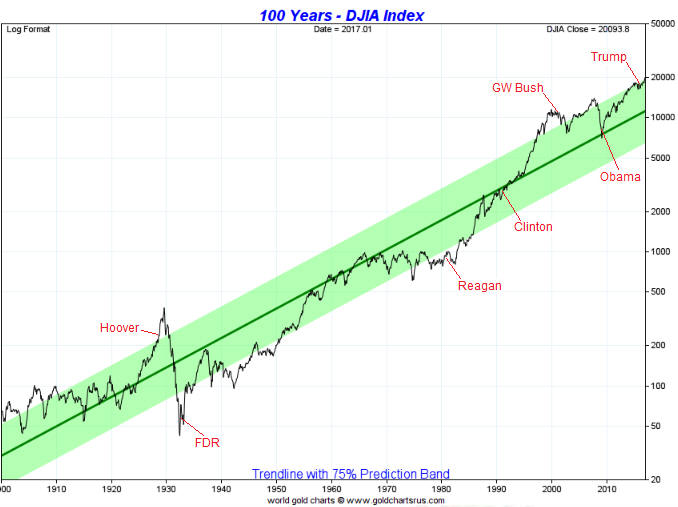
A wide-angle view of the US stock market

January 14, 2017

Here is an excerpt from a recent TSI commentary:

Until the S&P500 Index (SPX) broke out to the upside in early-July of 2016 we favoured the view that an equity bear market had begun in mid-2015. Supporting this view was the performance of NYSE Margin Debt, which had made what appeared to be a clear-cut downward reversal from an April-2015 peak.

As we’ve explained in the past, leverage is bullish for asset prices as long as it is increasing, regardless of how far into ‘nosebleed territory’ it happens to be. It’s only after market participants begin to scale back their collective leverage that asset prices come under substantial and sustained pressure. For example, it was a few months AFTER leverage (as indicated by the level of NYSE margin debt) stopped expanding and started to contract that major stock-market peaks occurred in 2000 and 2007. That’s why, during the second half of 2015 and the first few months of this year, we considered the pronounced downturn in NYSE Margin Debt from its April-2015 all-time high to be a warning of an equity bear market.

As at the end of November-2016 (the latest data) NYSE Margin Debt still hadn’t exceeded its April-2015 high, but the following chart from Doug Short shows that it is close to doing so. Furthermore, given the price action in December it is likely that NYSE Margin Debt has since made a new all-time high.

Even if it didn’t make a new high in December, the rise by NYSE Margin Debt to the vicinity of its April-2015 peak is evidence that leverage is still in a long-term upward trend and that the equity bull market is not yet complete.

More timely evidence that the US equity bull market is not yet complete is provided by indicators of market breadth, the most useful of which is the number of individual stocks making new 52-week highs.

The number of individual stocks making new highs on the NYSE and the NASDAQ peaked with the senior stock indices at multi-year highs during the first half of December. The number of individual-stock new highs has since fallen sharply, but this is normal and is not yet a significant bearish divergence.

The change over the past 6 weeks in the number of individual stocks making highs is consistent with the view that a sizable short-term decline is coming, but at the same time it suggests that neither a long-term top nor an intermediate-term top is in place. The reason is the strong tendency for the number of individual-stock new highs to diverge bearishly from the senior indices for at least a few months prior to an intermediate-term or a long-term top.

The US equity bull market may well continue, but that doesn’t mean it’s worth participating in. No investor should attempt to buy into all, or even into most, bull markets. In our opinion, it’s best to restrict participation to those bullish trends that are underpinned by relative value.

If the US equity bull market continues it will definitely not be because the market is underpinned by relative value. As illustrated by another chart from Doug Short (see below), based on an average of four valuation indicators the S&P500’s valuation today is the same as it was at the 1929 peak and second only to the 2000 peak.

The market has primarily been propelled by and to a certain extent remains underpinned by the combination of monetary inflation and artificially-low interest rates, that is, by the machinations of the Fed.