
The only problem with Keynesian theory is that it is completely wrong

May 5, 2017

Governments and central banks have invoked the writings of J.M. Keynes to justify the massive increases in government spending and monetary inflation that have occurred over the past 9 years. However, some of Keynes’s apologists have pointed out that the famous British economist would not have agreed with many of the policy responses for which his work has provided the intellectual justification. They point out, for example, that Keynes only advocated temporary increases in government spending as a means of absorbing shocks to the economy, and that he was dead against currency debasement and the creation of structural deficits. The problem, though, isn’t that Keynes’s theory has been applied to an unreasonable extreme; the problem is that the theory is completely wrong.

For starters, the laws of economics always apply, so if greater government deficit-spending really did act to strengthen the economy during recessions then it would also act to strengthen the economy during the good times. On the other hand, if greater government deficit-spending hurt the economy during the good times then it would also hurt the economy during recessions. The point is that there isn’t one set of laws that applies during periods of growth and another set that applies during periods of contraction.

Secondly, the concept that the government can provide a sustainable boost to the economy by increasing its spending is based on the fallacy that increased consumer spending causes the economy to grow. It causes GDP to increase due to the misleading way the GDP calculation is done, but for an increase in consumer spending to be sustainable it must be an effect of real growth; that is, it must follow an increase in production, which, in turn, must follow an increase in saving. Consumer spending is the caboose, not the engine.

Thirdly and as most people realise, the government usually does things much less efficiently than the private sector. The fact is that government spending tends to involve a lot of wastage. This is not an issue for the true Keynesian because he views an increase in spending as an economic plus even if the spending is totally unproductive, but it should be an issue for a good economist.

Fourthly, the government doesn’t generate any real wealth of its own that can be spent in order to offset what’s happening in the private sector. Instead, everything the government spends must first be borrowed or stolen from the private sector. So, how can the private economy possibly be helped by the government increasing the rate at which it steals and borrows from the private sector?

Fifthly, recessions occur because of the widespread mal-investment prompted by the earlier expansions of the supplies of money and unbacked credit brought about by the central bank and the commercial banks. As a result of this mal-investment, the economy’s structure becomes distorted such that it is geared to produce too much of some things and not enough of others. Unfortunately, the Keynesians mislabel the distortion caused by inflation as an “output gap”, which they then cite as justification for more inflation and more government spending. To further explain, recessions are symptoms of the process via which an economy attempts to rid itself of the distortions caused by prior inflation and intervention. And yet, in its role as “economic shock absorber”, the central-planning team comprising the government and the central bank tries to sustain the distortions. How can this possibly be beneficial?

If an economy is strong enough it should be able to recover DESPITE the application of Keynesian remedies designed to smooth-out the transition to the next expansion, which is why the economy usually recovers. However, the economic structure will necessarily be weakened by each successive increase in government spending and each successive monetary-inflation-fueled boom until, eventually, the economy will be in such a weakened state that it will be unable to bounce back in the face of more Keynesian policies. That’s why the US economy’s recovery from the 2007-2009 recession has been ‘surprisingly’ lacklustre and why Japan’s economy now seems incapable of strong growth.

Hyperinflation* and/or a totalitarian state are the inevitable destinations if Keynes’s theories are relentlessly applied over the long term. The reason is that each round of policy mistakes creates the justification for more mistakes, setting in motion a downward spiral that will be inescapable as long as the perceived solution entails more of the same. The only unknown is how long it will take to reach one or both of these destinations.

*Just to be clear and as explained in a previous blog post, I have never been of the view that hyperinflation is an imminent threat to the US economy. The imminent threat is the continuing erosion of freedom as new interventions by the government are justified by the adverse consequences of earlier interventions.
What should the gold/silver ratio be?

May 2, 2017

The price of gold is dominated by investment demand* to such an extent that nothing else matters as far as its price performance is concerned. Investment demand is also the most important driver of silver’s price trend, although in silver’s case industrial demand is also a factor to be reckoned with. In addition, changes in mine supply have some effect on the silver market, because unlike the situation in the gold market the annual supply of newly-mined silver is not trivial relative to the existing aboveground supply of the metal.

Given that the change in annual mine supply is irrelevant to the gold price and is not close to being the most important driver of the silver price, why do some analysts argue that the gold/silver ratio should reflect the relative rarities of the two metals in the ground and therefore be 10:1 or lower? I don’t know, but it isn’t a valid argument.

A second way of using relative rarity to come up with a very low gold/silver ratio is to assert that the price ratio should be based on the comparative amounts of aboveground supply. Depending on how the aboveground supplies are calculated, this method could lead to the conclusion that silver should be more expensive than gold. It would also lead to the conclusion that gold should be the cheapest of all the world’s commonly-traded metals, instead of the most expensive. For example, if gold’s relatively-large aboveground supply was a reason for a relatively low gold price then gold should not only be cheaper than silver, but also cheaper than copper.

Another argument is that the gold/silver ratio should be around 16:1 because that’s what it averaged for hundreds of years prior to the last hundred years. This is also not a valid argument, because changes in technology and the monetary system can cause permanent changes to occur in the relative values of different commodities and different investments. For example, when monetary inflation was constrained by the Gold Standard the stock market’s average dividend yield was always higher than the average yield on the longest-dated bonds, but the 1934-1971 phasing-out of the official link to gold permanently altered this relationship. In a world where commercial and central banks can inflate at will, the stock market will always yield less than the bond market (except when the central-bank leadership goes completely ‘off its rocker’ and implements the manipulation known as NIRP). This is because stocks have some built-in protection against inflation. The point is that the ratio of gold and silver prices during an historical period in which both metals were officially “money” does not tell us what the ratio should be now that neither metal is officially money and one of the markets (silver) has a significant industrial demand component.

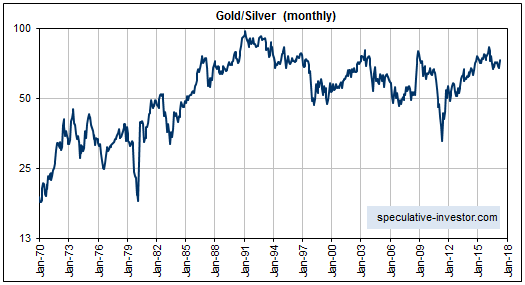
The global monetary system’s current configuration dates back to the early 1970s, when the last remaining official link between gold and the US$ was severed. This probably means that we can look at how gold and silver have performed relative to each other since the early 1970s to determine what’s normal and what’s possible. With reference to the following chart, here’s a summary of what happened during this period:

a) The gold/silver ratio spent the bulk of the 1970s in the 30-40 range, but broke out of this range to the downside during the second half of 1979 in response to massive accumulation of silver bullion and silver futures by the Hunt brothers.

b) The ratio dropped as low as 16:1 in January of 1980, but then returned to 40 in the ‘blink of an eye’ as rule changes by the commodity exchange created financial problems for the highly-geared Hunts and a commodity-investment bubble began to deflate.

c) During the second half of the 1980s the ratio trended upward as US financial corporations weakened. The ratio peaked at around 100 at the beginning of 1990s in parallel with a full-blown banking crisis that almost resulted in the collapse of some of the largest US banks.

d) The ratio trended lower throughout the 1990s as the banks recovered (with the help of the Fed) and financial assets trended upward.

e) From the late 1990s through to the beginning of 2011 the ratio oscillated between 45 and 80, with 80 being reached near the peaks of financial crises (early-2003 and late-2008) and 45 being reached in response to generally high levels of economic confidence.

f) In February of 2011 the ratio broke below the bottom of its long-term range and rapidly moved down to around 30. The huge price run-up in silver that led to this large/fast decline in the gold/silver ratio was fueled by the overt bullishness of a high-profile/well-heeled speculator (Eric Sprott) and by various rumours, including rumours of silver shortages and the unwinding of a price-suppression scheme led by JP Morgan. There were no silver shortages and there was no price-suppression scheme to be unwound, but as is often the case in the financial markets the facts didn’t get in the way of a good story.

g) The 2010-2011 parabolic rise in the silver price ended the same way that every similar episode in world history ended — with a price collapse.

h) Silver’s Q2-2011 price collapse set in motion a major, multi-year upward trend in the gold/silver ratio. In this case, the upward trend in the ratio was driven by the deflating of a commodity investment bubble and problems in the European banking industry. The ratio rose all the way to the low-80s and is still at an unusually-high level in the 70s.

gold_silver_010517

The gold/silver ratio’s performance over the past five decades suggests that the 45-60 range can now be considered normal, with moves well beyond the top of this range requiring a banking crisis and/or bursting bubble and moves well beyond the bottom of this range requiring rampant speculation focused on silver.

*In this post I’m lumping speculative, safe-haven and savings-related demand together under the term “investment demand”.

Are rising nominal interest rates bullish or bearish for gold?

April 28, 2017

The short answer to the above question is that they are neither. Read on for the longer answer.

Consider what happened to nominal interest rates during the long-term gold bull markets of the past 100 years. Interest rates generally trended downward during the gold bull market of the 1930s, upward during the gold bull market of the 1960s and 1970s, and downward during the bull market of 2001-2011. History’s message, therefore, is that the trend in the nominal interest rate does not strongly influence gold’s long-term price trend.

History tells us that gold bull markets can unfold in parallel with rising or falling nominal interest rates, but this shouldn’t be interpreted as meaning that interest rates don’t affect whether gold is in a bullish or bearish trend. The long-term trend in the nominal interest rate is not critical; what is of great importance, as far as the gold market is concerned, is the REAL interest rate, with low/falling real interest rates being bullish for gold and high/rising real interest rates being bearish. For example, when gold was making huge gains during the 1970s in parallel with high/rising nominal interest rates, real interest rates were generally low. This is because gains in inflation expectations were matching, or exceeding, gains in nominal interest rates (the real interest rate is the nominal interest rate minus the EXPECTED rate of currency depreciation).

Very low real interest rates are artifacts of central banks, because in an intervention-free market all lenders would insist on a significant real return in exchange for temporarily relinquishing control of their money. In other words, “very low real interest rates” essentially means “very loose monetary policy”.

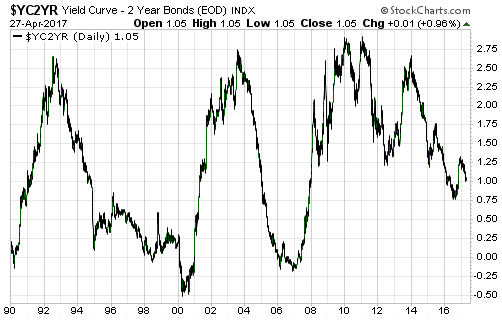
Something else that affects gold’s price trend is the difference between long-term and short-term interest rates (the yield-spread, or yield curve), with a rising yield-spread (‘steepening’ yield curve) being bullish for gold and a falling yield-spread (flattening yield curve) being bearish. It works this way because a rising trend in long-term interest rates relative to short-term interest rates generally indicates either falling market liquidity (associated with increasing risk aversion and a flight to safety) or rising inflation expectations, both of which are bullish for gold.

As is the case with the real interest rate, under the current monetary system the yield-spread tends to be a symptom of what central banks are doing. If money were free of central bank manipulation then the yield-spread would spend most of its time near zero (the yield curve would be almost horizontal) and would experience only minor fluctuations, but thanks to the attempts by central banks to ‘stabilise’ the financial world the yield-spread experiences the huge swings shown on the chart included below.

yieldcurve_270417

Last but not least, gold is influenced by the economy-wide trend in credit spreads (the differences between interest rates on high-quality and low-quality debt securities). Gold, a traditional haven in times of trouble, tends to do relatively well when credit spreads are widening and relatively poorly when credit spreads are contracting.

In summary, gold benefits from low real interest rates, an increasing yield-spread (a steepening yield curve), and widening credit spreads, each of which can occur when nominal interest rates are rising or falling.

Long-term price targets are meaningless

April 24, 2017

Many commentators like to speculate on where the dollar-denominated gold price is ultimately headed. Some claim that it is destined to reach $3,000/oz, others claim that it won’t top until it hits at least $5,000/oz, and some even forecast an eventual rise to as high as $50,000/oz. All of these forecasts are meaningless.

Long-term dollar-denominated price targets are meaningless because a) they fail to account for — and cannot possibly account for, since it is unknowable — the future change in the dollar’s purchasing power, and b) the only reason a rational person invests is to preserve or increase purchasing power. To further explain by way of a hypothetical example, assume that five years from now a US dollar buys only 20% of the everyday goods and services that it buys today. In this case, the US$ gold price will have to be around $6,500/oz just to maintain its current value in purchasing power terms. To put it another way, in my example a person who buys gold at around $1300/oz today and holds it will suffer a loss, in real terms (the only terms that matter), unless the gold price is above $6,000/oz in April-2022. Considering a non-hypothetical example to make the same point, in 2007-2009 a resident of Zimbabwe who owned a small amount of gold and not much else would have become a trillionaire in Zimbabwe dollars and would also have remained poor.

The purchasing power issue is why the only long-term forecasts of gold’s value that I ever make are expressed in non-monetary terms. For example, throughout the first decade of this century I maintained that gold’s long-term bull market would continue until the Dow/gold ratio had fallen to at least 5 and would potentially continue until Dow/gold fell to 1.

The 2011 low of 5.7 in the Dow/gold ratio wasn’t far from the top of my expected bottoming range, although I doubt that the long-term downward trend is over. In any case, none of the buying/selling I do this year will be based on the realistic possibility that the Dow/gold ratio will eventually drop to 1. Such long-term forecasts are of academic interest only, or at least they should be.

If I were forced to state a very long-term target for the US$ gold price, it would be infinity. The US$ will eventually become worthless, at which point gold will have infinite value in US$ terms. But then, so will everything else that people want to own.