
The stock market’s mythical ability to discount the future

August 8, 2017

Some analysts state that the US stock market is over-valued and also that the stock market is good at discounting the future. Well, it can’t be both! If the stock market is good at discounting the future then current valuations are reasonable based on the profits that will be earned by companies over the next few years. On the other hand, if the stock market is over-valued then it is, by definition, doing a poor job of discounting the future.

Perhaps the stock market was once good at discounting the future, but a knowledgeable observer couldn’t claim with a straight face that the US stock market has been a good discounting mechanism over the past 20 years. Over this period we’ve seen valuations reach stratospheric levels in response to delusions about tech and internet company earnings, and then a collapse to bring prices into line with reality, followed by another rise to stratospheric valuations based on delusions that global growth knew no bounds and low-quality loans could be bundled together to create investment-grade securities, and then another collapse to bring prices into line with reality, followed by yet another upward ramp to stratospheric valuations.

The most recent multi-year ramp-up in stock prices was supposedly due to the discounting of an imminent ramp-up in corporate earnings, but S&P500 earnings during the second quarter of this year were no higher than they were three years earlier.

It is not difficult to come up with a superficial explanation for the US stock market’s abysmal 20-year record as a discounting mechanism. The explanation begins with the observation that from 1996 through to 2007 the market was dominated by the public, and, as the saying goes, the public will believe the most preposterous of bullish stories as long as the price is rising. As a result of the 2008 collapse, the public left the market and has not returned. At an earlier period in history this might have resulted in longer-term value-oriented investors taking control, but this time around it resulted in the market becoming dominated by computerised trading systems designed to scalp profits from extremely short-term fluctuations. That is, the market is now dominated by traders that make no attempt to discount the future beyond the next few hours or minutes.

The above explanation contains some truth, but for two main reasons it is far from complete. First, the general public hasn’t changed — it always has been and always will be the dumb money. Second, computerised trading systems are equally ‘happy’ to scalp profits by going short during declines or going long during advances. They are directionally neutral.

A better explanation begins with the realisation that the stock market as a whole has NEVER been a discounting mechanism. It has, instead, always reacted with a lag to changes in the monetary backdrop. The big difference over the most recent two decades is that for the most part the monetary backdrop has been far more supportive of asset prices than in the past. One consequence has been the stock market’s ability to spend a lot more time than usual in a condition called “extreme over-valuation”.
Trump will not really cut taxes, revisited

August 2, 2017

When I posted the “Trump will not really cut taxes” article in February there was a realistic chance that some form of tax-slashing proposal would be implemented before year-end. That’s no longer the case, but as far as the US economy’s health is concerned it makes less difference than most people think. What really matters is the total amount of government spending; not how the spending is financed.

To understand what I mean, it helps to think of the government as a giant parasite that feeds on the economy. The parasite uses part of what it eats to foster its own growth, while the remainder passes through and is excreted back into the economy. The parasite’s food is a mixture of taxation and borrowing, and provided that it is growing or maintaining its current size then a reduction in one food source MUST be offset by an equivalent increase in the other food source. For example, if the parasite doesn’t shrink then a reduction in taxation must be made up by an increase in borrowing.

The above is an over-simplification because the method by which the parasite gets its sustenance will have some influence on the economic outcome, but it hopefully explains why the Trump tax cuts are not a ‘make or break’ issue as far as the US economy’s health is concerned. The crux of the matter is that as long as the amount of government spending doesn’t shrink, less wealth being sucked out by direct taxation will result in more wealth being sucked out by another method.

That’s why the only genuine tax cut is the one that’s funded by reduced government spending.

The “commodity supercycle” myth dies hard

August 1, 2017

[The following is an excerpt from a TSI commentary published about one month ago, but with updated charts.]

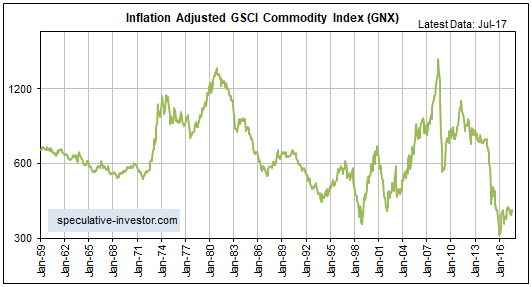
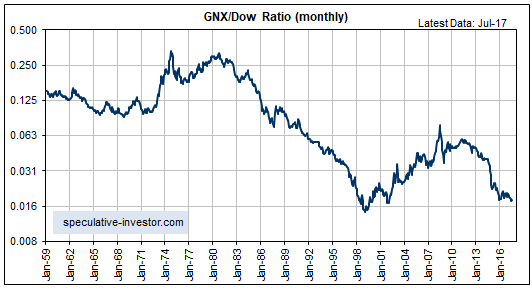
Some commentators on the financial markets still refer to something called the “commodity supercycle”. This is remarkable considering that the inflation-adjusted (IA) GSCI Commodity Index (GNX) made a new all-time low early last year and that relative to the Dow Industrials Index the GNX is not far from the all-time low reached in 1999. The relevant charts are displayed below. Just how badly would commodities have to perform to completely bust the supercycle myth?

IAGNX_010817

GNX_Dow_010817

We’ve been debunking the “commodity supercycle” in TSI commentaries for at least 10 years. The following lengthy excerpt from an August-2007 commentary is an example:

…when it comes to the “commodity supercycle” we are definitely sceptics. We concur with the view that commodity prices in general and metal prices in particular are in long-term upward trends, but we do not think these trends are being driven by the strong growth of “Chindia” or the global spread of capitalism or the industrialisation of Asia or the movement of billions of people to the ranks of the “middle class” or any of the other catchphrases routinely used to neatly explain the price action. In our opinion, these explanations rank alongside slogans such as “new economy” and “technology-driven productivity miracle” that were used to legitimise the price action of tech stocks during the boom of the late-1990s.

As we see it, inflation (money supply growth) is causing a rolling boom/bust cycle whereby the combination of relative valuation and scarcity determines which sectors will be the major beneficiaries of inflation during the current cycle and which sectors will be relegated to the investment ‘scrap heap’.

The analysts who concoct simple explanations based on real (non-monetary) changes in the world and repeat these explanations in mantra-like fashion will look incredibly prescient for a long time, even though they largely ignore the monetary factors that are actually at the root of the price changes. Some of these analysts will even take-on the status of prophets due to their apparent abilities to see the future. But the inflation-fueled boom will eventually turn into a bust, even if the touted fundamental bases for the boom persist. For example, the growth of the internet and technological progress in general did not ‘miss a beat’ when the NASDAQ crashed. All that happened was that the primary focus of inflation shifted, causing the “new economy” prophets to fade away and bringing to the fore a new bunch of prophets who chant “commodity supercycle”.

The above three paragraphs can be summarised as: There never has been and there is never likely to be a “commodity supercycle”. Instead, during some periods financial assets are the main beneficiaries of monetary inflation and during other periods commodities are among the main beneficiaries of monetary inflation.

It’s as simple as that.

The periods when financial assets are the main beneficiaries of monetary inflation are, on average, much longer than the periods when commodities are among the main beneficiaries of monetary inflation. This is because central bankers generally view large multi-year rises in commodity prices as evidence of an inflation problem and large multi-year rises in financial-asset prices as evidence that everything is fine. Consequently, steps are taken to curtail the monetary inflation more quickly when commodity prices are leading the charge.

The situation today presents an asset-allocation challenge because it’s far too soon for a new long-term commodity boom to get underway, but the major financial assets (stocks and bonds) are near their highest valuations ever. We are dealing with this situation by becoming more short-term-oriented in our thinking, which for us means not looking beyond the next 6-12 months when deciding what to own.

The “we” fallacy

July 26, 2017

Globalisation, a term that when used in economics refers to the integration of national economies into a global marketplace, is perceived to be part of the reason for economic weakness in some countries. This is a perception that the politically-astute feed upon, often by invoking the “we” fallacy.

According to the “we” fallacy, anyone who happens to be located inside an arbitrary border is one of “us” and deserves preferential treatment at the expense of anyone who happens to be located outside the border. The “we” fallacy underpins the concerns that are routinely expressed about trade deficits, the thinking being that “we” are being hurt because “they” sell more stuff to us than we sell to them*.

To expose the flawed logic that initially leads to teeth-gnashing over trade deficits and subsequently leads to protectionist trade policies, I’ll use a hypothetical example involving two pig farmers (Bill and Bob) and a butcher (Arthur). Bill, Bob and Arthur live and work in a small US town located 1 mile south of the US-Canada border. Bill is a more efficient pig farmer than Bob and is thus able to sell his pigs at a 10% lower price. Consequently, Arthur buys twenty pigs per year from Bill and none from Bob. This arrangement continues for several years, at which point Bill decides to move his farm 2 miles to the north (to the other side of the US-Canada border).

Business-wise, nothing changes and Arthur continues to buy 20 pigs per year from Bill. However, due to the minor change in the physical location of Bill’s farm the business that Bill and Arthur have been conducting for many years now adds to the US trade deficit. In other words, a business relationship that nobody was previously concerned about suddenly becomes a problem for the collective “we”, even though nothing has really changed. Bob, sensing an opportunity, complains to the US government that he will have to fire his farmhand unless something is done to prevent his business from being undercut by cheap imports. In response, the US government slaps a 15% tariff on Canadian pigs, prompting Arthur to start using Bob as his pig supplier.

In this hypothetical example Bob has clearly benefited from the government’s interference in the pig market, but only at Arthur’s expense. Arthur is now forced to pay 10% more for his pigs, which will either cut into his profits — and, perhaps, curtail his plans to invest in the growth of his business — or cause him to raise his prices. Whatever happens, Bob’s gain will be matched by the loss incurred by other people within the US. In other words, the US “we” will not actually benefit, even in the unlikely event that the Canadian government doesn’t take counter-measures in an effort to protect its own collective “we”.

In the same way that the overall US economy failed to benefit from the pig tariff in my hypothetical example, “we” can never benefit from policies that restrict international trade. This is because from an economics perspective there is no “we”, there are just individuals trading with each other for their mutual benefit. A consequence is that when measures are taken by the government to protect the collective “we”, what actually results is the artificial creation of both winners and losers. The benefits gained by some individuals within the economy will be offset by the losses of others within the same economy.

The upshot is that protectionist measures are, at best, a zero-sum game, although in most cases they will turn out to have a net-negative effect on the ‘protected’ economy because they will interfere with price signals, keep inefficient businesses alive, and generally make both the cost of doing business and the cost of living higher than would otherwise be the case.

Protectionist measures are often popular, though, especially during hard economic times. Here’s why:

First, you generally need only a superficial understanding of economics to see the immediate and direct effects of a policy, whereas a deeper understanding of economics is often required to see the long-term and indirect effects. Very few people have this deeper understanding, so all they see are the immediate and direct effects of protectionism, which could be positive.

Second, the immediate benefits of the protectionist policy are typically concentrated, whereas the costs are widely spread. As a result, a politician can adopt a protectionist stance to gain the support of the relatively small number of people who are advantaged without losing the support of the much larger number of people who are disadvantaged. It’s an example of robbing Peter to pay Paul, where Paul notices and Peter doesn’t.

Third, when things are obviously going wrong it’s convenient to point the finger of blame outward at “them”. It certainly beats trying to identify the real source of the problem when doing so would lead to the finger of blame being pointed inward.

I guess we should be thankful that the same flawed logic that is often applied to international trade is usually not applied to interstate trade and is never applied to trade between towns, neighbourhoods and individuals within the same state, because if it were then there would be a lot less trade and a lot less wealth. The only reason the flawed logic isn’t applied at a more micro level is that the collective “we” is arbitrarily defined as everyone on a particular side of a country border.

*Refer to my 13th February blog post for an explanation of why a trade deficit is never a problem.