Commodities and the Commodity Currencies

September 18, 2017

[This blog post is an excerpt from a TSI commentary published about two weeks ago.]

The Australian Dollar (A$) and the Canadian Dollar (C$) are called “commodity currencies” for a reason. The reason is that regardless of what’s happening in their associated local economies, on a multi-year basis they will usually trend in the same direction as broad-based commodity indices.

Since 2001 there have been three major rallies in the A$, each lasting about 2.5 years. These 2.5-year rallies are indicated by vertical red lines and notes on the following chart. Our assumption, which is also indicated on the following chart, is that the fourth 2.5-year A$ rally began in early-2016. In other words, we are guessing that the A$ upward trend that began in early-2016 will continue until around mid-2018. As well as being based on the lengths of previous major upward trends, this guess is based on what we expect from commodity prices.

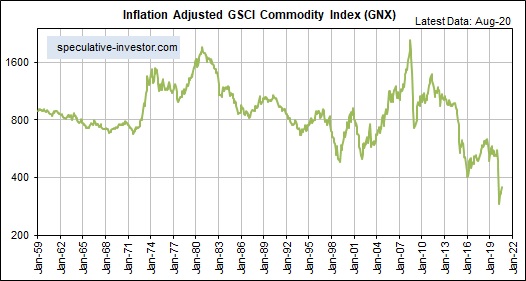
Speaking of commodity prices, in addition to the A$ the chart shows the GSCI Spot Commodity Index (GNX). Unsurprisingly, each of the 2.5-year A$ rallies indicated on the chart coincided with an upward-trending GNX. In terms of price direction, the main difference between the post-2001 performance of the A$ and the post-2001 performance of GNX is that GNX trended upward from the beginning of 2002 until its blow-off top in mid-2008 whereas the A$ experienced a flat 2-year correction during 2004-2005.

Mainly for interest’s sake (pun intended), the chart also shows the yield on the 10-year T-Note. The 10-year interest rate had a downward bias during two of the A$’s 2.5-year rallies and an upward bias during the third rally. We expect that it will have an upward bias over the course of the current (fourth) rally.

The next chart shows the relationship between the C$ and commodity prices as represented by GNX. If anything, with one notable 6-month exception the positive correlation between the C$ and GNX has been even stronger than the positive correlation between the A$ and GNX. The notable exception occurred during the first half of 2008, when a speculative blow-off move to the upside in the commodity markets was accompanied by a decline in the C$. This divergence was a warning that the commodity-price gains would prove to be temporary.

We are expecting the upward trends in the commodity indices and the commodity currencies to extend well into next year, although it’s likely that short-term corrections will begin soon.

Revisiting the US yield curve

September 11, 2017

In a blog post in February of last year I explained that an inversion of the US yield curve has never been a recession signal. Instead, the genuine recession signal has always been the reversal in the curve from ‘flattening’ (short-term interest rates rising relative to long-term interest rates) to ‘steepening’ (short-term interest rates falling relative to long-term interest rates) after an extreme is reached. It just so happens that under normal monetary conditions an extreme usually isn’t reached and the reversal therefore doesn’t occur until after the yield curve becomes inverted.

The fact is that it doesn’t matter how ‘flat’ or inverted the yield curve becomes, there’s a good chance that the monetary-inflation-fueled economic boom will be intact as long as short-term interest rates are rising relative to long-term interest rates. The reason, in a nutshell, is that the boom periods are dominated by borrowing short to lend or invest long, a process that puts upward pressure on short-term interest rates relative to long-term interest rates. It’s when short-term interest rates begin trending downward relative to long-term interest rates that we know the boom is in trouble.

The following chart shows that the spread between the 10-year T-Note yield and the 2-year T-Note yield is much narrower now than it was a few years ago. This means that there has been a substantial flattening of the US yield curve. Also, the chart shows no evidence of a trend reversal. This implies that the inflation-fueled boom is still intact.

yieldcurve_110917

The most useful leading indicator of the global boom-bust cycle

September 1, 2017

The long-term economic oscillations between boom and bust are caused by changes in the money-supply growth rate. It can therefore make sense to monitor such changes, but doing so requires knowing how to calculate the money supply. Unfortunately, most of the popular monetary aggregates are not useful in this regard because they either include quantities that aren’t money or omit quantities that are money.

What “Austrian” economists refer to as TMS (True Money Supply) is the most accurate monetary aggregate. Whereas popular measures such as M2, M3 and MZM contain credit instruments, TMS only contains money. Specifically, TMS comprises currency (notes and coins), checkable deposits and savings deposits.

The following chart shows the year-over-year TMS growth rate (the monetary inflation rate) in the US. It has fallen sharply over the past 8 months — from around 11% to around 5% — and is now at its lowest level since 2008.

The chart displayed above suggests that the US economic boom* is on its last legs. It may well be, but the 2002-2006/7 boom continued for almost 2 years after the US monetary inflation rate fell to near its current level in early-2005.

The reason for the long delay during 2005-2007 between the decline in the US TMS growth rate to a level that ordinarily would have ended the boom in less than 12 months and the actual ending of the boom was the offsetting effect of rapid monetary inflation in the euro-zone. This prompted me to develop a monetary aggregate that I call “G2 TMS”, which combines the US and euro-zone money supplies. Here is a monthly chart showing the growth rate of G2 TMS.

The rate of change in the G2 TMS growth rate has been the most useful leading indicator of the global boom-bust cycle over the past two decades. Of particular significance, a decline in the G2 TMS growth rate from well above 6% to below 6% warns of a shift from boom to bust within 12 months.

At the end of July the G2 TMS growth rate was slightly above the boom-bust transition level.

*An economic boom is defined as a multi-year period during which the creation of a lot of money out of nothing causes an unsustainable increase in economic activity.

Interest Rates and Gremlins

August 29, 2017

Everyone is familiar with the term “interest rate”, but most people don’t understand what the term means. Unless you understand what the term means, you won’t fully understand why the central bank’s ‘management’ of interest rates damages the economy.

To understand what the interest rate is, it helps to understand what it isn’t. It isn’t the price of money. The price of money is what money buys, which can be different in every transaction. For example, if an apple is priced at $1, a new car is priced at $30,000 and a dental checkup is priced at $100, then the price of a dollar can be said to be 1 apple or 1/30000th of a car or 1/100th of a dental checkup.

The interest rate is the price paid by a borrower for a temporary increase in his purchasing power, or, looking at it from a different angle, the price received by a lender in consideration for temporarily giving up some of his purchasing power. This price will naturally take into account the risk that the borrower will be unable to make full repayment (credit risk) and the risk that money will be worth less in the future than it is at the time the loan is made (inflation risk). However, even if there were no credit or inflation risk to consider the interest rate would still be positive. The reason is that a unit of money in the hand today will always be worth more than a promise to pay a unit of the same money in the future.

This means that as well as being determined by the risk of default and the risk of inflation, the interest rate in any transaction will be determined by the time preferences of the borrower and lender. Someone with a strong desire to consume in the present has a high time preference. It’s likely that if this person has insufficient money to satisfy his immediate desire to consume then he will be willing to pay a high rate of interest to temporarily increase his purchasing power. Alternatively, it’s likely that someone whose desire to consume in the present is low relative to the amount of cash he has on hand will be willing to lend money to the right borrower at a relatively low rate of interest.

In any given transaction the credit risk component of the overall interest rate will end up being part of the lender’s real return if the borrower doesn’t default, but if credit risk is priced correctly then over a large number of transactions the amount received to compensate for this risk will be offset by actual borrower default. For example, if the risk of borrower default is correctly priced at 5%/year, then over a large number of transactions enough borrowers will default to impose a cost on the lender of 5%/year. Therefore, the time component of the interest rate is the same as the expected real return to the lender.

The implication is that on an economy-wide basis the real interest rate should be determined by the average of people’s time preferences.

To further explain, when the quantity of real savings is high relative to the general desire to consume in the present, the average time preference is low and the real interest rate SHOULD be low. Entrepreneurs and other businessmen will respond to this interest-rate signal by embarking on long-term projects that assume a future increase in consumer spending (high savings in the present implies higher consumer spending in the future). Capital equipment will be purchased, office buildings and shopping malls will be built, etc. When the quantity of real savings is low and people throughout the economy are consuming with abandon, the average time preference is high and the real interest rate SHOULD be high. Entrepreneurs and other businessmen will respond to this interest-rate signal by holding-off on new long-term projects. Although they won’t look at it in these terms, in effect they are being told, by the way the market is pricing time, that the future level of consumer spending will be insufficient to support certain investments.

The word “should” is capitalised in the previous paragraph because in the real world there exists a gremlin with the power to distort the interest rate. The gremlin is constantly tinkering with the interest rate, the result being that this vital price signal is always misleading to some degree. In fact, thanks to the mischievous acts of this gremlin the interest-rate signal is occasionally the opposite of what it should be.

Of particular relevance, due to the gremlin’s preference for distorting the interest rate in a downward direction the real interest rate is sometimes low during periods when the quantity of savings is low and the majority of people are spending like crazy, that is, when the average time preference is high. The result is that entrepreneurs and other businessmen throughout the economy embark on long-term projects that have no hope of being profitable. Individuals will naturally make mistakes, but for a large proportion of the population to make the same investing error the interest-rate signal must be wrong.

No prize for guessing the identity of the gremlin.