Trade as a zero sum game

April 9, 2018

[This blog post is an excerpt from a TSI commentary published on 27th March 2018]

The policies of the Trump Administration are being influenced by the view that international trade is a zero sum game, where whoever receives the most money is the winner at the expense of whoever receives the most goods. Under this line of thinking, which sometimes goes under the name “mercantilism”, policies are beneficial if they increase the amount of money coming into the country relative to the amount of money going out of the country. As discussed below, it’s the wrong way to look at the world.

Another way of framing the mercantilist position is that the winner is the one who ends up with the larger amount of the medium of exchange and the loser is the one who ends up with the larger amount of real wealth. For reasons we’ll get into in a moment there are actually no winners and losers, but if it were true that one side was getting the better deal then surely it would be the one that ended up with the most real wealth; especially these days, when the medium of exchange is created out of nothing by the banking system.

Also, it’s important to understand that countries don’t trade with each other. For example, the US doesn’t trade with China. What we mean is that a country is not an economic entity that buys and sells. Instead, individuals in one country trade with individuals in another country and in each transaction both sides believe that they are benefiting (otherwise the transaction wouldn’t happen). While it is technically possible to lump together all the transactions undertaken by the individuals in one region and arrive at the conclusion that ‘we’ have a trade deficit or ‘we’ have a trade surplus, in the real world there is no ‘we’ when it comes to trade.

Unfortunately, however, governments pay attention to the meaningless lumping-together of millions of individual transactions, and if the result happens to be what is commonly called a deficit then the government will often conclude that it should place obstacles in the way of many transactions. You may think that you are benefiting from a deal with a foreign seller, but according to the government you are creating a problem for the collective ‘we’ and must be hindered or stopped.

The Trump Administration is in the spotlight at the moment for having undertaken three sets of protectionist measures over just the past two months. There were the tariffs on imported washing machines and solar panels announced in January, the tariffs on imported steel and aluminium announced at the beginning of March and the as-yet-unspecified tariffs on $60B of Chinese imports announced last week. However, the US government does not have a monopoly on counter-productive mercantilism. Far from it! The same sort of ‘reasoning’ that has informed the trade-related missteps of the US government over the past two months is informing the actions of most governments around the world.

For example, other governments are threatening to impose their own tariffs in response to the US tariffs, which is something they would not do unless they wrongly believed that such restrictions could benefit their own economies. For another example, the large quantity of US$-denominated reserves collectively held by central banks around the world has almost nothing to do with the US$ being the official reserve currency and almost everything to do with exchange-rate management designed, using terribly flawed logic, to gain an international trade advantage. Refer to the May-2015 post at the TSI Blog for more colour on this issue.

There is nothing that any one government can do directly to change the wrongheaded protectionist ways of other governments. The best that any single government can do is to not become part of the problem. The ideal situation is that no side erects barriers to international trade, but the second-best situation for any one country is that its own government opts not to erect barriers. Just because some other government decides to impose economic sanctions on its own citizens doesn’t mean that your government is justified in doing the same.
Money Matters

March 30, 2018

[This blog post is an excerpt from a recent TSI commentary]

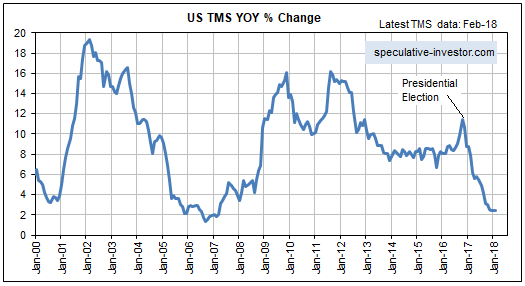
The year-over-year rate of growth in the US True Money Supply (TMS) was around 11.5% in October of 2016 (the month before the US Presidential election) and is now only 2.4%, which is near a 20-year low. Refer to the following monthly chart for details. In terms of effects on the financial markets and the economy, up until recently the US monetary inflation slowdown was largely offset by continuing rapid monetary inflation elsewhere, most notably in Europe. However, the tightening of US monetary conditions has started to have noticeable effects and these effects should become more pronounced as the year progresses.

The tightening of monetary conditions eventually will expose the mal-investments of the last several years, which, in turn, will result in a severe recession, but the most obvious effect to date is the increase in interest rates across the entire curve. The upward acceleration in interest rates over the past six months has more than one driver, but it probably wouldn’t have happened if money had remained as plentiful as it was two years ago.

It would be a mistake to think that the tightening has been engineered by the Fed. The reality is that the Fed has done very little to date.

The Fed has made several 0.25% increases in its targeted interest rates, but the main effect of these rate hikes is to increase the amount of money the Fed pays to the commercial banks in the form of interest on reserves (IOR). It doesn’t matter how you spin it, injecting more money into banks ain’t monetary tightening!

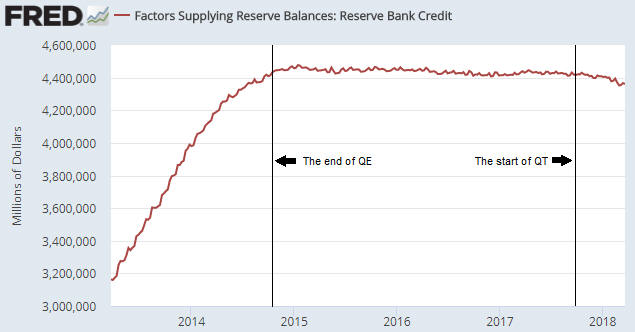
The Fed’s actual efforts on the monetary loosening/tightening front over the past 5 years are encapsulated by the following weekly chart of Reserve Bank Credit (RBC). This chart shows that there was a rapid rise in RBC during 2013-2014 that ended with the completion of QE in October-2014. For the next three years RBC essentially flat-lined, which is what should be expected given that the Fed was neither quantitatively easing nor quantitatively tightening during this period. In October-2017 the Fed introduced its Quantitative Tightening (QT) program. To date, this program has resulted in only a small reduction in RBC, but the plan is for the pace of the QT to ramp up.

Strangely, the most senior members of the Fed appear to believe that their baby-step rate hikes constitute genuine tightening and that the contraction of the central bank’s balance sheet is neither here nor there. The reality is the opposite.

So, the Fed is not responsible for the large decline in the US monetary inflation rate and the resultant tightening of monetary conditions that has occurred to date.

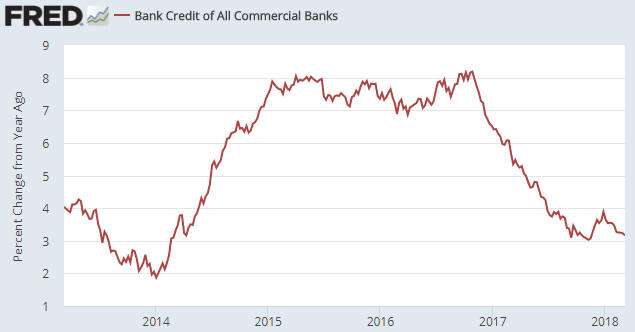
The responsibility for the tightening actually lies with the commercial banks. As illustrated by the next chart, the year-over-year rate of growth in commercial bank credit was slightly above 8% at around the time of the Presidential election in late-2016 and is now about 3%.

We won’t be surprised if a steepening yield curve prompts commercial banks to collectively increase their pace of credit creation over the next two quarters, but with the Fed set to quicken the pace of its QT the US monetary inflation rate probably will remain low by the standards of the past two decades. At the same time, the ECB will be taking actions that reduce the monetary inflation rate in the euro-zone. This could lead to stock and bond market volatility during the second half of this year that dwarfs what we’ve witnessed over the past two months.

Another look at gold’s true fundamentals

March 20, 2018

The major long-term driver of the gold price is confidence in the official money and in the institutions (governments, central banks and private banks) that create/promote/sponsor the official money. As far as long-term investors are concerned the gold story is therefore a simple one: gold will be in a bull market when confidence in the financial establishment (money, banks and government) is in a bear market and gold will be in a bear market when confidence in the financial establishment is in a bull market.

In real time it often doesn’t seem that simple, though, because on a weekly, monthly or even yearly basis a lot can happen to throw an investor off the scent. However, the risk of being thrown off the scent can be reduced by having an objective way of measuring the ebbs and flows in the confidence that drives, among other things, the performance of the gold market. That’s why I developed the Gold True Fundamentals Model (GTFM). The GTFM is determined mainly by confidence indicators such as credit spreads, the yield curve, the relative strength of the banking sector and inflation expectations, although it also takes into account the US dollar’s exchange rate and the general commodity-price trend.

An alternative to objective measurement is to rely on gut feel, but gut feel is notoriously unreliable in such matters because it is, by definition, influenced by personal biases. For example, it will be influenced by “projection bias”. This is the assumption that if you perceive things in a certain way, then most other people will perceive them in the same way. Projection bias plays a big part in a lot of gold market analysis. The market analyst will observe central bank or government actions that from his/her perspective are blatantly counter-productive, and go on to assume, often wrongly, that most market participants will view the actions in the same way.

Another alternative is to assume that gold’s fundamentals are always bullish and therefore that any large or lengthy price decline must be the result of a grand price-suppression scheme. Given its absurdity it’s amazing how popular this line of thinking has become in the gold market. Then again, it’s a line of thinking that has been aggressively promoted over the past two decades and has a certain emotional appeal.

Due to the effects of market sentiment the gold price occasionally will diverge from its ‘true fundamentals’ (as indicated by the GTFM) for up to a few months, but ALL substantial upward and downward trends in the gold price over the past 15 years have been consistent with the fundamental backdrop.

Does this invalidate the idea that manipulation happens in the gold market?

Of course not. Every experienced and knowledgeable trader/investor knows that all financial markets have always been subject to manipulation and always will be subject to manipulation. It does, however, invalidate the idea that there has been a successful long-term gold-price-suppression program.

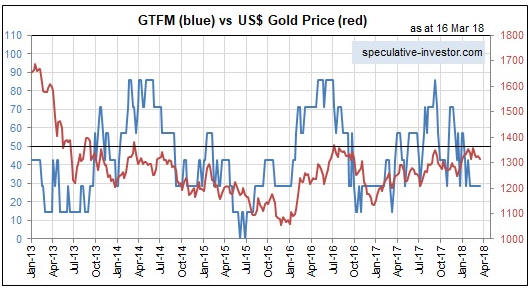
The current situation (as at the end of last week) is that gold’s true fundamentals, as indicated by the GTFM, have been bearish for the past 10 weeks. Also, the true fundamentals have spent more time in bearish territory than bullish territory since the second half of last September. Refer to the following chart comparison of the GTFM and the US$ gold price for details.

GTFM_200318

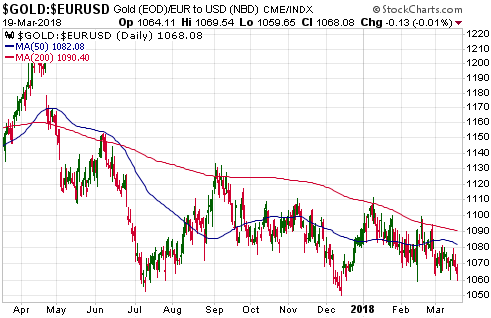
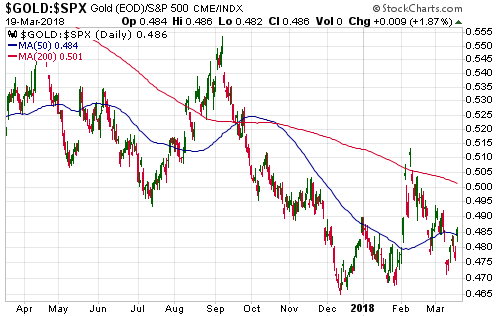
Now, considering the fundamental backdrop it seems that the gold price has held up remarkably well over the past several months, but that conclusion only emerges if your sole measuring stick is the US$. When performance relative to the other senior currency (the euro) and the world’s most important equity index (the S&P500) are taken into account it becomes clear that the gold market has been weak. Here are the relevant charts.

gold_euro_200318

gold_SPX_200318

The fundamental backdrop is continually shifting and potentially could turn gold-bullish within the next few weeks. It just isn’t bullish right now. Also, there could be a strong rally in the US$ gold price in the face of neutral-bearish fundamentals. If so, we would be dealing with a US$ bear market as opposed to a gold bull market.

In a gold bull market the ‘value’ of an ounce of gold rises relative to the major equity indices and both senior currencies. For this to happen the true fundamentals would have to be decisively bullish most of the time.

The rising interest-rate trend

March 5, 2018

The rising interest-rate trend in the US isn’t new and isn’t related to the Fed’s so-called “policy normalisation” program. However, it has only just started to matter.

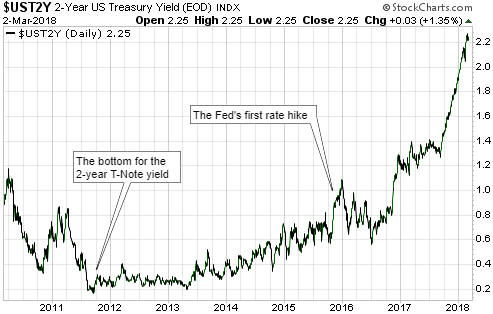
That the rising interest-rate trend isn’t new and isn’t related to the Fed’s rate-hiking efforts is clearly illustrated by the following chart. This chart shows that the US 2-year T-Note yield began trending upward in 2011 — more than 6 years ago and more than 4 years prior to the Fed’s first rate hike.

UST2Y_050318

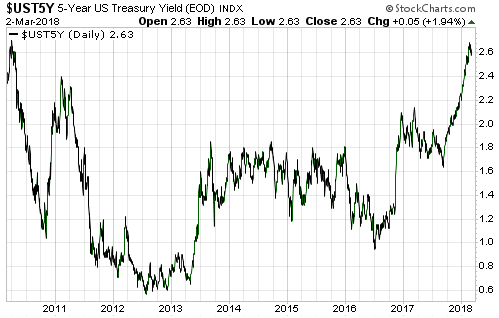
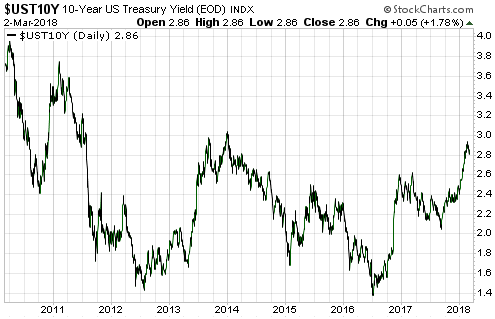
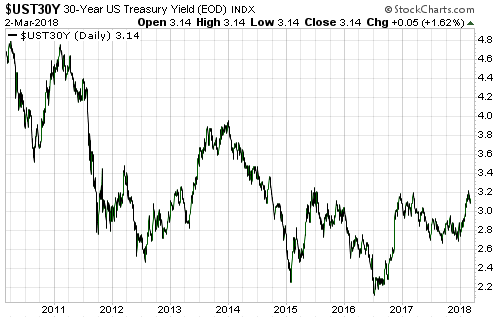
As we go further out in duration we find later beginnings to the rising-yield trend. This is evidenced by the following three charts, the first of which shows that the 5-year yield bottomed in mid-2012, the second of which shows that the 10-year yield double-bottomed in mid-2012 and mid-2016, and the third of which shows that the 30-year yield continued to make lower lows until mid-2016. But even in the case of the 30-year yield the rising trend is now more than 18 months old.

UST5Y_050318

UST10Y_050318

UST30Y_050318

Given that US interest rates have been rising for more than 6 years at the short end and more than 18 months at the long end, why has the trend suddenly begun to draw a lot of attention in the mainstream press?

The answer is: because rising yields on credit instruments have begun to put downward pressure on equity prices. The stock market is capable of ignoring rising interest rates for long periods, as has been demonstrated by the market action of the past few years. However, if a rising interest-rate trend persists for long enough it transforms, as far as the stock market is concerned, from an irrelevance to the most important thing.

The way that interest rates gradually turned upward over several years despite the relentless downward pressure applied by the central bank suggests that we are dealing with the end of a very long-term decline. In other words, there’s a good chance that we are now in the early stages of a 1-2 decade (or longer) rising interest-rate trend. But how could that be, when debt levels are very high and the economy-wide savings rate is very low?

Under the current monetary regime, major upward trends in interest rates are not driven by the desire to consume more in the present (the desire to save less) or by rapidly-increasing demand for borrowed money to invest in productive enterprises. That, in essence, is a big part of the problem — interest-rate trends do not reflect what they should reflect. Instead, major upward trends in interest rates are driven primarily by rising inflation expectations, or, to put it more aptly, by declining confidence in money.

Of particular relevance, under the current monetary regime it is not only possible for a large, general increase in the desire to save to be accompanied by rising interest rates, it is highly probable that when a large rise in interest rates happens it will be accompanied by a general desire to save more. It’s just that the desire for greater savings won’t manifest itself as a greater desire to hold cash. It will, instead, manifest itself as a desire to hold more of something with near-cash-like liquidity that is not subject to arbitrary devaluation by central banks and governments. Gold is the most obvious example.