Commodities and the AI Bubble

October 21, 2025

[This blog post is an excerpt from a recent commentary at www.speculative-investor.com]

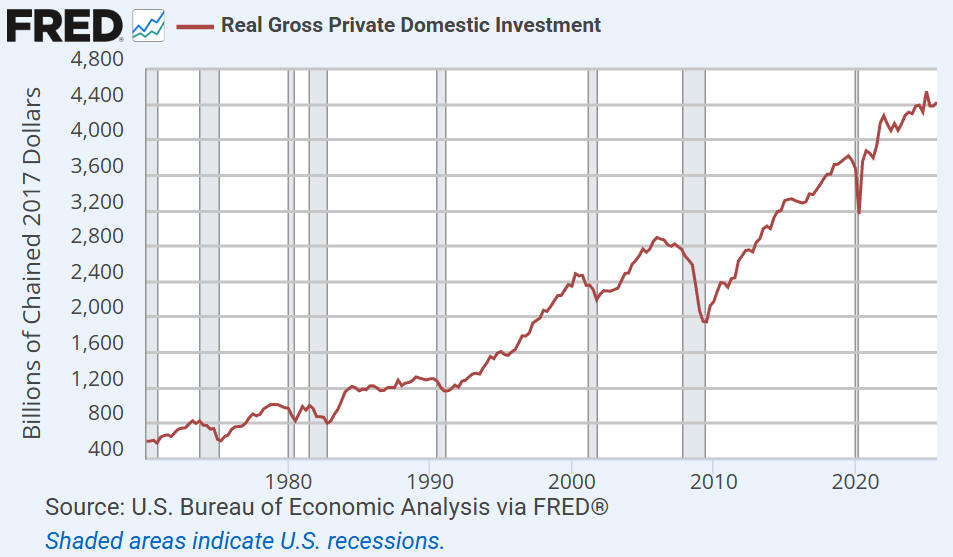
Based on their extreme valuations, AI-focussed equities are in a bubble and have been for a considerable time, but what about the investments in AI infrastructure such as datacentres, semiconductors, servers and the associated power supplies? Does the rapid rate of investing in AI-related hardware, software and buildings constitute a bubble?

We suspect that it does, but at this time there is no way of knowing. Investment that turns out to be malinvestment always is based on forecasts of future demand that prove to be far too optimistic, but not all optimistic forecasts of future demand turn out to be wrong.

One sign that the investment underway in AI-related hardware and software constitutes a bubble is the creative ways that are being used to fund it. For example, the following meme reflects how three of the most important companies in the AI world recently funded each other. NVIDIA invested US$100B in OpenAI, which used the money to buy server capacity from Oracle, which used the money to purchase chips from NVIDIA. This circular transaction boosted the equity valuations and the revenues of all three companies involved.

Our 1-2-year bullish outlooks for some industrial commodities, including natural gas, uranium, copper and tin, are linked in part to the AI buildout. Therefore, could the bursting of the AI bubble cut-short the cyclical commodity bull market?

We don’t think so, for six reasons.

First, even if the stock prices of AI-focussed companies were to crash soon, the investment in the associated AI infrastructure probably would add significantly to commodity demand for at least another two years. This is based on the datacentres already under construction and planned to commence construction in the near future.

Second, there are other important potential drivers of increased commercial demand for commodities, chief among them being the rebuilding of Ukraine, the rebuilding of Gaza and the construction of the massive Yarlung Tsangpo Hydroelectric Project in China.

Third, restrictions on international trade are likely to put upward pressure on commodity prices in some parts of the world, including the US, by making the international trading of commodities less efficient. For example, whereas previously it would have made sense to import a commodity rather than produce it locally, due to tariffs it could make more sense to produce locally. However, it generally takes several years to build a new mine and the mine-building process itself consumes large quantities of commodities.

Fourth, the combination of a weaker US$ and increased government spending around the world will both support the commercial demand for commodities and boost the speculative demand for commodities as an inflation hedge.

Fifth, even though investment in ‘renewable’ energy such as solar and wind is now being de-emphasised or actively discouraged by the US government, there continues to be massive investment in these forms of energy around the world and especially in China. This will boost the commercial demand for industrial metals.

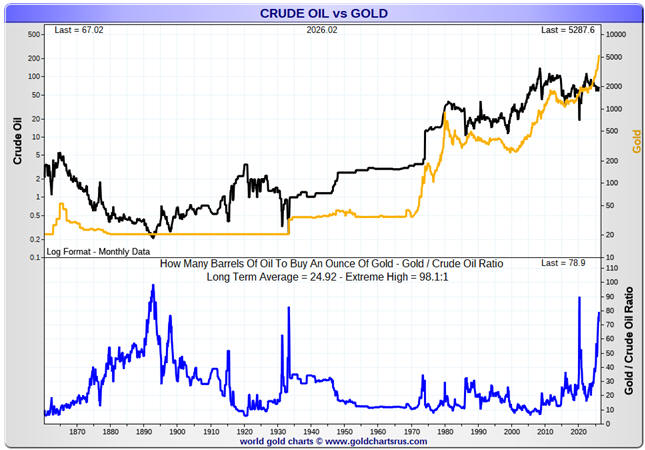
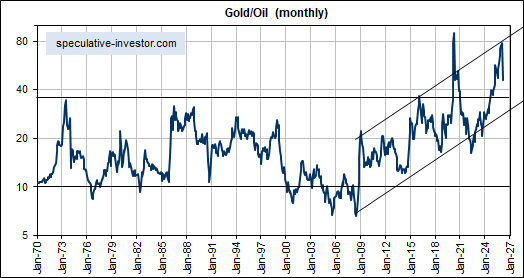
Sixth, the gold bull market of the past few years projects a commodity bull market over the next few years (commodity bull markets are just gold bull markets that have broadened).

In our opinion, the rise in the prices of some commodities over the past six months is just a taste of what’s to come.

US Recession: Not yet, but possibly soon

October 7, 2025

[This blog post is an excerpt from a recent commentary published at www.speculative-investor.com]

Indicators of sentiment suggest that the US economy is weak, while macroeconomic indicators such as GDP suggest that the US economy is doing fine. This difference between what most people perceive and the performances of economic aggregates such as GDP has been apparent for years, and can be explained as follows.

First, the reality is that people who are asset rich and/or cash rich have done extremely well over the past few years and continue to do so due to higher interest income and equity prices. They have increased their spending accordingly, boosting measures such as GDP in the process.

Second, there has been an investment boom associated with AI that has led to massive capital spending on datacentres. Everything that goes into building these new datacentres has added to GDP while doing very little, to date, to improve the lives or the job prospects of the vast majority of people. In fact, the datacentres are increasing the cost of energy and therefore the cost of living for the average person.

Third, the government has spent rapidly over the past few years and continues to do so, ensuring that there is plenty of ‘fiscal stimulus’ to boost the economic aggregates.

A result is that numbers such as economy-wide consumer spending look good, while for most consumers it feels like the economy is in recession or heading that way. The economy-wide numbers matter for the financial markets and for our analyses, but it’s important to understand why the perceptions of most people don’t align with these aggregates.

Overall, the economic indicators to which we pay attention point to an economy that is far from strong but at the same time is not yet weak enough to be put into the recession category. For example, the ISM New Orders Index (NOI) continues to be low enough to generate a recession warning signal without doing what it usually does after a recession gets underway in earnest: plunge below 40. This means that the NOI has been generating a recession warning for three years now without the overall economy entering official recession territory, which is something that has never happened before.

As we’ve noted many times in the past, something that should happen before a recession gets underway in earnest is a sufficient general widening of credit spreads to push the High Yield Index Option Adjusted Spread (HYIOAS) above its 65-week MA (the blue line on the following chart). HYIOAS generates the occasional false recession warning, which is what happened during the first quarter of this year, but in the past it has never failed to signal an actual recession. In other words, it generates the occasional false positive but no false negatives.

HYIOAS’s current message is that the US economy is not in recession.

The US economy therefore does not appear to be in recession right now, although it would not take much in the way of additional weakness to tip the scales decisively in that direction. This risk is a reason to hold a larger cash reserve than usual, but it is not a reason to avoid investments/speculations in commodities and commodity-related equities. As we’ve noted in the past, commodities and the associated equities performed very well during the bulk of the 1973-1974 inflationary recession (probably the best historical analogue) and also performed well during the first six months of the 2007-2009 deflationary recession.

Hedge, don’t bet

September 28, 2025

[This blog post is an excerpt from a commentary posted at www.speculative-investor.com last week]

The senior US stock indices have trended upward with only minor pullbacks since April, leaving them very overbought by most measures and at their highest valuations in history. Furthermore, the Russell2000 Small-Cap Index is testing long-term resistance. At the same time, the economy is weakening under the weight of tariffs, regime uncertainty and many years of malinvestment, pointing to either slower earnings growth ahead or earnings contractions if the long-delayed recession finally arrives. Consequently, the current market situation seems precarious.

It is precarious, which is why our own accounts are now about 50% in cash. This is up from 30% in April-2025 and is the highest cash percentage we have had in many years. However, over the past 18 months we have steered clear of bearish speculations in our own accounts and with regard to TSI recommendations/positions (we have not added a stock-market-focussed put option to the TSI List since March-2024).

As an aside, we came close to adding an IWM (Russell2000 ETF) put option to the TSI List in July of this year, but for the option to be added the IWM price had to test resistance at US$230 before reversing downward. It ended up reversing downward from significantly below this resistance and then rebounded off support, prompting us to write (in the 11th August Weekly Update): “…note that a rise by IWM to resistance at $230 now would constitute an upside breakout and would NOT create a buying opportunity for IWM puts.” A week later we went on to explain: “…the small-cap-focussed Russell2000 ETF (IWM) finally attacked resistance at US$230 last week. The resistance has held for now, but the fact that IWM pulled back to support before attacking resistance makes it more likely that the resistance will be breached.” The resistance eventually was breached and a rise to the next important resistance at US$245 soon followed.

Our interest in equity-index-related bearish speculations diminished greatly after we fully understood the reality that with passive investing strategies having come to dominate the market, the traditional mix of equity market fundamentals such as corporate earnings and valuation had all but ceased to matter. In fact, valuation now works in the opposite way, in that the greater the relative overvaluation of a particular stock the larger the proportion of ‘passive’ money that will be allocated to the stock, driving its valuation even higher.

The situation is precarious, because at some point the system that is putting a relentless bid under the market and especially under the stocks with relatively large market capitalisations will go into reverse. At that point and with valuations in the stratosphere, there will be no value-oriented investors to ‘buy the dip’ and most people will be surprised at how far and how fast the market falls.

The system won’t go into reverse because valuations have become too high, because, as explained above, high valuations are not an impediment to demand if most of the demand is ‘passive’. It will go into reverse because the net flow of money into passive funds stops or simply becomes insufficient. This could happen due to the “boomer” generation withdrawing money from their retirement accounts or it could be the result of much higher unemployment (a recession).

Unfortunately, there is no way of predicting when the major reversal point will arrive. At this time we suspect that the overall bullish trend will continue until the end of this year (with a significant intervening correction), but it could continue for much longer than that. In the meantime, we plan to continue doing what we have been doing, which is 1) adjust our overall cash percentage based on short-term risk considerations and 2) find ways to profit on the long side that don’t involve turning a blind eye to the values of underlying businesses. Fortunately, there have been excellent opportunities in the commodity realm over the past 12 months and we expect that there will be many additional opportunities in this realm over the next couple of years.

The US dollar’s long-term cycle

September 12, 2025

[This blog post is an excerpt from a recent commentary at www.speculative-investor.com]

Since 1970, which roughly was when the current monetary system involving no official link to gold was born, the USD/CHF exchange rate (the US$ relative to the Swiss franc) has experienced a repeating pattern of 8-10 years down followed by 6-8 years up. We rarely discuss this cycle at TSI, because it only becomes relevant when the window for a cyclical turning point is entered, which only happens every 6-10 years. We are discussing it today because a turning-point window has been entered.

The cyclical pattern outlined above began with an 8-year downward trend in the US$ (relative to the Swiss franc) during 1970-1978. This decline was followed by an upward trend that culminated in 1985 and then a 10-year decline to a major bottom in 1995. The following weekly chart picks up the story in 1991, which means that it captures the final few years of the 1985-1995 cyclical decline and everything thereafter.

The chart shows that the most recent cyclical decline kicked off at the start of 2017, so it is not a coincidence that the last time we discussed this long-term cycle at TSI was in 2017. An 8-10-year decline from the 2017 high would result in the next major low for the USD being set during 2025-2027. Hence our comment above that a turning-point window has been entered.

It’s worth pointing out that knowledge of the above-described cycle generally isn’t useful for practical trading purposes, because the countertrend moves during both cyclical uptrends and cyclical downtrends can be substantial. However, it is useful to know that previous cyclical downward trends, which culminated in 1978, 1995 and 2011, had large declines during their final 12 months. If this aspect of the long-term pattern repeats, then a large decline in the USD still lies ahead.

So, where does this leave us?

Our view at the start of this year was that the USD was about to embark of a 1-2-year decline to complete a cyclical downward trend. We subsequently refined this view and over the past several months have written that we expected a cycle low to be set late this year at not far below the early-July low. While we continue to expect that this year’s low will be not far below the early-July low, we no longer expect this year’s low to be the ultimate cycle low. Here are the three reasons in order of ascending importance:

1) As mentioned above, previous long-term declines in the USD have involved large declines during their final 12 months. Unless the USD loses about 10% of its value against the CHF within the next three months, the decline during the 12 months leading up to this year’s low will be minor in comparison.

2) Major USD lows have occurred at 16-17-year intervals (Q3-1978, Q2-1995, Q3-2011). The same interval projects 2027-2028 for the next major low.

3) Total US equity market capitalisation as a percentage of global equity market capitalisation reached a peak of almost 70% early this year. Refer to the following chart for the details. There is evidence in capital flow data and in the following chart that a reversal has occurred. Furthermore, the trade-related policies of the Trump Administration will tend to reduce capital in-flows at the same time as they restrict goods in-flows to the US, and US equity valuations are extremely high in both absolute and relative terms. A result is likely to be a multi-year period of weakness in US equities relative to global equities, which, in turn, would mean a multi-year period during which our US$ True Fundamentals Model (UTFM) spends most of its time in bearish or neutral territory.

Chart source: Lord Abbett

Further to the above, we expect that the USD will make an intermediate-term low before the end of this year, but the overall cyclical decline is now expected to extend into 2027. A cycle low in 2027 still would be within the window projected by the 6-8 years up followed by 8-10 years down repeating pattern. It also would mesh with the 16-17-year cycle of major USD lows and our expectations regarding currency market fundamentals.