
The coming “inflation” problem in the US

February 23, 2021

Due to the central-banking world’s unshakeable belief that money must continually lose purchasing power and the current authority of the central bank to do whatever it takes to achieve its far-reaching goals, the greater the perceived threat of deflation the more monetary inflation there will be. That’s why the endgame for the current monetary system involves rapid “price inflation”. This has been obvious for a long time, but some well-known analysts are just starting to cotton-on.

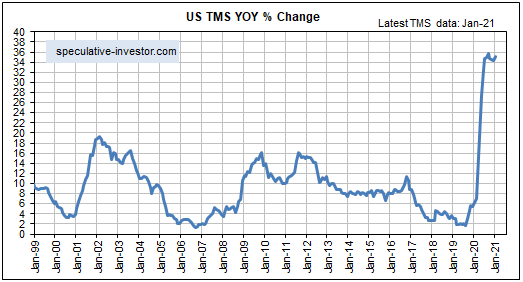
There were examples of the aforementioned phenomenon (the greater the fear of deflation, the higher the rate of monetary inflation) during 2001-2002 and again during 2008-2009, but 2020 provided the best example yet. As evidence we point to the following chart and the fact that the quantity of US dollars created during the 12-month period ending January-2021 (4.8 trillion) is greater than the entire US money supply at the beginning of 2007.
TMS_blog_230321

As an aside, it would be a good thing if deflation were the high-probability outcome that many analysts/commentators still claim it is, because deflation is relatively easy to prepare for. To prepare for deflation all you have to do is be ‘cashed up’, whereas in a high-inflation environment you are forced to speculate just to avoid a large loss of purchasing power.

At the moment the world’s most influential central bankers and economists don’t see a problem with rapid monetary inflation, because according to their favourite indicators previous large increases in the supply of money over the past two decades had only minor effects on the purchasing power of money. Also and as noted at the start of this discussion, the central-banking world is labouring under the belief that the economy would benefit from more “price inflation”.

However, in response to the most recent monetary inflation surge there will be a lot more traditional “price inflation” than a) there was in response to the previous money-supply growth spurts and b) the average central banker would consider to be beneficial. This isn’t only because of the much larger amount of money creation this time around, but also because of the way the new money is being distributed.

Whereas most of the new money created in reaction to earlier deflation scares was injected into the financial markets and stayed there, via the “stimulus” programs implemented last year and that are on the cards for this year the US government is, in effect, sucking a lot of money out of the bond market and sending it to the general public. Also, there will be a huge infrastructure spending bill that will do something similar (siphon money from the bond market to the public).

The Fed technically is still injecting new money into the financial markets by purchasing bonds from Primary Dealers, which means that it is doing what it did in response to earlier deflation scares. However, for all intents and purposes it is now monetising a rapidly-expanding government budget deficit.

According to the book Monetary Regimes and Inflation, all of the great inflations of the 20th Century were preceded by central bank financing of large government deficits. Furthermore, in every case when the government deficit exceeded 40% of expenditure and the central bank was monetising the bulk of the deficit, which has been the case in the US over the past 12 months, a period of high inflation was the result. In some cases hyperinflation was the result.
TSI Themes

February 17, 2021

At any given time there will be many investable themes ‘on the go’ within the financial markets, but due to time constraints we cannot cover all or even most of these themes at TSI. Instead, we pick out a few to focus on.

For the information of non-subscribers, here is a summary of the themes that we focused on during the second half of last year and that remain focal points of the regular TSI commentaries.

1) Aggressive monetary and fiscal stimulus will create the illusion of global economic strength (an artificial economic boom).

2) The rising trend in inflation expectations that began during the first half of 2020 will extend through the first half of 2021 and possibly for years to come.

3) The US dollar is immersed in a cyclical bear market that began in March of 2020.

4) Multi-year bullish trends are underway in industrial and agricultural commodities.

5) The electrification of transport is an unstoppable global trend that will have major bullish implications for certain commodities, especially lithium, manganese and the rare-earth elements.

6) The cannabis-legalisation trend in the US is accelerating and will enable US-focused cannabis companies to achieve rapid sales growth during 2021-2022.

7) Gold will perform poorly relative to industrial commodities until the transition to the next economic bust phase begins.

Our own account has some exposure to other themes, but the above list covers the ones we have been concentrating on as far as the TSI commentaries are concerned. We expect that all of the above will remain applicable over the coming few months, but that changes will be required at some point this year due to prices becoming too stretched to the upside or signs of an economic downturn becoming evident in our favourite leading indicators or “inflation” moving well beyond what the Fed deems appropriate.

Rampant Speculation

February 8, 2021

[This blog post is an excerpt from a commentary posted at TSI last week]

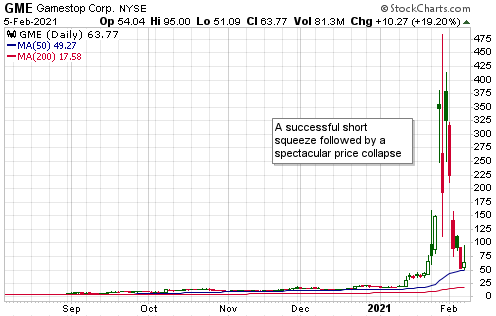
We assume that everyone reading this has at least superficial knowledge of the incredible goings-on around the stock of GameStop (GME), a video game retailer. The GME situation became so extraordinary last week that it drew the attention of senior US policymakers, but more importantly it is representative of what’s happening throughout the stock market and is symptomatic of the US money supply’s Fed-driven explosive growth.

There are no ‘good guys’ in the GME saga. The small traders who banded together via Reddit to create a massive “short squeeze” in the stock of a company that was on its way to bankruptcy have no right to claim the moral high ground, because they set out to do more damage to an already-broken price discovery process in order to make a ‘quick buck’. The short sellers who were ‘squeezed’ paid a legitimate price for poor risk management. The brokers that without warning imposed restrictions on the trading of GME and in some cases forced their customers out of the stock were simply acting to limit their own exposure, in that stockbrokers can be left ‘holding the bag’ when prices go crazy and traders can’t meet margin calls. And politicians are trying to portray themselves as being supportive of the ‘little guy’ while ignoring the underlying cause.

On a side note, the problem with ‘squeezing the shorts’ in the stock of a company with very little underlying value is that if the squeeze is successful then there will be almost no buyers on the way back down. As a result, successful short squeezes are often followed by spectacular price collapses.

GME_050221

The underlying cause of the crazy price action is the explosive money-supply growth engineered by the Fed. This record-breaking expansion of the money supply hasn’t led to rapid rises in official measures of “price inflation” YET, but its effects are plain to see. One of the most obvious effects at the moment is the rampant speculation in parts of the stock and commodity markets.

The participants in each bubble believe that there are some fundamental considerations that make their bubble special, meaning that their bubble is believed to be not actually a bubble but a reasonable assessment of future prospects. For example, Tesla bulls believe that Tesla’s market cap makes sense considering the company’s future earnings potential, bitcoin bulls believe that bitcoin’s price rise is justifiable and is nothing compared to what’s coming, and many retail equity traders now believe that the stock market offers them a sure-fire way to make a lot of money very quickly without the need to do any real work.

However, all of the spectacular price rises are part of the same story. All of today’s bubbles are linked to what’s being done to money and they all will burst at around the same time, disabusing ‘investors’ of the notion that their favourite bubble is somehow special.

Recognising that an investment is a bubble isn’t a good reason to bet against the investment. In fact, it’s the opposite. Betting against a bubble is one of the surest ways to lose money quickly.

The goal should be to participate in a bubble while paying very careful attention to managing risk. As long as profits are harvested on a regular basis, a sizable cash reserve is maintained and debt-based leverage is avoided, astute investors/speculators can do well during a bubble without taking excessive risk. They won’t do as well as the true believers, but they won’t give back all of their gains after the inevitable collapse occurs.

Rising fear of inflation

January 26, 2021

[This post is an excerpt from a commentary published at TSI on 17th January 2021]

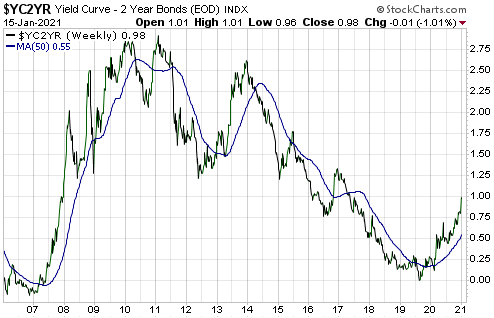
The US yield curve, represented on the following weekly chart by the spread between the 10-year T-Note yield and the 2-year T-Note yield, has been steepening since the third quarter of 2019. Moreover, the pace of the steepening is accelerating.

yieldcurve_blog_260121

A steepening of the yield curve can be primarily driven by decreasing yields on short-dated treasuries or increasing yields on long-dated treasuries. The former results from a general increase in the desire to hold the most liquid and lowest-risk financial assets, such as cash and T-Bills. It is bullish for gold and bearish for commodities and most equity sectors. The latter results from a general increase in inflation expectations. It is also bullish for gold but is more bullish for commodities and certain equity sectors.

The steepening that occurred from the third quarter of 2019 through the first half of 2020 was driven by declining yields on short-dated treasuries, but the steepening that has occurred since August-2020 was driven by rising yields on long-dated treasuries, that is, by rising inflation expectations.

Given what the US government and the Fed have done and plan to do, it shouldn’t be a surprise to anyone that inflation expectations are in a rising trend and that the trend is accelerating. Of particular significance, President-elect Biden has proposed a new “stimulus” package with a US$1.9 trillion price tag, and it is well known that this spending package will be followed by an infrastructure bill that probably will involve another $1-$2 trillion of additional spending. Also, we have statements from the Fed to the effect that now is not the time to be talking about reducing the monetary accommodation and that there won’t be any tightening until an inflation problem is obvious to all.

The Fed could try to suppress one of the symptoms of a burgeoning inflation problem by attempting to control the yield curve, that is, by ramping-up its purchases of long-dated treasuries with the aim of lowering yields at the long end of the curve. However, that would amount to creating more money out of nothing in an effort to address a problem caused by creating too much money out of nothing. Even by the Fed’s own standards this would be counterproductive.

The bottom line is that there will be a lot more inflation and a further large increase in inflation fear before there is a realistic chance of a deflation scare.