The S&P500 is coiling ahead of the Fed’s decision

September 16, 2015

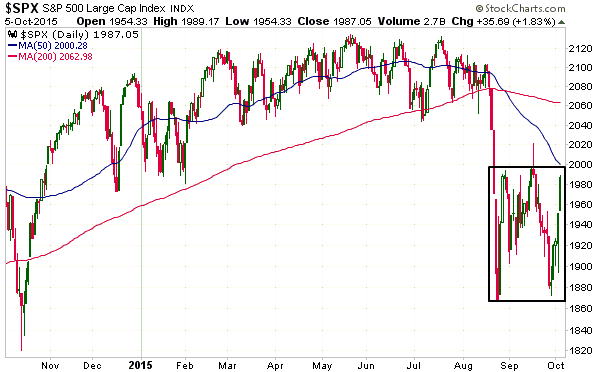
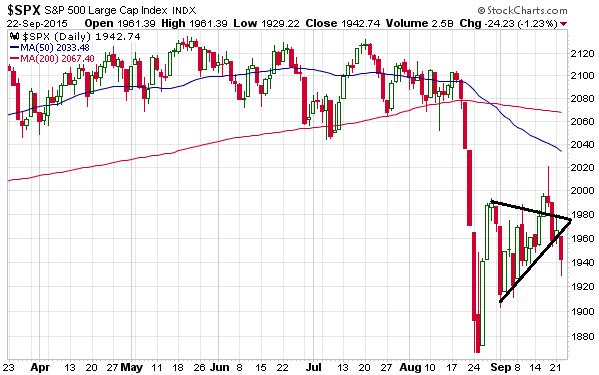
I’ve placed a small bet (via put options) that the senior US stock indices will drop to test their 24th August lows by mid-October. At the same time I acknowledge the potential for a sharp move to the upside over the next 2-3 days in anticipation of and in reaction to the Fed’s 17th September interest-rate decision. That’s why my bearish bet is small.

The chart pattern of the S&P500 Index (SPX) suggests that there will be a sharp move over the days immediately ahead, although it doesn’t point to a particular direction. One possible outcome involves an upside breakout within the next two days from the contracting triangle drawn on the following chart and then a downward reversal. This is the near-term outcome that would confuse the greatest number of traders, which is why I favour it.

SPX_blog_160915

I never risk money on guesses about what any financial market is going to do over time periods as short as a few days, but it’s still fun to guess.

Economic busts are not caused by policy mistakes

September 14, 2015

What I mean by the title of this post is that the central-bank tightening that almost always precedes an economic bust is never the cause of the bust. However, it’s a fact that economic busts are indirectly caused by policy mistakes, in that policy mistakes lead to artificial, credit-fueled booms. Once such a boom has been fostered, an ensuing and painful economic bust becomes unavoidable. The only question is: will the bust be short and sharp (the result if government and its agents stay out of the way) or drag on for more than a decade (the result if the government and its agents try to boost “aggregate demand”)?

The most commonly cited historical case of a policy mistake directly causing an economic bust is the Fed’s gentle tap on the monetary brake in 1937. This ‘tap’ was quickly followed by the resumption of the Great Depression, leading to the superficial conclusion that the 1937-1938 collapse in economic activity would never have happened if only the Fed had remained accommodative.

Let’s now take a look at what actually happened in 1937-1938 that could have caused the economic recovery of 1933-1936 to rapidly and completely disintegrate.

First, while commercial bank assets temporarily stopped growing in 1937, they didn’t contract. Commercial bank assets essentially flat-lined during 1937-1938 before resuming their upward trend in 1939.

Second, outstanding loans by US commercial banks were roughly the same in 1938 as they had been in 1936, so there was no widespread calling-in of existing loans. That is, there was no commercial-bank credit contraction to blame for the economic contraction.

Third, the volume of money held by the public was higher in 1937 than in 1936 and was roughly the same in 1938 as in 1937.

Fourth, M1 and M2 money supplies were roughly unchanged over 1937-1938, so there was no monetary contraction.

Fifth, the consolidated balance sheet of the Federal Reserve system was slightly larger in 1937 than in 1936 and significantly larger in 1938 than in 1937, so there was no genuine tightening of monetary conditions by the Fed at the time.

Sixth, an upward trend in commercial bank reserves that began in 1934 continued during 1937-1938.

Seventh, there were no increases in the interest rates set by the Fed during 1937-1938. In fact, there was a small CUT in the FRBNY’s discount rate in late-1937.

What, then, did the Fed do that supposedly caused one of the steepest economic downturns in US history? The answer is that it boosted commercial-bank reserve requirements.

All of which prompts the question: How did a 1937 increase in reserve requirements that didn’t even lead to a monetary or credit contraction possibly cause manufacturing activity to collapse and unemployment to skyrocket?

It’s a trick question, because the increase in reserve requirements clearly didn’t cause any such thing. The economic collapse of 1937-1938 happened because the recovery of 1933-1936 was not genuine, but was, instead, an artifact of increased government spending and other attempts to prop-up prices. The economy had never been permitted to fully eliminate the imbalances that arose during the late-1920s, so a return to the worst levels of the early-1930s was inevitable.

Many analysts are now worrying out loud that the Fed will repeat the so-called “mistake of 1937”, but the real problem is that the Fed and the government repeated the policy mistakes of the late-1920s and then repeated the policy mistakes of 1930-1936. The damage has been done and another economic bust is now unavoidable, regardless of what the Fed decides at this week’s meeting.

Gold’s true fundamentals are mixed, at best

September 11, 2015

To paraphrase Jim Grant, gold’s perceived value in US$ terms is the reciprocal of confidence in the Fed and/or the US economy. That’s why the things I refer to as gold’s true fundamentals are measures of confidence in the Fed and/or the US economy. I’ve been covering these fundamental drivers of the gold price in TSI commentaries for about 15 years.

Note that I use the word “true” to distinguish the actual fundamental drivers of the gold price from the drivers that are regularly cited by the majority of gold-market analysts and commentators. According to many pontificators, gold’s fundamentals include the volume of gold being imported by China, the volume of gold being transferred out of the Shanghai Futures Exchange inventory, the amount of “registered” gold at the COMEX, India’s monsoon and wedding seasons, the amount of gold being bought/sold by various central banks, changes in mine production and scrap supply, and wild guesses regarding JP Morgan’s exposure to gold. These aren’t true fundamental price drivers. At best, they are distractions.

In no particular order, the gold market’s five most important fundamental drivers are the real interest rate, the yield curve, credit spreads, the relative strength of the banking sector, and the US dollar’s exchange rate.

Over the past 2 years gold’s true fundamentals have usually been mixed, meaning neither clearly bullish nor clearly bearish. What has tended to happen during this period is that when one of the fundamentals has moved decisively in one direction it has been counteracted by a move in the opposite direction by one of the others. For example, when credit spreads began to widen (gold-bullish) in mid-2014, the flattening of the yield curve (gold-bearish) accelerated. For another example, when the yield curve reversed direction and began to steepen (gold-bullish) in January of this year, the real interest rate turned upward (gold-bearish) and the banking sector began to strengthen relative to the broad stock market (gold-bearish).

Charts illustrating the performances over the past 5 years of the first four of the above-mentioned fundamental drivers of the gold market are displayed below. The first chart shows that the 10-year TIPS yield, a proxy for the real US interest rate, made a 2-year low in April of this year but has since moved to a 1-year high and into the top third of its 2-year range. This is bearish for gold. The second chart shows that a proxy for US credit spreads has been working its way upward since mid-2014 and recently broke to a new 2-year high. This is bullish for gold. The third chart shows that the US yield curve began to steepen in January, which is bullish for gold, but its performance over the past two months casts doubt as to this driver’s current message. And the fourth chart shows that after being relatively weak from July-2013 through to January-2015, the bank sector suddenly became relatively strong early this year. This driver has therefore shifted from gold-bullish to gold-bearish.

The overall picture painted by these charts is that gold’s fundamentals are still mixed, although there is perhaps a slight bearish skew due to the new 12-month high in the real interest rate. I’m anticipating a shift towards a more gold-bullish fundamental backdrop, but it hasn’t happened yet.

TIPS_100915

creditspread_100915

yieldcurve_100915

BKX_SPX_100915

Money need not be anything in particular

September 9, 2015

This post was inspired by an exchange between Martin Armstrong of Armstrong Economics and one of his readers. In an earlier blog entry Mr. Armstrong wrote: “The wealth of a nation is the total productivity of its people. If I have gold and want you to fix my house, I give you the gold for your labor. Thus, your wealth is your labor, and the gold is merely a medium of exchange. So it does not matter whatever the medium of exchange might be.” One of his readers took exception to this comment and argued that money should be tangible and ideally should be gold or silver.

Mr. Armstrong’s reply is worth reading in full. After giving us an abbreviated history of money through the ages, he sums up as follows:

Paper money is the medium of exchange between two people where one offers a service or something they manufactured, which is no different than a gold or silver coin requiring CONFIDENCE and an agreed value at that moment of exchange. You can no more eat paper money to survive than you can gold or silver. All require CONFIDENCE of a third party accepting it in exchange. For the medium of exchange to be truly TANGIBLE it must have a practical utilitarian value and that historically is the distinction of a barter system vs. post-Bronze Age REPRESENTATIVE/INTANGIBLE based monetary systems predicated upon CONFIDENCE.

I agree with Mr. Armstrong’s central point. Many gold advocates assert that gold is “real wealth” and has intrinsic value, which is patently wrong. Value is subjective and will change based on circumstances. For example, you might place a high value on gold in your current circumstances, but if you were stranded alone on an island with no hope of rescue then gold would probably have no value to you. Gold has exactly the same intrinsic value as a Federal Reserve note: zero.

However, he is very wrong when he states: “…it does not matter whatever the medium of exchange might be.” On the contrary, it matters more than almost anything in economics!

The problem with today’s monetary system isn’t that the general medium of exchange (money) has no intrinsic value. As noted above, money also had no intrinsic value when it was gold. The problem with today’s monetary system is that an unholy alliance of banks and government has near-total control of money. Banks have the power to create new money at whim, as does the government via the central bank.

Aside from the comparatively minor problem of causing the purchasing power of money to erode over time, the creation of money out of nothing by commercial banks and central banks distorts the relative-price signals that guide investment. This happens because the money enters the economy in a non-uniform way. In the US over the past several years, for example, most new money entered the economy via Primary Dealers who used it to purchase financial assets from other large speculators. The stock and bond markets were therefore the first and biggest beneficiaries of the new money, which led to an abnormally-large proportion of investment being directed towards strategies designed to profit from rising equity prices and low/falling interest rates. Such investment generally doesn’t add anything to the productive capacity of the economy. In fact, it often results in capital consumption.

Instead of saying “it does not matter whatever the medium of exchange might be”, what Mr. Armstrong should have said was: it does not matter whatever the medium of exchange might be, as long as it is chosen by the free market. Putting it another way, the government should stay out of the money business.