Have economists learned anything since the 1970s?

March 18, 2016

Judging by Ambrose Evans-Pritchard’s 15th March article in the Financial Times, which rehashes the most popular economics-related fallacies of the 1970s, the answer to the above question is a resounding NO.

Here’s an excerpt from the article that neatly encapsulates the ideas that were widely believed by economists during the 1960s-1970s, that were shown to be false during the 1970s, and that are now apparently again accepted as true:

Every major downturn since the First World War has been caused by the Fed, determined to snuff out inflation as the credit cycle matures. Expansions rarely die of old age. They are killed.

There may have been other factors in each historical episode — the oil shocks of the 1970s, or the first Gulf War in 1991 — but the Fed has been the determining catalyst each time.

Mr Fischer could hardly have been clearer. He spelled out why the 1970s ‘Phillips Curve’ trade-off between unemployment and inflation is alive and well, and an implicit warning that prices could soon take off since the labour market is clearly approaching the electric fence of Milton Friedman’s NAIRU (non-accelerating inflation rate of unemployment).

The fact is that the Fed does cause severe economic downturns, but not by tightening monetary policy. In the real world, every boom that occurs on the back of money-pumping and interest-rate suppression contains the seeds of its own destruction. The reason is that the falsification of prices resulting from the central bank’s efforts to stimulate economic activity leads to widespread malinvestment.

Once the malinvestment occurs, a painful period of adjustment becomes inevitable. As Mises explained about 100 years ago, the only question is whether the adjustment begins sooner as a consequence of deliberately slowing the pace of money-pumping or later as a consequence of a collapse in confidence in the money. Politicians naturally want the adjustment to happen later (after the next election or, best of all, on somebody else’s watch), but the later it happens the more painful it will be.

It seems that Keynesian economic theories have to be totally discredited every generation, because regardless of how wrongheaded they are proved to be they always make a spectacular comeback. Furthermore, it’s not like what’s now commonly known as Keynesian Economics was invented by J.M.Keynes. In essence, all Keynes did was give his name, stamp of approval and incomprehensible language to ideas that had been tried to disastrous effect as far back as ancient Roman times.

It’s not hard to understand why these wrongheaded ideas inevitably get revived. They always recapture their lost popularity because they sound good at the most superficial level (they can sound like a way to provide free lunches for all) and because they seem to provide governments with an excuse to expand their reach.

Death crosses are often golden and golden crosses are often deathly

March 15, 2016

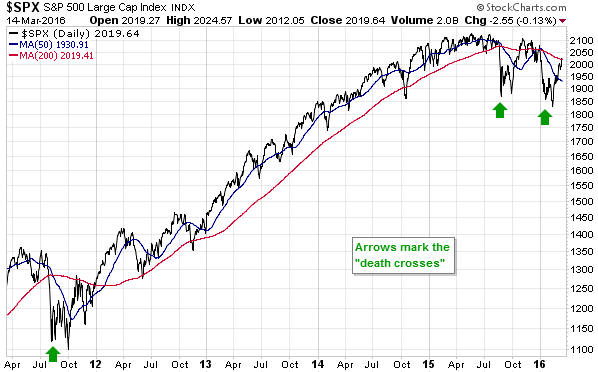
A “death cross” is when the 50-day moving average (MA) goes from above to below the 200-day MA. According to conventional wisdom death crosses are bearish, but they often occur near short-term price lows and therefore tend to be bullish.

For example, over the past 5 years the S&P500 Index (SPX) has experienced three death crosses. The first occurred near the August-2011 price bottom, which turned out to be a wonderful time to buy. The second occurred near the August-2015 price bottom, which was last year’s low. The third occurred near the low in January this year. I’ll be surprised if the January low turns out to be the 2016 low, but it was followed by a tradable rally.

SPX_140316

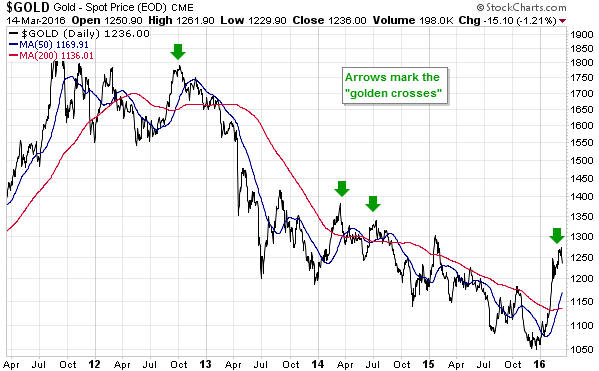
A “golden cross” is when the 50-day moving average (MA) goes from below to above the 200-day MA. According to conventional wisdom golden crosses are bullish, but they often occur near short-term price highs and therefore have short-term bearish implications more than half the time.

For example, short-term tops in the gold price occurred near “golden crosses” in September-2012, March-2014 and July-2014. Also, it’s too soon to know for sure, but it seems that a golden cross marked a short-term top in the gold price during the first half of this month.

gold_140316

Death crosses tend to have short-term bullish implications because they often happen around the time that the market becomes stretched to the downside. Similarly, golden crosses regularly have short-term bearish implications because they often happen around the time that the market becomes stretched to the upside.

Rules For Stock Speculation

March 14, 2016

Here are 21 rules/guidelines that I try to follow when speculating in the stock market. I don’t always follow them and in such cases I usually end up regretting it.

1. Every investment must pass the “Sleep Test”

An investment should not be so large that you lie awake at night worrying about it. To be a successful speculator or investor you must be able to remain relaxed and objective. An uncomfortably large investment or trade, although offering a potentially great return, can jeopardise your ability to remain objective and can thus lead to mistakes.

2. Avoid the emotions of hope, greed and fear

Hope is often associated with unrealistic expectations and causes an investor to cling to a losing position, magnifying the losses unnecessarily. Greed causes an investor to buy at the wrong time, such as near the peak of a rally, and to risk excessive amounts of money. Fear prevents an investor from buying at a time when the market presents the best opportunities to buy and prompts him to sell at the worst possible time (at the bottom of a correction or bear market).

3. A corollary to Rule 2 is: Treat your investing/trading as a business, not a Vegas-style gamble

This involves:

a) Checking your emotions at the door. You won’t be able to make objective decisions if you get excited by profits and/or depressed by losses.

b) Following an entry and exit plan for every stock you buy.

c) Not caring what happens to the price of a stock after you sell it. If you constantly worry that a stock will rocket higher after you sell then you will never be able to exit at an appropriate time.

d) Ignoring the cheerleaders. The cheerleaders (those commentators who become progressively more bullish the higher the price goes and who focus exclusively on the potential for huge rewards as if buying into the market right now were a sure path to great riches) tend to bring out the gambling spirit in their followers.

4. Use a disciplined risk-management approach at all times

It is difficult to own-up to a mistake. There is also usually the fear that if I sell now for a small loss the price will immediately rebound and I will have lost the opportunity to profit from the rise. After all, “hope springs eternal” and that stock that keeps dropping like a stone will one day soar like an eagle; all I need to do is be patient.

A systematic approach to risk management, which may or may not include ‘stop losses’, must be used to protect your investment capital. This is a hard lesson to learn and can usually only be learnt the hard way through experience.

5. Minimise the role of luck in your investing by playing a percentage game

Playing a percentage game encompasses the following guidelines:

a) Do not try to make a killing during any given year, but, instead, follow an approach designed to generate above-average returns over several years. In this way you might actually end up making a killing, but be aware that the vast majority of people who set out to get rich quick in the stock market end up a lot poorer.

b) Never plan to buy at the bottom or sell at the top. Instead, plan to buy on those occasions when the reward/risk ratio is high and to not buy, or to sell, on those occasions when it is low.

c) Take some money off the table during periods of extreme strength so you won’t feel pressured to sell during the periodic shakeouts.

d) Do some buying during the severe shakeouts that periodically occur in long-term bull markets. Note, though, that this will usually only be possible from a financial and/or an emotional standpoint if you previously took some profits into strength.

e) Never make whole-scale buy or sell decisions. Instead, scale into positions during weakness and scale out during strength, all the while maintaining exposure to the long-term bull market of the time.

f) Don’t ‘bet the farm’ on any single forecast. Forecasts, regardless of how well thought-out they appear to be, are just opinions, and any opinion can be wrong.

g) Don’t risk a large portion of your capital on any single stock. Regardless of how attractive a stock appears to be, acknowledge the fact that ‘stuff’ sometimes happens even to the best of companies.

6. Do your buying during those times when the fundamentals AND the price action are favourable

The fundamentals are favourable if the current price of the stock is low relative to the value of the underlying business, where the value of the underlying business is detemined by the company’s assets and growth prospects.

Examples of favourable price action include consolidations or basing patterns within longer-term upward trends.

7. Don’t focus on the profit/loss of a trade while the trade is on-going

Thinking about how much money you are making or losing on a trade while the trade is on-going may cause the emotions of fear and/or greed to influence your decisions. Have an exit plan for each stock and continue to monitor the fundamentals and the price action to determine whether to hold or to sell.

8. Make sure your exit plan for a stock is consistent with your entry plan

For example, if favourable price action was your main reason for buying a stock then you should exit if the price action turns unfavourable. In this case a reasonable approach could involve setting a protective stop just below a technical support level. However, if your decision to buy was based primarily on value considerations then it would make no sense to sell simply because the price became lower.

9. Remember that there are no absolute highs or lows

It is often the cheapest stocks that fall the furthest and the most expensive stocks that show the greatest price appreciation. Also, a price level that seems low or high today might appear the opposite in 12 months time.

10. Always maintain a substantial cash balance

You must always be in a position to take advantage of any opportunities that arise and the only way to do this is to always have significant cash reserves.

11. Close an event-based trade as soon as the anticipated event occurs

For example, let’s say a company you follow is about to announce its latest earnings. You expect the company to announce earnings that surprise on the upside and purchase the stock with the aim of taking a profit in the days following the announcement. If the company subsequently announces a result that does not exceed expectations you must immediately sell because the basis for your trade has proven to be false. If, however, the company does announce higher-than-expected earnings then you must sell within a few days of the announcement irrespective of the price action because this was your plan going into the trade. A disciplined approach will prevent short-term trades from becoming unwanted long-term investments.

12. Don’t be stingy when it comes to market information and stock buy/sell prices

The speculative investor does not day-trade and does not enter a position with the aim of taking a quick small profit. The timeframe for a trade will generally range from 1 month to 24 months and the goal will generally be to achieve a return of more than 30%. As such, it makes no sense to hold out for the final few percent when making a purchase or a sale.

Market- or stock-related information that increases your chances of investing/trading success is worth paying for.

13. Be aware that when the public is either extremely bullish or extremely bearish, the risk of a trend change is high

When the vast majority is extremely bullish then almost everyone who is going to buy has already bought and there is only one direction for the market to go, and that’s down. Similarly, when the vast majority is extremely bearish then almost everyone who is going to sell has already sold and there is only one direction for the market to go, and that’s up. Beware, though, that what constitutes a bullish or bearish extreme will differ depending on the long-term trend. For instance, sentiment can become more bullish and stay bullish for longer during a bull market than during a bear market.

14. Be patient

On average, you should not realistically expect to find more than two great opportunities per year to profit from market timing (sometimes there will only be one and there will seldom be more than three). As such, it pays to be patient and to wait for the major market reversals that usually accompany extremes in mass psychology. When these opportunities occur, the speculative investor must be financially prepared (refer to Rule 10) and psychologically prepared (refer to Rule 2) to take full advantage.

15. Remember and learn; don’t regret or blame

Take full responsibility for all of your investment decisions and never fall into the trap of blaming others when things go wrong. Losses are often learning experiences and can actually be money well spent if they prevent you from making the same mistake again, but if your reaction to a loss is to look outside yourself for someone/something to blame then you’ve learnt nothing from the experience and the money was wasted.

16. Keep yourself well-grounded

This encompasses the following:

a) Never complain about losses or brag about profits.

b) When the market is trending strongly higher and your stocks are going up every day remember that you are nowhere near as smart as you think you are; and during the severe corrections when every stock you own appears to be headed towards zero remember that you aren’t as dumb as you feel.

c) Be prepared to change your opinion if the facts change. In other words, don’t become wedded to any stock or to any market view.

d) Don’t act as if the current rally will be the last great money making opportunity. It won’t be.

e) Always keep your mind open to new ideas and analysis/evidence that contradicts your current view of the financial world. Most people are quick to embrace anything that meshes with their existing beliefs and to dismiss anything that contradicts these beliefs, which is why most people never see the signs of a trend change until it is too late.

17. Know the story behind every stock you buy

It is not enough to simply follow the recommendations in any newsletter because even if these recommendations are on-the-mark you won’t be able to buy or to hold in the amidst of a selling panic unless you have the confidence that stems from having a thorough understanding of the story.

18. Know yourself

For example, if you are someone who gets antsy and has trouble sleeping whenever the stocks you own make big moves, then don’t buy volatile stocks. Or if you know you are going to be too busy to fully understand the stories behind individual stocks then allocate most of your stock-market-related capital to ETFs and mutual funds.

19. Never use margin debt

NEVER buy stocks on margin. This is because as soon as you begin using margin debt you become a ‘weak hand’ — someone who would likely be forced to sell in reaction to a sharp price decline, that is, someone who would likely become a forced seller at a time when they should probably be buying.

20. Keep in mind that the ‘market’ does not know or care about your cost basis

When deciding whether to sell, hold or add-to a position in a stock, the price you paid for the stock is irrelevant. The market is under no obligation to raise the price of the stock to the point where you are able to exit at a profit or a reduced loss, and the fact that the price of a stock has fallen a long way from your purchase cost will never be a good reason to continue holding.

When deciding what to do with an existing position it is often helpful to first consider what you would do if you didn’t have the position. For example, if your current position in stock ABC has a market value of X$, think about what you would do if you had X$ of additional cash to invest and no position in stock ABC. In this case, would stock ABC be one of your top choices for investing the X$? If your answer is an unequivocal NO, then why are you continuing to hold the stock?

21. Understand that there is no such thing as “just a paper loss”

A loss is a loss, whether you take it or not. For example, if the price of a stock you own falls by 50%, then at that point you have lost 50% regardless of whether or not you lock-in the loss by selling. To view a loss as being somehow less serious if the position hasn’t yet been closed, or, worse still, to think that you haven’t actually incurred a loss at all until you sell, is both amateurish and financially-hazardous.

Brazil Boom and Bust

March 10, 2016

Brazil, the ‘B’ in the BRIC acronym, was widely considered to be a model of emerging-market economic excellence during 2003-2011. Now it is widely considered to be an economic basket-case. What went wrong?

There are always many factors involved in a major economic turnaround, but for Brazil’s economy — and for many other economies over the past 15 years — the most important point to understand is that the impressive growth was not genuine; it was an artifact of rapid monetary inflation. Brazil’s government was just as corrupt and interventionist as ever during the period of impressive growth, but for a long time nobody noticed (or cared) because rapid domestic monetary inflation in parallel with a commodity bull market driven by rapid global monetary inflation created the illusion of increasing prosperity.

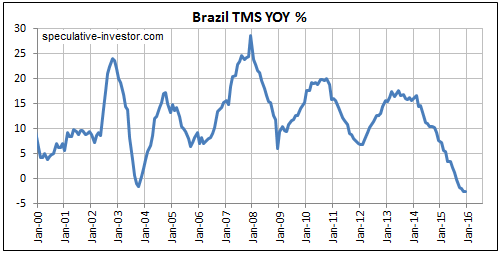
Brazil no longer has a monetary inflation problem. In fact, as depicted in the True Money Supply (TMS) chart below, it is now experiencing monetary DEFLATION.

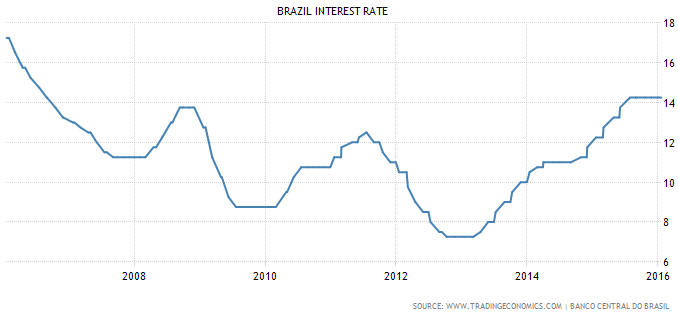
And yet, Brazil’s central bank is still ‘tightening the monetary screws’. As illustrated by the following chart, it moved its targeted interest rate to an 8-year high of 14.25% in mid-2015 and has kept it there.

Brazil_intrate_020316

The current situation in Brazil underlines the problem of having monetary central planners. Even the smartest and most incorruptible of central planners will make the economy less efficient, because the right level for a price is the price that would exist in the absence of government or central-bank interference. However, monetary central planners tend to make matters even worse by reacting to backward-looking economic data and to the lagged effects of earlier policies.

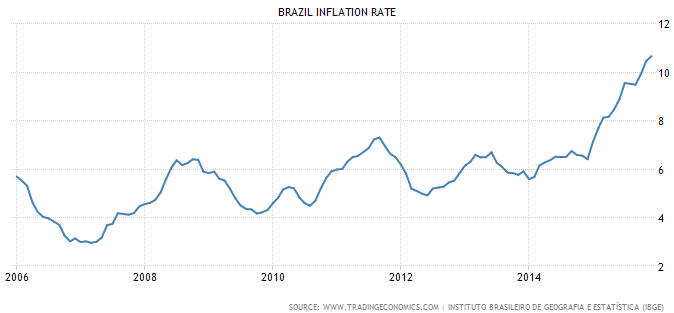
In Brazil’s case, rather than acknowledging the extreme current tightness of monetary conditions and acting accordingly, the central bank is fixating on the CPI, which is, in turn, accelerating upward due to the lagged effects of the monetary inflation that happened years ago. This is a good example of how central bankers not only fail in their self-proclaimed mission to smooth-out the business cycle, but also greatly amplify the economic oscillations.

Brazil’s experience over the past 10 years is another in a long line of real-world demonstrations of Austrian Business Cycle Theory. Rapid monetary inflation and the lowering of interest rates results in an artificial boom, during which the GDP numbers look good at the same time as wealth-destroying investing mistakes are being made on a grand scale. The boom sets the stage for a bust, which wipes out all of the preceding gains and then some.

Bad logic on trade

March 9, 2016

Although he could well be the least bad of the choices currently being offered to US voters (mainly because he would be less inclined towards “regime change” and bombing foreigners than the other choices), Donald Trump has made many ridiculous statements on the campaign trail. Examples include his proposal for a giant wall to stop Americans from escaping to Mexico (or the other way around, I can’t recall) and his idea about banning all Muslims from entering the US. The example that I’m covering in this post has to do with Trump’s comments on international trade. If he really believes what he is saying about trade deficits and tariffs (he might not — he might just be pandering to voters), then his economics knowledge is mindbogglingly inadequate.

I was prompted to write this post by the article linked HERE. This article reveals a surprisingly-good* understanding of economics. In particular, it makes the point that when it comes to trade, what’s commonly referred to as a “deficit” does not constitute a loss. A so-called deficit could actually be viewed as a benefit given that the side with the deficit is a net receiver of valuable goods in exchange for money that these days gets created out of nothing, although it makes more sense to view trade as a win-win situation.

By way of further explanation, if you shop at Walmart then you run a trade deficit with Walmart. Obviously, this is not a problem for you, otherwise you wouldn’t do it. It’s a case of you preferring some of the products on the shelves at Walmart over some of the cash in your wallet and Walmart preferring your cash to the products on its shelves. Walmart, in turn, runs a trade deficit with each of its suppliers for the same reason — one side of the transaction favours the product over the cash and the other side favours the cash over the product.

The point is that when a trade occurs it is illogical to think of the side that parts with money in exchange for goods or services as the loser.

Furthermore, despite the assertions of power-hungry politicians (is there any other kind?) to the contrary, the logic that applies to trading within national borders doesn’t magically cease to apply when the trade is conducted across borders. For example, if Bill and Fred are trading with each other, the trade doesn’t change from being a net positive or a non-issue when they are both in the US to a national problem when Bill steps across the border into Canada.

But isn’t it the case that every dollar that flows out of the country due to a trade deficit is a dollar less of spending within the domestic economy, which, in turn, leads to a weaker domestic economy and higher unemployment?

According to neo-Keynesian orthodoxy the answer is yes, but the correct answer is no. In reality, every dollar that flows out due to a trade deficit eventually returns as some form of investment. That’s why the $500B+ annual US trade deficit has not reduced the US money supply. As Joseph Salerno explains in a 2014 article, trade-deficit dollars get invested by foreigners in US stocks, bonds, real estate such as buildings and golf courses, and financial intermediaries like banks and mutual funds, with many of the dollars ultimately being lent to or invested in US businesses. These businesses then spend the dollars on paying wages and buying real capital goods like raw materials, plants, equipment and software.

The point is that the flow of spending in the US economy is not diminished by a negative trade balance, but merely re-routed. There will be a redirection of labor and capital out of export industries into industries producing consumer and capital goods for domestic use, with no net loss of jobs.

A net loss of jobs will, however, come about due to the policies such as tariffs and currency devaluation that are put in place to ‘fix’ a perceived trade-deficit problem. Tariffs simply impose an additional cost on a large group of consumers for the benefit of a small number of producers, resulting in a net loss to the economy by supporting inefficient businesses and reducing the amount that consumers can spend elsewhere.

In conclusion, the idea that the government should act to make it more expensive for its own citizens to purchase goods that are made in other countries is so transparently stupid it’s difficult for me to understand how such actions can be advocated with a straight face.

*I expect to find the application of good economic theory at sites such as mises.org and davidstockmanscontracorner.com, but I’m always surprised when I find it in articles at mainstream websites such as Yahoo Finance.

Latest thoughts on Bitgold/Goldmoney

March 4, 2016

There have recently been far more than the normal number of interesting trading opportunities in the stock market, causing me to be busier than usual. This is due to the time involved in researching the larger number of opportunities with the aim of deciding what to present in the weekly TSI reports and what to do with my own money. I’m not complaining; this is just a roundabout way of explaining why I’ve posted less at the blog over the past two weeks, why this post on Goldmoney will not be as detailed as originally intended, and why blog posts could be sparse over the next few weeks. As a non-profit enterprise conducted mostly for fun, the blog necessarily plays second fiddle to preparing the TSI reports and planning/executing my own trades.

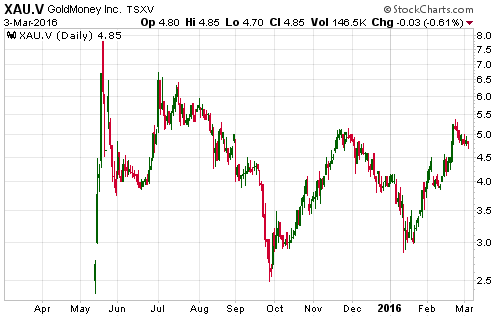
Getting to the point, here’s how I concluded my last post on Goldmoney (XAU.V): “At this stage I don’t have enough information to value Goldmoney, although I suspect that ‘reasonable value’ is a long way below the current price. I’ll post some updated thoughts when I have a clearer view of what the stock is worth, which might not be until February next year. In the meantime I’ll stay away. I have no desire to own the stock and, despite the apparent valuation-related downside risk, no desire to short the stock.” More information about Goldmoney’s financial performance has since become available.

I currently don’t have the time to go through the information in detail, but a cursory look at the company’s latest financial statements confirms my earlier impression that Goldmoney will have trouble making a profit. It made another loss in the final quarter of last year and continues to consume cash.

From the perspective of a Goldmoney user, the business is great. Customers can store gold, use gold as a medium of exchange and even take delivery of physical gold in manageable quantities, all at a low (or no) cost. From the perspective of a Goldmoney shareholder, however, the business is not so great. Of particular significance, unlike a mutual fund that charges a fee based on AUM (Assets Under Management), Goldmoney charges nothing to store its customers’ assets (gold bullion). This means that the larger the amount of Goldmoney’s AUM, the greater the net cost to the owners of the business (Goldmoney’s shareholders).

It’s important that under the current fee structure, Goldmoney will generally lose money on customers who use the service primarily for store-of-value purposes. This is where PayPal has a big advantage over Goldmoney. Nobody views their PayPal account as a long-term store of value. Instead, they view it as short-term parking for money to be spent, and when the money is spent PayPal usually gets a commission. This results in PayPal being very profitable, with earnings of US$1.2B (US$1.00/share) in 2015. Many of Goldmoney’s customers, however, view the service as a convenient way to store their physical gold. They don’t want to spend their gold, they want to save it.

Based on what I’ve seen to date I continue to believe that Goldmoney offers a great product, but is operating an inherently low-margin business deserving of a low valuation. Use the service, but don’t buy the stock.

XAU_030316

Gold and Confidence

March 1, 2016

This post is a modified excerpt from a recent TSI report.

A point I’ve made many times in TSI commentaries over the years is that the major trends in gold’s relative value have nothing to do with what most people think of as “inflation” (a rising CPI). They are, instead, driven by shifts in how the financial establishment (the central bank plus the commercial banks) is perceived and by shifts in the perception of economic growth prospects. In more general terms, they are driven by shifts in confidence. There are times when a substantial decline in confidence is related to rising inflation expectations, but in developed economies there are more times when it isn’t. And even when it is, it’s not really the decline or the expected decline in the purchasing power of money that results in a greater desire to own gold; it’s the belief* that the stewards of the monetary system are losing control.

The happenings of the past three months constitute an excellent example. Inflation expectations were low when gold began to turn upward in December and if anything are even lower now, but over the past several weeks we had a very fast rally in the real gold price. It should be clear to any knowledgeable observer that the rally had absolutely nothing to do with fear of “CPI inflation”. Rather, it was driven by the combination of fear that the economically-destructive insanity known as Negative Interest-Rate Policy (NIRP) will spread to the US and fear of banking collapse in Europe.

Everything that the world’s most important central banks are doing is based on logical conclusions drawn from false premises. The false premise upon which interest-rate suppression is based is that economic growth is caused by borrowing and consumption. The reality is that saving is the foundation of sustainable economic growth. By pursuing policies that punish saving and reward borrowing, central banks set the scene for slower economic progress.

Now, progress-hindering monetary policy is not something new. It has been the order of the day for a very long time, but it has never before been taken to such extremes. Moreover, senior central bankers are making it crystal clear that they are not close to being done — that they are ready and willing to continue along the current path if the relentless beatings fail to lift morale — even though it is becoming more obvious by the day that the unconventional monetary policies have hurt far more than helped.

The upshot is that today’s central bankers are completely stupid, where stupid is defined as having an unwitting tendency towards self destruction**. Unfortunately, due to their immense power these men and women are taking entire economies along for the ride. The gradual dawning that this is happening is why gold is getting more popular.

*Central banks and governments never had genuine control, but there has been widespread BELIEF over the past several years in the abilities of central banks to create stronger economies.

**The Doug Casey definition.

An oil glut doesn’t preclude an oil price bottom

February 23, 2016

This blog post is a modified excerpt from a 17th February TSI commentary.

I don’t need to read/watch the news to know that the supply-demand backdrop remains unsupportive for the oil price. All I have to do is look at the spread between spot prices and futures prices in the oil market. The larger the contango, that is, the higher the futures price relative to the spot price, the more abundant the current supply and the less price-supportive the so-called ‘fundamentals’.

As recently as a few days ago, oil for delivery in July-2016 was $6.40/barrel, or about 20%, more expensive than oil for immediate delivery onto the cash market. This was very unusual. It meant that if someone could buy physical oil and store it cheaply they could make a risk-free annualised return of almost 40% by simultaneously selling July futures contracts. The reason that every man and his dog was not eager to do this trade is that the cost of storing oil is now so high that even a contango that represents a potential 40% annualised return on a physical-futures arbitrage is not very profitable. And the reason that the cost of storing oil is now so high is that there is a much-greater-than-normal amount of oil already in storage.

Unfortunately, knowing that there is an oil glut and, therefore, that the ‘fundamentals’ remain bearish doesn’t tell us what will happen to the oil price in the future. This is because the bearish fundamentals are very well known and are factored into the current price. It is also because the fundamentals are always bearish at major price bottoms in commodities markets.

I suspect that the oil price is now close to a major bottom. This is because at its recent low the “inflation”-adjusted oil price was below its 1986 bottom and almost as low as its 1998 bottom (the two lowest points of the past 40 years). It is also because if stock markets have made long-term peaks then the commodities markets are likely to be among the main beneficiaries of future monetary inflation.

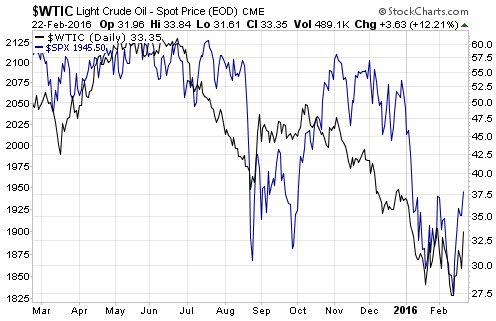
However, it’s very unlikely that there will be a ‘V’ bottom in the oil market. Considering the short-term positive correlation between the oil price and the S&P500 Index (see chart below) and the well-known bearish fundamentals, it’s more likely that the oil market will build a base this year involving a Q1 bottom and one or two successful tests of the bottom.

oil_SPX_220216

The “Streetlight Effect” in the gold market

February 22, 2016

In an old joke, a policeman sees a drunk searching for something under a streetlight and asks what he has lost. The drunk says that he lost his keys, and they both start looking under the streetlight together. After a few minutes the policeman asks the drunk if he is sure he lost them here, and the drunk replies, “no, I lost them in the alley”. The policeman then says “so why are you looking here?”, and the drunk replies, “because this is where the light is”. This joke led to the name “Streetlight Effect” being given to a psychological tendency for people to look for clues where it is easiest. Many gold-market analysts have obviously succumbed to this psychological tendency.

It is obvious that many gold-market analysts have succumbed to the “Streetlight Effect” because they fixate on a tiny fraction of the overall gold supply and they do so because this tiny fraction of the overall supply is where the well-defined numbers are. The rest of the supply, which probably accounts for at least 90% of the total, is ignored because its location can’t be pinpointed and its size can’t be accurately measured. In effect, due to a lack of definitive data they make the assumption that the bulk of the world’s gold supply doesn’t exist. No wonder their supply-demand analyses don’t make sense.

To be more specific, there are many gold-market analysts who focus on the amount of gold produced by the mining industry, the amount of gold in COMEX warehouses, the publicly-reported warehouse stocks in London and the bullion inventories of gold ETFs, as if the sum of these quantities was a reasonable estimate of the world’s total amount of gold in saleable form. This is a huge mistake. Furthermore, they assume that once gold leaves a warehouse for which there are publicly-reported numbers the gold effectively ceases to exist, as if it has evaporated into the air. However, it is far more reasonable to assume that almost every ounce of gold that leaves a publicly-reported inventory remains part of the total supply.

In any case and as I explained last week, even if the “Streetlight Effect” didn’t apply and the location of every ounce of aboveground gold was known, the information wouldn’t tell us anything about the price and therefore wouldn’t be useful from an investing/speculating perspective.

Can a US recession occur without an inverted yield curve?

February 19, 2016

This blog post is a modified excerpt from a recent TSI newsletter.

One of the bullish arguments on the US economy and stock market involves pointing out that a) the yield curve hasn’t yet signaled a recession, and b) the historical record indicates that recessions don’t happen until after the yield curve gives a warning signal. This line of argument arrives at the right conclusion for the wrong reasons.

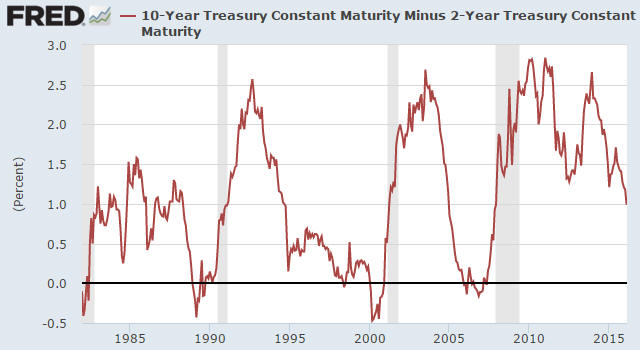
The bullish argument being made is that every recession of the past umpteen decades has been preceded by an inverted yield curve (indicated by the 10-year T-Note yield dropping below the 2-year T-Note yield). The following chart shows that while the yield curve has ‘flattened’ (the 10yr-2yr spread has decreased) to a significant degree it is still a long way from becoming inverted (the yield spread is still well above zero), which supposedly implies that the US economy is not yet close to entering a recession.

The problem with the argument outlined above is that it doesn’t take into account the unprecedented monetary backdrop. In particular, it doesn’t take into account that as long as the Fed keeps a giant foot on short-term interest rates it will be virtually impossible for the yield curve to invert. It should be obvious — although to many pundits it apparently isn’t — that the Fed can’t hold off a recession indefinitely by distorting the economy’s most important price signal (the price of credit), that is, by taking actions that undermine the economy.

The logic underpinning the bullish argument is therefore wrong, but it’s still correct to say that the yield curve hasn’t yet signaled a recession. The reason is that an inversion of the yield curve has NEVER been a recession signal; the genuine recession signal has always been the reversal in the curve from ‘flattening’ (long-term interest rates falling relative to short-term interest rates) to ‘steepening’ (long-term interest rates rising relative to short-term interest rates) after an extreme is reached. It just so happens that under more normal monetary conditions, an extreme isn’t reached and the reversal therefore doesn’t occur until after the yield curve becomes inverted.

This time around the reversal will almost certainly happen well before the yield curve becomes inverted, but it hasn’t happened yet.

Changes in gold location say nothing about the gold price

February 16, 2016

It’s amazing how much time and effort is spent by some analysts in attempting to track the movements of gold between locations. It’s amazing because such analysis provides no useful information about price, that is, such analysis has no practical value for speculators and investors.

Regardless of whether the gold price is in a rising trend or a falling trend, some parts of the world will be net buyers and other parts of the world will be net sellers. Furthermore, the amount of gold being shifted between sellers and buyers could rise or fall during a rising price trend or a falling price trend. To put it more succinctly: transaction volume does not indicate price direction.

Consequently, even if it were possible to track all of the movements in gold that were happening throughout the world every day, the resulting data would not provide reliable clues about the future change in the gold price. In fact, the data wouldn’t even do a good job of explaining past changes in the gold price. And in any case, accurately tracking the movements of gold is not remotely close to being possible.

A common mistake is to fixate on the gold being stored in LBMA and COMEX inventories, as if these publicly-reported warehouse stocks represented the total amount of privately-held gold in saleable form. A related mistake is to assume that when gold is shifted out of a publicly-reported inventory it has effectively been taken off the market and is no longer part of the available supply.

In reality, the bulk of the world’s privately-held gold in readily-saleable form will NEVER be part of a publicly-reported inventory. That’s due to the perceived nature of gold. Many people own gold for store-of-value or financial-safety purposes and do not want to report their ownership, especially to governments. On a related point, just because gold has been removed from an LBMA or a COMEX warehouse and can no longer be tracked by the likes of Gold Fields Mineral Services (GFMS) does not mean that the gold is no longer part of the supply-demand equation. It is still available; it’s just that you, the analyst, have no way of knowing where it is.

Gold-market analysts should accept reality and stop pretending that the supply of gold is limited to the amount that they can pinpoint.

There is nothing inherently wrong with market manipulation

February 15, 2016

The financial markets have always been manipulated and always will be manipulated. They are manipulated when they are free and they are manipulated when they are heavily regulated by government. If you choose to be involved in the markets, you should accept this reality. If you cannot accept this reality then you should get out of the markets and never return. If you try to change this reality by advocating greater government regulation of the markets then you are part of the problem.

Manipulating a market involves attempting to give yourself an advantage by encouraging the price to move higher or lower. For example, if you wanted to buy you would possibly try to create the impression that there is greater supply than is actually the case, prompting other traders to sell and causing the price to decline. If you wanted to sell you would possibly try to create the impression that there is greater demand than is actually the case, prompting other traders to bid-up the price. Whether currently legal or not, there is nothing ethically wrong with private entities using such tactics*.

A hundred years ago the manipulation of market prices was generally not considered to be unfair. In fact, highly-respected traders such as Jesse Livermore would sometimes be hired for the purpose of manipulating a market in such a way as to allow a large position to be either bought or sold at a better price than could otherwise be achieved. The best traders could do this by selling and buying in such a way as to create a false impression of the underlying market strength in the minds of other traders.

These days, governments are heavily involved in the financial markets in an effort to create a “level playing field”. As a result, the average investor has never before been at such a disadvantage. Rather than the likes of Jesse Livermore manipulating prices of individual securities from time to time, we now have central bankers treating the major financial markets as if they were puppets that could be moved in any desired way by pulling the right strings.

Never before have prices in the financial markets been so distorted and deceptive, but people now feel more secure because it is clear that the government and its agents are hard at work ensuring that nobody can take advantage of anbody else. Moreover, whenever anything goes wrong in the markets the popular outcry is: “The government oughta do something!” So, everytime something goes wrong and a lot of people lose money it creates the justification for even greater regulation with the stated goal of making the markets safer.

A lot of people are horrendously misguided. They believe that the right government regulations are needed to create a free market, but this only demonstrates that they have absolutely no idea what a free market is. A genuinely-free market is one that is devoid of government intervention. As soon as the government starts regulating a market, the market is no longer free. The greater the regulation, the less free the market.

Is there a reason to be optimistic that a shift towards freer markets lies in the not-too-distant future?

Unfortunately, no, because very few people are prepared to give up even an ounce of perceived security to gain a pound of additional freedom.

*Note: Not all actions that fall under the “manipulation” umbrella are ethical. For example, whether legal or not, it would generally not be ethical for a bank or broker to front-run the orders of its customers if doing so resulted in the customers getting a worse price. Such actions are a breach of trust and/or fiduciary duty. Also, regardless of whether or not its purpose is price manipulation, government involvement in the financial markets is generally unethical because governments operate with stolen money.

Gold versus silver during bull markets

February 10, 2016

This post is a modified excerpt from a recent TSI report.

A popular view is that silver outperforms gold during bull markets for these metals, but that’s only true if the entire bull market is considered. That is, it’s true that silver has in the past achieved a greater percentage gain than gold from bull-market start to bull-market end. However, since the birth of the current monetary system the early stages of gold-silver bull markets have always been characterised by relative WEAKNESS in silver.

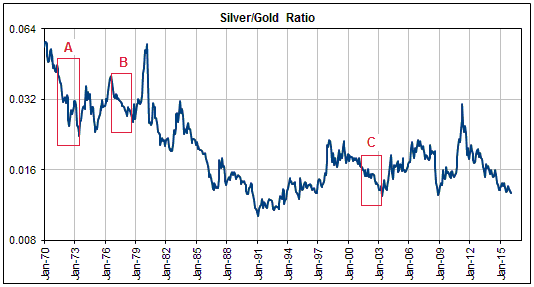
To check that this is, indeed, the case, refer to the following long-term chart of the silver/gold ratio. The boxes labeled A, B and C on this chart indicate the first two years of the cyclical precious-metals bull markets of 1971-1974, 1976-1980 and 2001-2011, respectively. Clearly, silver underperformed gold during the first two years of each of the last three cyclical precious-metals bull markets that occurred within secular bull markets. Therefore, assuming that a gold bull market has either just begun or will soon begin, on what basis should we expect to see persistent and substantial strength in silver relative to gold over the coming 1-2 years?

The one plausible answer to the above question is that the scope for additional weakness in silver relative to gold has been greatly diminished by the extent to which silver has already fallen relative to gold. In particular, in gold terms silver is now almost as cheap as it was in early-2003 (2 years into the most recent previous bull market), which means that it is close to its lowest price of the past 20 years. Silver is also now vastly cheaper relative to gold than it was when cyclical bull markets were getting underway in 1971 and 1976.

In summary, history tells us to expect continuing weakness in silver relative to gold during the first two years of the next precious-metals bull market (which has possibly just begun), whereas the unusually-depressed current level of the silver/gold ratio suggests that the historical precedents might not apply this time around.

I don’t have a strong preference either way.

The US government debt held by the Fed is interest free

February 8, 2016

There are things that monetary enthusiasts* such as me take for granted that are not widely understood. In an email discussion with a friend and fellow monetary enthusiast it occurred to me that the treatment of interest paid on the debt held by the Fed might be one of those things. That’s the reason for this short post.

The Fed currently has about 4.2 trillion dollars of debt securities on its balance sheet, about 2.5 trillion dollars of which are US Treasury securities. The interest that the Fed earns on all of its debt securities — less a relatively small amount to cover the Fed’s own operating expenses — gets paid into the General Account of the US Treasury. In other words, the interest that the US government pays on the Treasury bonds, notes and bills held by the Fed gets returned to the government. This effectively means that any US government debt held by the Fed is interest free.

An implication is that if government debt is held by the Fed, the interest rate on the debt is irrelevant. An interest rate of 20% is essentially no different to an interest rate of 1%, since whatever is paid by the government returns to the government.

Another implication is that when considering what-if interest-rate scenarios and the ability of the US government to meet its financial obligations under the different scenarios, the assumption should be made that the portion of the debt held by the Fed has an effective interest rate of zero. For example, let’s say that at some point in the distant future the average interest rate on the US government’s debt has risen to 10% and the Fed owns 80% of the debt. In this hypothetical — but not completely farfetched — situation, the effective average interest rate on the US government’s debt would only be 2%.

The bottom line is that it’s not so much the Fed’s interest-rate suppression that benefits the US government, it’s the fact that the interest-rate suppression is conducted via the large-scale accumulation of the government’s debt.

* People who spend significant time every week tabulating/charting monetary statistics and poring over reports published by the US Federal Reserve and other central banks.

Explaining gold’s relative expensiveness

February 5, 2016

In the blog post “Some gold bulls need a dose of realism“, I noted that relative to the Goldman Sachs Spot Commodity Index (GNX) the gold price was at an all-time high and about 30% above its 2011 peak. I then wrote: “Rather than imagining a grand price suppression scheme involving unlimited quantities of “paper gold” to explain why gold isn’t more expensive, how about trying to explain why gold is now more expensive relative to other commodities than it has ever been.

A rational explanation of gold’s relative expensiveness begins with the premise that major trends in the gold/commodity ratio are invariably associated — in an inverse manner — with major trends in economic confidence. Since credit spreads are one of the best indicators of economic confidence, with generally-widening credit spreads signifying declining confidence and generally-narrowing credit spreads signifying rising confidence, it would be logical if there were a positive correlation between the gold/commodity ratio and credit spreads. As evidenced by the following chart, that’s exactly what there is.

goldGNX_IEFHYG_030216

The current widening trend for credit spreads dates back to mid-2014, which is when the oil price began to trend downward and obvious cracks began to appear in the global growth theme. More recently, cracks began to appear in the US growth theme and the pace of credit-spread widening accelerated, leading to an accelerated rise in the gold/commodity ratio.

Could gold become even more expensive relative to commodities in general? The answer is yes, but only if economic confidence continues to decline.

I doubt that the decline in economic confidence has run its course, so I expect the gold/commodity ratio to move further into new-high territory before something more important than a short-term top is put in place. However, there’s a good chance that the gold/commodity ratio will make a multi-year peak this year, due mainly to increasing strength (catch-up moves) in other commodities.

A chart that refutes the gold price suppression story

February 2, 2016

The assertion that the gold price has been successfully manipulated downward over a great many years via the relentless selling of “paper gold” contains more than a few logical and factual holes. In this brief post I’m going to highlight one of these holes.

Before I get to the main point, it’s worth pointing out that in order to sell “paper gold” there must be demand for “paper gold”, since demand for physical gold cannot be satisfied with paper claims. It is also worth pointing out that downward pressure on the price of “paper” gold that was not supported by the “physical” market would inevitably result in the price of “paper” gold making a sustained and substantial move below the price of the physical commodity, which hasn’t happened. Over the past several years the prices of gold futures contracts have generally been very close to the spot price and there have been regular small dips in futures prices to below the spot price, but this situation is a natural and predictable effect of the Fed’s unnatural zero-interest-rate policy. Taking the US$ interest-rate backdrop into account, the price of “paper” gold has generally not been lower relative to the price of physical gold than a knowledgeable observer would expect.

The main point of this post is that while gold is different from other commodities, under the current monetary system the price of gold should never become completely divorced from the prices of other commodities. In particular, the price of gold should always remain within certain bounds relative to the price of platinum.

Now, the platinum market effectively ‘lives from hand to mouth’, in that the bulk of the current year’s consumption will be satisfied by the current year’s production. It should therefore be obvious to anyone with a modicum of objectivity that it isn’t possible to manipulate the platinum price downward, beyond brief fluctuations, by selling paper claims to the commodity. As a result, the multi-decade high in the gold/platinum ratio illustrated by the following chart is evidence that if there has been a concerted attempt to suppress the gold price, it has been ineffective to put it mildly.

gold_plat_010216

I’ve come to understand that adopting the view that the gold market has been subject to a successful and long-term price suppression scheme is like adopting a child — it’s a lifetime commitment through thick and thin. I therefore don’t expect to change anyone’s opinion on this topic, but I’m hoping that some readers still have open minds.

The COMEX inventory nonsense continues

February 1, 2016

A ridiculous fuss continues to be made in some quarters about the ratio of “registered” COMEX gold to total futures open interest. For example, a 26th January ZeroHedge article includes the following chart and implies that the high (542:1) ratio of open interest to “registered” gold could soon result in a COMEX default. To put it politely, this is unadulterated hogwash.

As explained HERE, the ratio cited in the above-linked article is meaningless, and, in any case, there are now about 15 ounces of physical gold in COMEX warehouses for every ounce that will potentially have to be delivered during the current delivery month. And as explained HERE, converting “eligible” gold to “registered” gold is a quick and easy process.

Don’t be taken in by what are either deliberately misleading presentations of COMEX data or blatant displays of ignorance regarding how the commodity exchange works.

What do changes in GLD’s bullion inventory tell us about the future gold price?

January 30, 2016

Physical gold ‘flowing’ into GLD and the other gold ETFs does not cause the gold price to rise and physical gold flowing out of gold ETFs does not cause the gold price to fall. The cause and effect actually works the other way around, with the price change being the cause and the flow of gold into or out of the ETFs being the effect. I’ve covered the reasons before (for example, HERE and HERE), but cause and effect are regularly still being mixed up in gold-related articles so I’m revisiting the topic.

The Net Asset Value (NAV) of a gold ETF such as GLD naturally moves up and down by the same percentage amount as the gold price, so a change in the gold price will not necessarily require any change in the size of GLD’s bullion inventory. It’s only when GLD’s market price deviates from its own NAV that a change in bullion inventory occurs. For example, assume that the gold price gains 10%. In this case, GLD’s NAV will gain 10% and there will be no increase or decrease in GLD’s inventory as long as GLD’s market price also rises by 10%. However, if GLD’s market price rises by 11% then gold will be added to the ETF’s inventory to bring its market price and NAV back into line, and if GLD’s market price rises by only 9% then gold will be removed from the ETF’s inventory to bring its market price and NAV back into line.

Note that the manager of the ETF doesn’t have to initiate anything in the above-described process. The ETF’s Authorised Participants (APs) initiate the process in order to generate arbitrage profits. More specifically, a deviation between market price and NAV creates an opportunity for the ETF’s APs to pocket risk-free profits by selling or buying gold bullion and simultaneously buying or selling ETF shares.

All ETFs work the same way. That is, there’s nothing special about the way GLD works. The modus operandi ensures that the market prices of ETFs usually track their NAVs very closely.

Why, then, does the following chart show a long-term positive correlation between the gold price and GLD’s bullion inventory?

Because traders of GLD shares tend to get more optimistic about gold’s prospects and buy more aggressively AFTER the gold price has risen, causing GLD’s market price to rise relative to its NAV and prompting arbitrage that results in the addition of bullion to the ETF’s inventory. And because traders of GLD shares tend to become more pessimistic about gold’s prospects and sell more aggressively AFTER the gold price has fallen, causing GLD’s market price to fall relative to its NAV and prompting arbitrage that results in the removal of bullion from the ETF’s inventory. The correlation is far from perfect, because GLD traders won’t always become increasingly optimistic in reaction to a price rise or increasingly pessimistic in reaction to a price decline.

gold_GLDinv_280116

A final point worth making is that the annual change in GLD’s bullion inventory has always been very small relative to the total size of the gold market. Given the size of the total aboveground gold supply, there is very little chance that a few hundred tonnes per year moving into or out of GLD’s coffers could have a significant effect on the price.

So, the answer to the question “What do changes in GLD’s bullion inventory tell us about the future gold price?” is: nothing.

The original Fed versus today’s Fed

January 26, 2016

In a recent blog post, Martin Armstrong wrote: “This constant attack on central banks is really hiding what the problem truly is — government. When the Fed was created, it “stimulated” the economy by purchasing corporate paper. The Fed was NEVER intended to buy government bonds. The politicians did that for World War I and never returned it to its purpose.” That’s not entirely true. Also, it’s naive to believe that the Fed would benefit the overall economy if it were restricted to its originally-intended purpose.

Contrary to Mr. Armstrong’s assertion, the Federal Reserve Act of 1913 actually does enable the Fed to buy government paper. Specifically, Section 14 of the Act states:

Every Federal reserve bank shall have power … [to] buy and sell, at home or abroad, bonds and notes of the United States, and bills, notes, revenue bonds, and warrants with a maturity from date of purchase of not exceeding six months, issued in anticipation of the collection of taxes or in anticipation of the receipt of assured revenues by any State, county, district, political subdivision, or municipality…

More generally, the Federal Reserve Act gave Federal Reserve banks the power to purchase short-term commercial paper (bills of exchange) and short-term government paper, and to set the discount rates associated with these purchases.

Secondly, the whole concept of economic stimulation by central banks in general and the Fed in particular is one of world history’s greatest-ever cases of mission creep. A central bank cannot possibly stimulate an economy by lowering interest rates and creating money; all it can do is distort an economy and exacerbate the boom-bust cycle. Although the theoretical framework had not yet been fully developed by the likes of Ludwig von Mises, this was generally known by economists at the time of the Fed’s establishment in 1913 and explains why there was no mention in the Federal Reserve Act of the Fed taking actions in an effort to modulate the pace of economic growth. Unfortunately, economics is the one science that has taken a giant step backwards over the past 100 years. Whereas there was originally no intention of having the Fed interfere with market rates of interest and react in a counter-cyclical manner to shifts in economic activity, most economists can no longer even envisage an economy that is free from central-bank manipulation.

Thirdly, while it would be a great improvement if the Fed were limited by the rules that originally governed its actions, it is important to understand that the problems (the periodic bank runs and financial crises) that the Fed was set up to address are the result of fractional reserve banking. Rather than eliminate fractional reserve banking, which would have been the correct solution, a central bank was established as a work-around. This is mainly because some of the most powerful and influential people in the country were bankers. Not surprisingly, most bankers like having the legal power to create money out of nothing.

My final point is that the Federal Reserve Act of 1913 was a foot in the economic door. Once the foot was in the door it was always going to be just a matter of time before the entire body had wormed its way in. The reason is that the powers of central banks grow in the same way as the powers of governments, with each intervention leading to problems that create the justifications for more interventions and with the occasional crisis providing the justification for a quantum leap in power. To put it succinctly, the mission creep was inevitable.

How much longer will the gold-mining bear market last?

January 25, 2016

(This post is an excerpt from a recent TSI commentary.)

Intermediate-term rallies in the gold-mining sector can happen during general equity bull markets and general equity bear markets, but on a long-term basis the gold-mining sector trends in the opposite direction to the broad stock market. An implication is that to get a new bull market in gold-mining stocks there will probably have to be a new broad-based equity bear market.

A good argument could be made that an equity bear market got underway last July, but at this stage the vast majority of market participants still believe that the bull market is intact. In general, people are very nervous about the short-term while remaining optimistic about the stock market’s long-term prospects. What would shake the long-term optimism of a critical mass of investors?

Based on what happened in 2000, an SPX break below the August-2015 low that was not quickly reversed would probably do it. This is the point we are trying to make with the following chart comparison. The chart compares the HUI and the SPX during the 12-month period beginning March-2000, or the 12-month period commencing just prior to the start of a cyclical stock-market decline.

Notice that the SPX bear market began with a sharp decline from a March high to an April low, after which there was a 4-5 month period of choppy trading that resulted in a test of the March high. At the time the March high was being tested hardly anyone believed that a bear market was underway. The market then began to trend downward and in October the SPX traded below its April low, but the downside breakout was quickly negated and there was a collective sigh of relief. It was still apparent to almost all market participants that they were dealing with a bull-market correction. Then, in November, the SPX again breached its April low and the breakout was not quickly negated. This was the point of recognition — the point when a critical mass of investors came to suspect that an equity bear market was in progress. This was also the point when the gold-mining sector commenced a bull market.

One of the reasons that the bear market in the gold-mining sector has been unusually long is that the general equity bull market has been unusually long. The general equity bull market is probably over, but very few people know it yet. Enough people to provoke a major trend change in the gold-mining sector will probably know it after the SPX makes a sustained break below the August-2015 low.