Natural Gas is very expensive AND very cheap

November 17, 2026

[This blog post is an excerpt from a recent commentary at https://speculative-investor.com/]

In the 21st October Interim Update, we noted that the price of Natural Gas (NG) in the US was less than one-tenth the price in Europe and Asia, creating a huge incentive to export Liquefied Natural Gas (LNG) from the US. Since then, the price differential has become even more extreme, with the following Bloomberg chart showing that the price of NG in Western Europe and Asia recently was 12-times the price in the US, a new all-time high for the ratio. This is magnifying the incentive to ship LNG from the US to Europe and Asia.
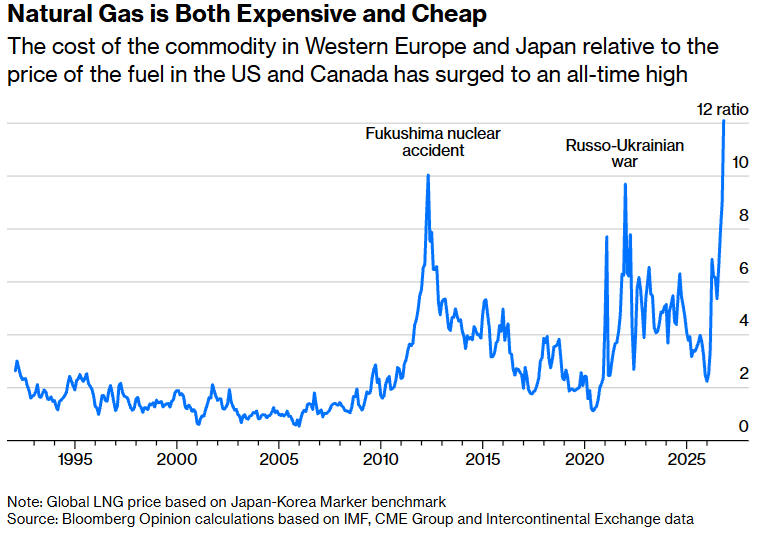
It is reasonable to assume that any NG that can be shipped out of the US is being shipped out, with LNG export capacity imposing rigid limits on the amount that is shipped. These limits will, however, rise over the next two years.

Specifically, it is expected that the US will add about 9.5 billion cubic feet/day (Bcf/d) of LNG export capacity during 2027-2028, increasing the total LNG export volume by more than 50% to 27 Bcf/d. Putting this into perspective, total US NG production will average about 113 Bcf/d in 2026, so the expected 2027-2028 addition to LNG exports would absorb about 8% of total current supply. This constitutes a significant reduction in the amount of NG that will be available to the domestic market and should help to reduce the international price gap highlighted above, but note that the bulk of the new capacity under development won’t become operational until the first half of 2028. The 2027 addition is expected to be a relatively modest 1.5 Bcf/d.

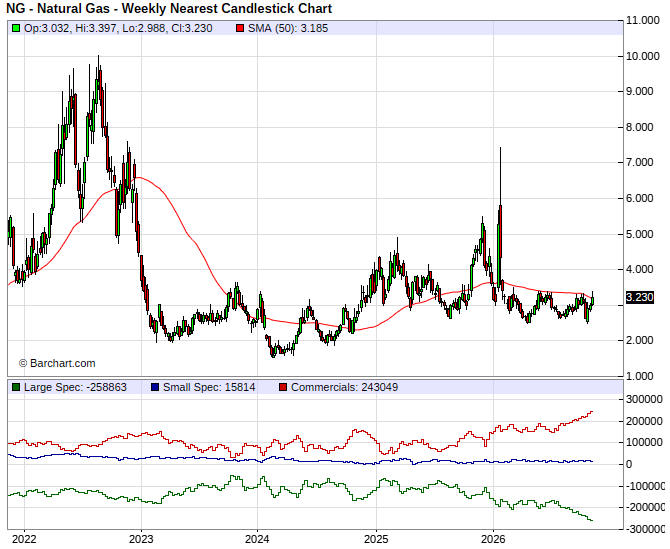
The main reason that there could be a meaningful rise in the US NG price in the short-term is the unusually large speculator short position in the futures market. As illustrated by the red line in the lower section of the following weekly chart, commercial traders collectively have by far their largest net-long position in NG futures of the past five years, meaning that speculators collectively have by far their largest net-short position in NG futures of the past five years.

Speculators are betting aggressively that due to the strong El Niño, the coming US winter will be very mild. This probably will be the case, but it creates the potential for even an average winter cold spell to ignite a substantial rally.

We’ll end this NG discussion by pointing out that on a continuous contract basis, the 50-week MA (the red line in the upper section of the following chart) has capped every rally in the NG price since early this year. Therefore, a solid weekly close above this MA would suggest that a larger-degree rally had begun.
Copper and tin production problems

November 2, 2026

[This blog post is an excerpt from a recent commentary at https://speculative-investor.com/]

Chile is by far the world’s largest copper-producing country, accounting for about 23% of global production. After that we have the Democratic Republic of the Congo (DRC) and Peru. Together, these three countries account for almost 50% of global copper production, a potential major problem in the making.

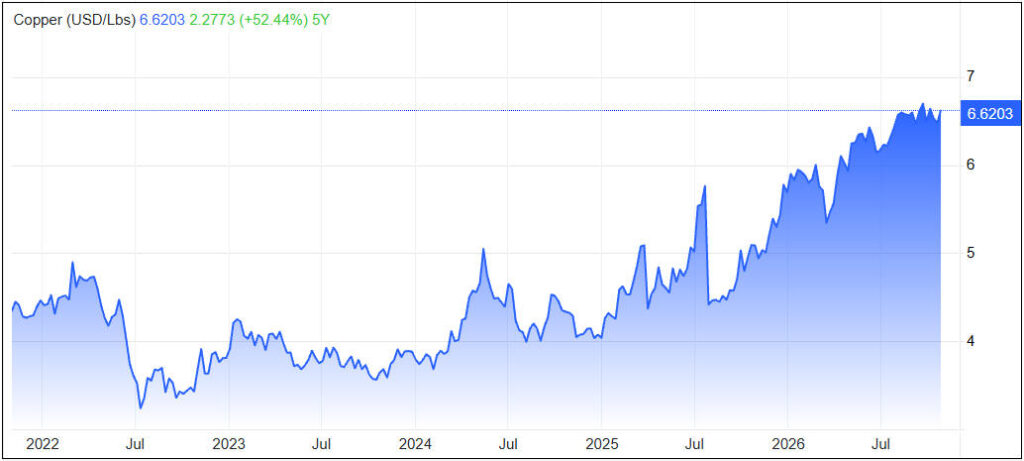
As discussed in the article posted HERE, the output of Chile’s copper mines is projected to fall 8%-9% this year, which would make 2026 the weakest year for this country’s copper production in at least two decades. Also, the article notes that the slump in Chilean copper production “adds to a string of mine disappointments around the world that have opened the door to the first annual decline in global mined-copper output since 2017, just as demand strengthens with increased investment in data centers and power infrastructure.”

One of the reasons for this year’s decline in Chile’s copper production, and a reason why this country’s production likely will be sub-par again next year, is the Super El Niño. As discussed HERE, “El Niño is weakening the high-pressure system that normally keeps storms away from central Chile, allowing more rain-bearing fronts into the region.” Previously we have focussed on the adverse effects of the Super El Niño on agriculture, but in Chile it also is adversely affecting mining. There may be similar issues in Peru, the world’s third-largest copper-producing country, but even if its copper mines are not impacted by extreme El Niño weather it appears that Peru’s copper production has plateaued.

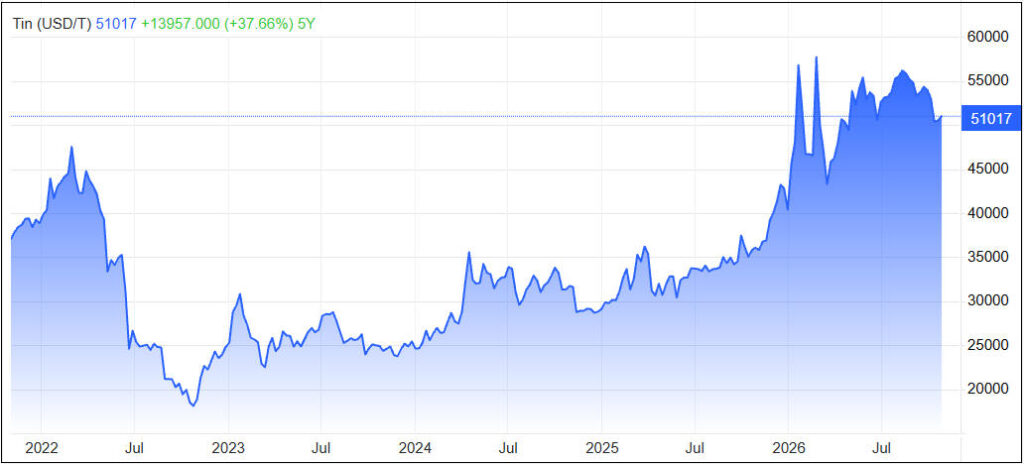
In the DRC, the world’s second-largest copper-producing country, there could be weather-related reductions to copper output associated with the Super El Niño, but the main threat at the moment is that the country is in the midst of the fastest-growing Ebola outbreak in its history, with more than 10,000 confirmed cases to date. In addition to being a major copper-producing country, the DRC is a major producer of tin, another metal that is critical for the datacentre building boom.

There have been large corrections in the prices of some industrial metals over the past several months, but the following charts show that the prices of copper and tin remain near their highs. This is most likely because production constraints associated with weather and disease are preventing relatively high prices from causing an adequate supply response to rising demand.

We would be bullish on the multi-year prospects for copper and tin based solely on projected demand growth, but adding the aforementioned production problems into the mix makes us even more so.