
The Fed versus the Market

July 25, 2017

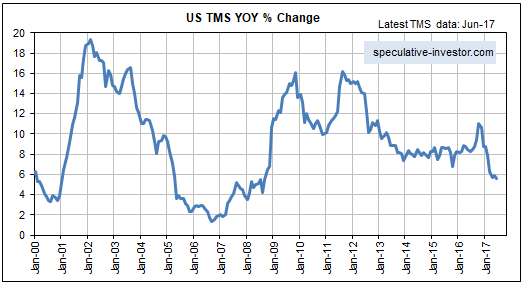
The following monthly chart shows that the year-over-year (YOY) growth rate of US True Money Supply (TMS) made a multi-year peak in late-2016 and has since fallen sharply to an 8-year low. The downward trend in US monetary inflation since late last year has been driven by the commercial banks, meaning that the pace of commercial-bank credit creation has been declining. The Fed, on the other hand, hasn’t yet done anything to tighten US monetary conditions. All the Fed has done to date is edge its targeted interest rates upward in a belated reaction to rising market interest rates.
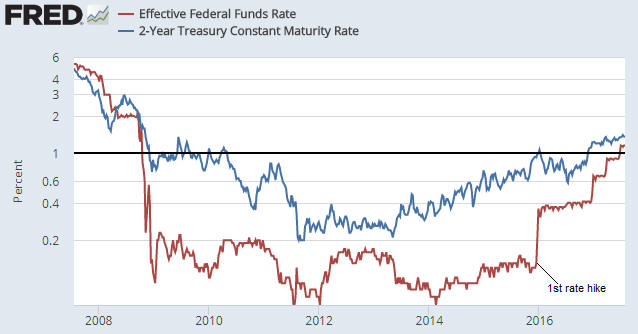
That the Fed has been tagging along behind the market is evidenced by the following chart comparison of the US 2-year T-Note yield (in blue) and the Effective Fed Funds Rate (in red). The chart shows that a) the 2-year T-Note yield bottomed and began trending upward in the second half of 2011, b) the Effective FFR bottomed and began trending upward in early-2014, and c) the Fed made its first rate hike in December-2015. The market has therefore been pushing the Fed to raise its targeted interest rates for several years.
FFR_2yr_250717

Interestingly, the Fed has caught up with and is possibly now even a little ahead of the market. This suggests scepticism on the part of the market that economic and/or financial conditions will be conducive to additional Fed rate hikes over the coming few months.

Based on the prices of Fed Funds Futures contracts we know that the market does not expect the Fed to make another rate hike until December at the earliest. This expectation is probably correct. Rather than make an additional ‘baby step’ rate hike there’s a good chance that the Fed’s next move will be to start reducing the size of its balance sheet by not reinvesting all the proceeds from maturing debt securities. Unless the stock market tanks in the meantime, this balance-sheet reduction will probably be announced on 20th September (following the FOMC Meeting) and kick off in October.

When the aforementioned balance-sheet reduction does start happening it will constitute the Fed’s first genuine attempt to tighten monetary conditions, although, as mentioned above, US monetary conditions have been tightening since late last year thanks to the actions of the commercial banks.
Don’t think like a lawyer

July 21, 2017

The job of a judge or juror is to impartially weigh the evidence and arguments put forward by both sides in an effort to determine which side has the stronger case. The job of a lawyer is to argue for one side, regardless of whether that side happens to be right or wrong. As a speculator it is important to think like a judge or a juror, not a lawyer.

Unlike a lawyer, a speculator can change sides ‘mid-stream’ if necessary to keep himself on the side favoured by the current evidence. There is no need for him to stick to a position come what may. However, changing sides is easier said than done, which is why so many speculators and commentators aren’t able to do it. Rather than let the evidence determine their stance, they adopt a stance and then look for confirming evidence. If they come across conflicting evidence, they downplay it. They aren’t aware of it, but their goal is to prove a particular case rather than align themselves with the strongest case.

Sometimes the case that a speculator desperately wants to prove also happens to be the case supported by the strongest evidence, enabling him to make large gains. However, if he continues to think like a lawyer he will eventually run into the problem that the weight of evidence shifts. After the inevitable shift happens he will steadfastly maintain his earlier position and lose whatever advantage he previously gained from being on the right side of the market.

In my speculations and financial-market writings I’m sometimes guilty of thinking like a lawyer. That’s why I developed the gold model (the Gold True Fundamentals Model – GTFM) that was discussed in a blog post last month. This model prevents my own biases and opinions from getting in the way when assessing whether the fundamental backdrop is bullish or bearish for gold.

The bottom line is that there is never a requirement for a speculator to defend a position. Unlike a lawyer, he is free to change with the evidence.

Inflation as far as the eye can see

July 18, 2017

Many investors pigeon-hole themselves as “inflationists” or “deflationists”, where an inflationist is someone who expects more inflation over the years ahead and a deflationist is someone who expects deflation. I am grudgingly in the inflation camp, because the overall case for more inflation is strong.

I use the word “grudgingly” in the above sentence for two reasons. First, more inflation adds to the existing economic problems and will eventually result in major social upheaval, so when I predict that there will be inflation as far as the eye can see I don’t want to be right. Second, it means that I get lumped together with the perennial forecasters of imminent hyperinflation, even though my only mentions of hyperinflation over the past 17 years were to explain why it had zero probability of happening anytime soon.

With regard to the US situation, the main reason the case for more inflation is strong is that it doesn’t depend on private-sector credit expansion; it depends on the ability and willingness of the Fed to monetise sufficient assets to keep the total supply of money growing. A consistent theme in my commentaries over the 17 years since the birth of the TSI subscription service has been that the Fed could and would keep the inflation going after the private sector became saturated with debt.

Prior to 2008 there was very little in the way of empirical evidence to support the belief that the Fed could keep the inflation going in the face of a private-sector credit contraction, but that’s no longer the case. Thanks to what happened during 2008-2014 we can now be certain that the Fed has the ability to counteract the effects on money supply, asset prices and the so-called “general price level” of widespread private-sector de-leveraging. The only question left open to debate is: will the Fed CHOOSE to do whatever it takes to keep the inflation going in the future?

Based on the publicly-stated views of those who operate the monetary levers as well as on the economic remedies prescribed by today’s most influential economists and financial journalists, there’s a high probability that the answer is yes. At least, there is a high probability that the answer will be yes until the fear of inflation becomes much greater than the fear of deflation. However, the Fed is faced with a difficult challenge. It does not (I assume) want to engineer a steep decline in the dollar’s purchasing power, so every step of the way it tries to do no more than the minimum necessary to ensure a steady and modest rate of purchasing-power loss, with 2%-per-year having become the semi-official target.

The challenge is actually more than difficult; it’s impossible. The impossible-to-solve problem faced by the Fed and all the other central banks is that it can never be determined, in real time, what the aforementioned “minimum” is, because money-supply changes affect the economy in unpredictable ways and with large/variable delays. The economy therefore ends up careening all over the place and we occasionally get deflation scares, which are periods when it seems as if genuine deflation is about to happen. Paradoxically, the deflation scares are highly inflationary because they always prompt the Fed to ramp up the rate of money pumping, but while a deflation scare is in progress it can feel like the deflationists are finally going to be right.

I’m not ruling out the possibility that the deflationists will eventually be right. I hope that they will be right in the not-too-distant future, because more inflation will only add to the economic distortions and lead to an even bigger problem down the track. It’s just that they are, in effect, betting that devotees to the central planning ideology will suddenly realise the error of their ways and let nature take its course. The odds are very much against this bet paying off.

Trying to solve the sentiment conundrum

July 3, 2017

[This post is a modified excerpt from a recent TSI commentary]

In a 12th June blog post I revisited the potential pitfalls in using sentiment as a market timing tool. As an example of a pitfall, the post included a chart of the Investors Intelligence (II) bull/bear ratio suggesting that US stock market sentiment had been consistent with a bull-market top for the bulk of the past four years. Even though the chart helped to make my point it is appropriate to question how sentiment, when used as a contrary indicator, could be so wrong for so long.

I’ve come up with a possible explanation for why measures of US stock-market sentiment that worked well as contrary indicators in the past have not been useful of late. The reason relates to the third of the potential pitfalls outlined in the above-linked blog post. Specifically:

…regardless of what sentiment surveys say, there will always be a lot of bears and a lot of bulls in any financial market. It must be this way otherwise there would be no trading and the market would cease to function. As a consequence, if a survey shows that almost all traders are bullish or that almost all traders are bearish then the survey must be dealing with only a small — and possibly not representative — segment of the overall market.

The explanation I’ve come up with is that prior to the past few years the II sentiment survey, which is a survey of investment advisors who regularly publish their views via newsletters, reflected the sentiment of the investing public, but this is not so much the case anymore. Prior to the past few years the advisors and the general public would become increasingly bullish or increasingly bearish together, with high levels of optimism invariably following persistent price strength and high levels of pessimism invariably following either persistent or dramatic price weakness. Over the past few years, however, the perceptions of these two groups took separate paths. Investment advisors became very optimistic in reaction to the strong upward trend in prices, but for the most part the general public remained unenthusiastic about the stock market.

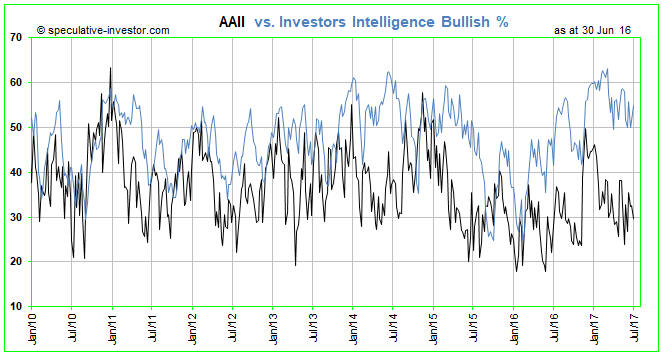
The change described above can be illustrated by comparing the II bullish percentage with the AAII (American Association of Individual Investors) bullish percentage, which has been done on the chart displayed below. The AAII survey is based on the opinions of retail investors, that is, the general public.

The chart shows that prior to 2014 the II (the blue line) and AAII (the black line) bullish percentages typically moved up and down together within a similar range, but that from 2014 onward the II bullish percentage tended to be significantly higher. Furthermore, the distance between the two survey results has increased since early this year, with the II bullish percentage remaining above 50 and the AAII bullish percentage spending most of its time in the 25-35 range. The most recent results show an II bullish percent of 54.9 and an AAII bullish percent of 29.7.

IIvsAAII_030717

It seems that the general public’s stock-market sentiment has not reached an optimistic extreme during the current cycle. Does this mean that there’s a lot more price strength to come or does it mean that the next major price top will happen without the general public having fully embraced the upward trend?

I don’t know, but it’s definitely possible that the public will never fully embrace the latest bullish trend for the simple reason that it is financially incapable of doing so. Having had its savings decimated when earlier Fed-fueled investment booms inevitably collapsed it may not have the financial wherewithal to enthusiastically participate in the Fed’s latest bubble-blowing venture.