State-sponsored cryptocurrencies revisited

December 6, 2017

In a blog post earlier this week I briefly argued that “government-controlled cryptocurrency” was a contradiction in terms. It depends on what is meant by “cryptocurrency”, but now that I’ve done some more research on the subject I understand how a central bank could make use of blockchain technology and why the government would want to implement a type of cryptocurrency.

My understanding of the subject was improved by reading the white paper on the “Fedcoin” published a few months ago by Yale University. I also read about the difference between “permissioned” and “permissionless” blockchains. As a result, I now understand that a blockchain is a data structure that can be either distributed, as is the case with Bitcoin, or centrally controlled, as would be the case with a “cryptocurrency” issued by a central bank.

I also understand how the commercial banks could profit from the advent of a centrally-controlled cryptocurrency. This is an important consideration because the way the world currently works it is unrealistic to expect the introduction of a new form of official money that would result in substantially-reduced profits for the major banks.

The Fedcoin paper linked above lays out how a state-sponsored cryptocurrency could work. Here are some of the salient aspects:

1. The system comprises a central ledger of all transactions (the blockchain) maintained by the Fed, nodes (commercial banks) and users (anyone who wants to spend or receive a Fedcoin).

2. A user of Fedcoins must have an account at the Fed. Opening an account would involve providing the KYC (Know Your Customer) identity information that anyone who has dealt with a financial institution over the past few years would be familiar with.

3. Users would have digital wallets that held encrypted funds and all transactions would have to be digitally signed, so in this respect the term “cryptocurrency” would apply. However, the Fed and the government would be able to determine the identity of the users involved in any/every transaction (due to item 2 above), so the encryption would not result in genuine privacy. Moreover, the government would have the power to “blacklist” a Fedcoin account, effectively freezing the account.

4. Commercial banks (the “nodes” of the system) would maintain copies of the central ledger and would verify transactions to ensure no double spending. Also, all Fedcoin transactions would be announced to the network of nodes.

5. The Fed would audit and allocate fees to the nodes, with bonuses going to the fastest nodes. I suspect that the payments would be high enough to make this a lucrative business for the nodes (the banks).

6. Nodes would send sealed low-level blocks to the Fed for incorporation into high-level blocks that get added to the blockchain.

7. The Fed would guarantee that one Fedcoin could be converted into one dollar. This would ensure that the Fedcoin had the same stability as the dollar.

8. From an accounting perspective, a Fedcoin would be equivalent to a dollar note. In particular, like physical notes and coins, Fedcoins would be liabilities on the Fed’s balance sheet.

9. The Fed would have total control over the supply of Fedcoins, so the advent of this cryptocurrency would not reduce the central bank’s ability to manipulate the money supply and interest rates. On the contrary, the central bank’s ability to manipulate would be enhanced, because it’s likely that the Fedcoin would replace physical cash. Among other things, this would simplify the imposition of negative interest rates should such a policy be deemed necessary by central planners.

What would be the advantages and disadvantages of a government-controlled cryptocurrency such as Fedcoin?

According to the Bank of England (BOE), digital currency could permanently raise GDP by up to 3% due to reductions in real interest rates and monetary transaction costs. Also, the central bank would be more able to stabilise the business cycle.

The BOE’s arguments amount to unadulterated hogwash, for reasons that many of my readers already know and that I won’t rehash at this time.

Clearly, the driving force behind a centrally-controlled cryptocurrency would be the maximisation of tax revenue, in that the replacement of physical cash with a digital system that enabled every transaction to be monitored would eliminate a popular means of doing business below the government radar. Fighting crime and promoting economic growth would be nothing more than pretexts.

That being said, a currency such as Fedcoin would offer one significant advantage to the average person, which is that people could do on-line transfers and payments without having an account with a commercial bank. This is because currency transfers could be done directly between digital wallets.

Also, an official cryptocurrency such as Fedcoin would offer some advantages over Bitcoin, the most popular unofficial cryptocurrency. First, Fedcoin would not have the Bitcoin volatility problem. Second, Fedcoin would be vastly more efficient.

With regard to the efficiency issue, the Proof of Work (POW) aspect of Bitcoin is a massive waste of resources (electricity, mainly). Furthermore, Bitcoin’s inefficiency is deliberately built into the system to limit the rate of supply increase. To explain using an analogy, the high and steadily-increasing costs deliberately imposed on Bitcoin transaction verification and the resultant creation of new coins would be akin to forcing all gold mining to be done by hand, and then, after a certain amount of gold was extracted, making a new rule that required all gold mining to be manually done by crippled miners.

In a way, Bitcoin and the “altcoins” constitute a large and rapidly-expanding Keynesian make-work project. Too bad that such projects result in long-term wealth destruction.

Given the benefits that the government, the central bank and the most influential economists (all of whom are Keynesian) would perceive, it’s a good bet that state-sponsored cryptocurrencies are on the way. For the private sector the introduction of such currencies would lead to cost savings in the money-transfer area, but enhancing the ability of the government to divert resources to itself and enabling even greater central bank control of money definitely would be a barrier to economic progress.
Are state-sponsored cryptocurrencies on the way?

December 4, 2017

The theme of a recent report from Casey Research was that the Russian government is planning to issue its own cryptocurrency (the “CryptoRuble”) that would be created, tracked and held on a state-controlled digital ledger. This was portrayed as being a huge plus for the Russian economy. I don’t see how giving the government greater ability to monitor financial transactions and thus divert more money into its own coffers could be anything other than a negative for any economy, but the Casey report got me thinking about whether a state-sponsored cryptocurrency is a valid concept.

I’m far from an expert on cryptocurrencies and so I could be missing something (please let me know if I am), but it seems to me that it is not a valid concept. The essence of the blockchain technology that underlies cryptocurrencies such as Bitcoin is that the ledger is DISTRIBUTED. This is what makes the system secure. Cryptocurrency exchanges and wallets can be hacked, but the blockchain itself is, for all intents and purposes, ‘unhackable’.

If a digital currency exists on a centrally-controlled ledger it is not a cryptocurrency, it is a garden variety electronic currency like the dollars in your bank account.

Central banks and governments want to eliminate physical cash so that there is a digital record of all transactions. This is not to promote economic growth or to fight terrorism or to reduce crime or to further any other noble cause; it is primarily to maximise tax revenue and secondarily to cut off a way of escaping from negative interest rates. Therefore, it’s a good bet that physical cash will be outlawed in the not-too-distant future. For exactly the same reason (they make it more difficult for the government to monitor financial transactions and thus maximise tax revenue) it’s likely that cryptocurrencies will be outlawed at some stage.

Another relevant point is that commercial banks generate a lot of profit by lending new money into existence and monetising securities. Given the banking industry’s influence on government and the reliance of government on the financial support of banks, there is no chance of the government implementing a monetary system that substantially reduces the profitability of commercial banks.

In summary, I expect that governments will attempt to make the official currency 100% digital/electronic, but not introduce their own cryptocurrencies. As far as I can tell, “government-controlled cryptocurrency” is a contradiction in terms.

The Boom Continues

December 2, 2017

[This post is a brief excerpt from a TSI commentary published a week ago]

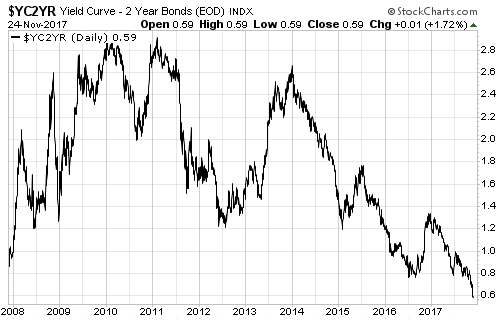
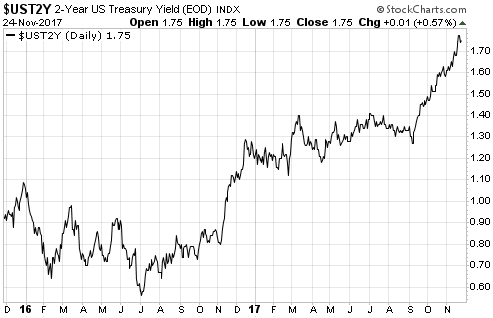
The US economic boom is still in progress, where a boom is defined as a period during which monetary inflation and the suppression of interest rates create the false impression of a growing/healthy economy*. We know that it is still in progress because the gap between 10-year and 2-year Treasury yields — our favourite proxy for the US yield curve — continues to shrink and is now the narrowest it has been in 10 years.

Reiterating an explanation we’ve provided numerous times in the past, an important characteristic of a boom is an increasing desire to borrow short to lend/invest long. This puts upward pressure on short-term interest rates relative to long-term interest rates, which is why economic booms are associated with flattening yield curves. The following chart shows the accelerating upward trend in the US 2-year yield that was the driving force behind the recent sharp reduction in the 10yr-2yr yield spread.

The above paragraph explains why a yield-curve trend reversal from flattening to steepening invariably occurs around the time of a shift from economic boom to economic bust. Such a reversal is a sign that the willingness and/or ability to take on additional short-term debt to support investments in stocks, real estate, factors of production and long-term bonds has diminished beyond a critical level. From that point forward, a new self-reinforcing trend involving debt reduction and the liquidation of investments becomes increasingly dominant.

The recent performance of the yield curve indicates that the US economy hasn’t yet begun the transition from boom to bust.

*The remnants of capitalism enable some genuine progress to be made during the boom phase, but the bulk of the apparent economic vibrancy is associated with monetary-inflation-fueled price rises and activities that essentially consume the ‘seed corn’.

Sentiment Synopsis, Part 2

November 28, 2017

A blog post titled “Sentiment Synopsis” posted two weeks ago contained some explanatory remarks about the Commitments of Traders (COT) reports and briefly discussed the sentiment situations for gold, silver, the Canadian dollar and the Yen using the COT data as the indicators of market sentiment. In this post I’ll do the same for the euro, the Swiss franc and oil, again with the help of charts from Gold Charts ‘R’ Us.

As noted in the earlier post, what I refer to as the total speculative net position takes into account the net positions of large speculators (non-commercials) and small traders (the ‘non-reportables’) and is the inverse of the commercial net position. The blue bars in the middle sections of the charts that follow indicate the commercial net position, so the inverse of each of these bars is considered to be the total speculative net position.

Let’s begin with the euro.

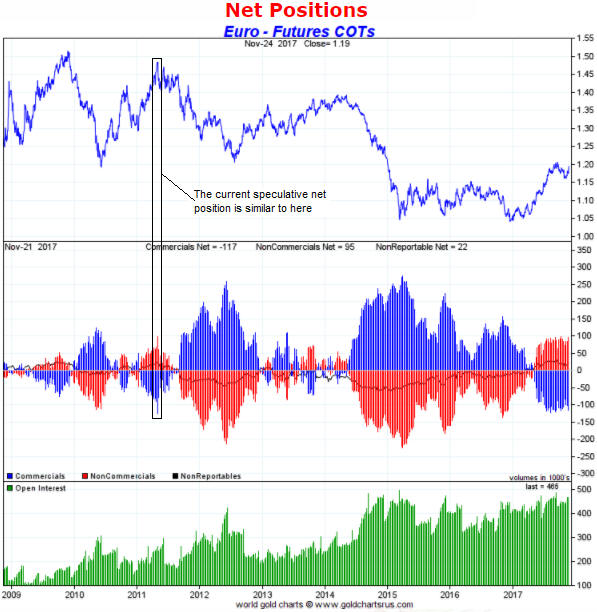
For the past few months the net speculative long position in euro futures has hovered near an all-time high. In fact, the only time that speculators in currency futures, as a group, have ever bet more heavily on a rise in the euro was in 2011 when the euro/US$ exchange rate was peaking in the high-1.40s. Consequently, it could be argued that sentiment is more conducive to euro weakness than euro strength in the short-term.

There is, however, a caveat, which is that if speculators were to become as bullish on the euro as they were bearish in Q2-2012 or Q1-2015 then the speculative net-long position in euro futures will become much larger than at any time in the past. The current COT situation should therefore be viewed as a short-term warning of euro weakness, but not a reason to place a substantial bearish bet.

euroCOT_281117

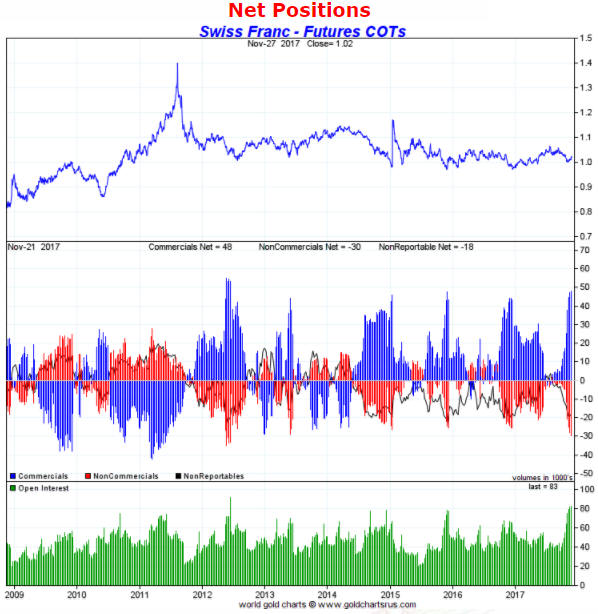
Turning to the following Swiss franc (SF) chart we see the opposite situation. Whereas the COT report indicates that speculators in the futures market are almost as bullish on the euro as they have ever been, it also indicates that the same speculators are almost as bearish on the SF as they have ever been. In particular, it was only for a brief period in 2012 that currency speculators, as a group, were more short (that is, more bearish) on the SF than they are right now. It looks very much like speculators in currency futures have been buying the euro and selling the SF as a pair trade, undoubtedly to take advantage of the downward trend in the SF/euro exchange rate that got underway in April.

I view the current COT situation as a reason to be short-to-intermediate-term bullish on the SF relative to both the US$ and the euro.

SFCOT_281117

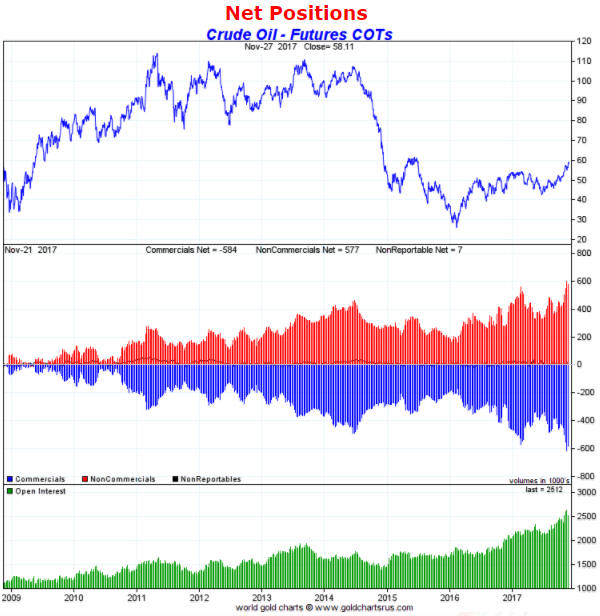
Last but not least, below is a chart showing the COT situation for US (West Texas Intermediate) crude oil futures. The chart tells us that the net speculative long position in oil futures made an all-time high two weeks ago and remains close to its high.

Based on considerations other than sentiment I expect the oil price to trade well into the $60s during the first half of next year, but oil’s COT situation is a short-term danger sign. In the absence of a steady stream of bullish news the oil price is likely to trade at least 10% below its current price within the next two months. I hasten to point out, however, that the risk/reward does not suggest that oil should be shorted.

oilCOT_281117