A reality check regarding China purchases of US debt

January 12, 2018

1. According to news reports, unnamed senior government officials in China have recommended slowing or halting the purchase of US Treasury securities.

2. If China’s government really was planning to reduce its investment or rate of investment in US government debt, why would it announce the change beforehand given that doing so would potentially lower the market value of its holdings?

3. The only reason to make the announcement is if there is no intention to implement a change but there is something to be gained by making the threat.

4. Clearly, the announcement is part of a negotiation strategy regarding China-US trade.

5. The reality is that China’s government buys and sells Treasury securities and other international reserve assets as part of its effort to manage (that is, manipulate) the Yuan’s exchange rate. When the Yuan is strengthening, international reserves will be bought — using newly-created local currency — to slow or stop the advance. When the Yuan is weakening, international reserves will be sold to slow the decline. That’s why China’s stash of US Treasury debt trended upward for many years prior to 2014 (when the Yuan was strengthening relative to the US$), trended downward during 2014-2016 (when the Yuan was weakening relative to the US$), and trended upward over the past 12 months (when the Yuan was strengthening relative to the US$).

6. China’s total investment in US Treasury securities was significantly greater 4 years ago than it is today. This is evidenced by the following chart, which shows that the combined Treasury holdings of China and Belgium (Belgium must be added to get the complete picture because that’s where China’s government keeps its custodial accounts) dropped from about 1.65 trillion in early-2014 to 1.2 trillion in May-2017. It’s likely that the holding is now about $100B larger, which implies that China’s government has been a net seller of about $350B of Treasury debt over the past four years.

ChinaTholding_110118

7. China’s government will continue to do what it has been doing — buy US Treasury debt when it feels the need to weaken the Yuan and sell US Treasury debt when it feels the need to strengthen/support the Yuan.

8. There are good reasons to expect that yields on US T-Bonds and T-Notes will be significantly higher in 6 months’ time, but the recent deliberately-misleading news emanating from China is not one of them.

Monetary Policy Madness?

January 8, 2018

In a recent newsletter John Mauldin wrote: “It is monetary policy madness to raise rates and undertake quantitative tightening at the same time.” However, this is exactly what the Fed plans to do in 2018. Has the Fed gone mad?

If mad is defined as diverging in an irrational way from normal practice then the answer to the above question is no. The Fed is following the same rule book it has always followed.

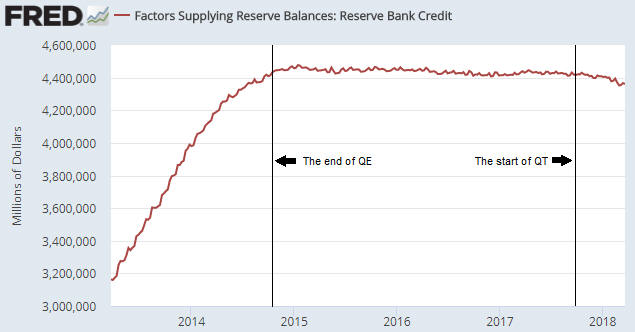
It should first be understood that earlier rate-hiking campaigns were always accompanied by quantitative tightening (QT). Otherwise, how could the Fed have caused its targeted interest rate (the Fed Funds rate) to rise? The Fed is powerful, but not powerful enough to command the interest rate to perform in a certain way. Instead, it has always manipulated the rate upward by reducing the supply of reserves to the banking system via a process that also reduces the money supply within the economy; that is, via QT. In other words, far from there being something unusual about the Fed simultaneously raising rates and undertaking QT, it is standard procedure.

What’s unusual about the current cycle is the scale. Having created orders of magnitude more money and bank reserves than normal during the easing part of the cycle the Fed must now implement QT on a much larger scale than ever before. At least, that’s what the Fed must do if it follows its rule book.

A plausible argument can be made that the Fed should now deviate from its rule book, but the argument isn’t that the economy is too weak to cope with tighter monetary policy. The correct argument is that the damage in the form of misdirected investment and resource wastage was done by the earlier quantitative easing (QE) programs and this damage cannot be undone or even mitigated by deflating the money supply. In effect, the incredibly loose monetary policy of 2008-2014 has made a painful economic denouement inevitable. At this point, reducing the money supply — as opposed to stopping the inflation of the money supply, which would be beneficial as it would prevent new mal-investment from being added to the pile — would exacerbate the pain for no good reason.

In other words, the damage done by monetary inflation cannot be subsequently undone by monetary deflation.

A plausible argument can also be made that for the first time ever the Fed now has the option of hiking interest rates without doing any QT. This is due to its ability to pay interest on bank reserves. This ability was acquired about 9 years ago solely for the purpose of enabling the Fed to hike its targeted interest rate while leaving the banking system inundated with “excess reserves” (refer to my March-2015 blog post for more detail). That is, this ability was acquired so that the Fed would not be forced to undertake QT at the same time as it was hiking rates.

However, the Fed is not going to deviate from its rule book. This is mainly because the Fed’s leadership believes that a new QE program will be required in the future.

To explain, a Fed decision not to implement QT would create an expectations-management problem in the future. Specifically, an announcement by the Fed that it was going to maintain its balance sheet at the current bloated level would be a tacit admission that QE involved a permanent addition to the money supply rather than a temporary exchange of money for securities. If the Fed were to admit this then the next time a QE program was announced there would be a surge in inflation expectations.

There has been monetary policy madness in spades over the past two decades, but within this context there is nothing especially mad about the Fed’s plan to raise rates and undertake quantitative tightening at the same time.

You can bet on the continuing popularity of superficial economics

January 1, 2018

It is appropriate to think of Keynesian economics as superficial economics*, because this school of thought generally considers what’s seen and ignores what’s unseen. To put it another way, Keynesianism focuses on the readily-observable situation and the immediate/direct effects of a policy while paying little or no attention to why the current situation came about and the indirect (not immediately obvious) consequences of a policy. This leads to nonsensical conclusions, such as that the economy can sometimes be helped by the destruction of wealth (the idea being that after assets are destroyed people can be ‘gainfully’ employed rebuilding them).

To further explain, when a shop window is broken the typical Keynesian would account for the additional work and income of the glazier hired to fix the window but would make no effort to understand how the shopkeeper would have allocated his scarce resources if his window had remained intact. And in a case where resources are ‘idle’, the Keynesian would focus exclusively on the direct effect of using increased government spending or central bank money-printing to put these resources to work. He would pay scant attention to why the resources were idle in the first place and would ignore the longer-term effects of creating artificial demand for some resources and forcing the private sector to fund projects that it would otherwise choose not to fund**.

Due to its shallow nature, Keynesian economics is not useful when attempting to understand the real-world drivers of production and consumption. However, it can be put to good use when attempting to understand and predict the actions of policy-makers.

Aside from the fact that almost all politicians are economically illiterate, if your overriding goal is to win the next election then what you want are policy-related effects that are short-term, obvious and direct. What you want is to be able to point to a bunch of guys in hard hats hammering away on a government-funded project, and say: “Without the bill I sponsored, these guys would not have jobs”. The longer-term economic negatives aren’t relevant because not one voter in a thousand will see the link between these negatives and the “stimulus” bill.

There will come a day when Keynesian economics has been totally discredited again***, but until that day there will be many opportunities to make money by betting on policy-makers acting stupidly.

    *In a blog post in May-2015 I suggested that Keynesian Economics should be renamed ASS (Ad-hoc, Superficial and Shortsighted) Economics.

    **The “idle resources” fallacy that underlies the justifications for various government stimulus programs was debunked by William Hutt in a book published way back in 1939 and was more more briefly — but still thoroughly — debunked by Robert Murphy in a January-2009 article.

    ***Keynesian economics was discredited during the 1970s but subsequently managed to claw its way back to a position of great influence. It is resilient because it seemingly gives politicians the scientific justification for doing what they already want to do, which is make themselves appear benevolent — and thus garner the support of more than 50% of the voters — by spending the money of some people to provide short-term benefits to other people.

It’s not a gold bull market

December 26, 2017

A popular view is that a new cyclical gold bull market commenced in December-2015. If so, the gold bull is now two years old. At the same time, the following weekly chart shows that the gold/SPX ratio (the US$ gold price divided by the S&P500 Index) recently made a 10-year low. Is it possible for gold to be hitting 10-year lows relative to the SPX two years into a gold bull market?

gold_SPX_261217

If the sole measuring stick is a depreciating currency then the answer is yes, but if a more practical measuring stick is used then the answer is no.

I explained in an earlier blog post that for a bull-market definition to be practical it must take into account the fact that what people really want from an investment is an increase in purchasing power, not just an increase in price. Unfortunately, it isn’t possible to accurately determine how an investment is doing in purchasing-power terms, but a reasonable alternative is to eliminate the poor measuring stick known as fiat currency from the equation by looking at the performances of different investments relative to each other. The ones that are in bull markets are the ones that are relatively strong.

The definition I arrived at was: An investment is in a bull market if it is in a multi-year upward trend in nominal currency terms AND relative to its main competition.

As also explained in the post linked above, measuring one market against another works especially well for gold bullion and the SPX. This is because they are effectively at opposite ends of an investment seesaw, with the SPX doing best when confidence in money, central banking and government is rising and gold doing best when confidence in money, central banking and government is falling.

I think that it makes no sense to define what happened since December-2015 as a gold bull market. I also think that it is important not to get hung up on bull/bear labels. Bull market or not, January through August of 2016 was a great time to own gold-mining stocks. And bull market or not, the period since August-2016 has been a not-so-great time to be heavily invested in gold-mining stocks.

Rather than being committed to the theory that a gold bull market began in December-2015 or the opposing theory that a gold bear market remains in force, it is better to use sentiment, price action and fundamentals to identify good buying and good selling opportunities in real time.