Which political team do you support?

April 24, 2018

Most people support a political party in the same way they support a sports team. The support is through thick and thin, regardless of the policies that are being proposed/enacted. And criticism of their team is not tolerated, because, well, it’s their team. People love to be part of a team.

One consequence of the team-spirit aspect of politics is that the average person doesn’t decide the appropriateness and efficacy of a policy by objective analysis, but rather by who is proposing/implementing the policy. If the policy is put forward by Party A then the supporters of Party A will claim it is a good idea and the supporters of Party B will be critical, whereas if the identical policy is put forward by Party B then the Party B supporters will be in favour of it and the Party A supporters will be critical. In some cases a policy put forward by a particular party will be so obviously bad that the more rational supporters of that party will be unable to come out openly in favour of it, in which case they usually will remain silent. They are like the one-eyed sports fans who shout abuse when the referee makes a bad decision in the opposing team’s favour but turn a blind eye when the referee makes a bad decision in their team’s favour.

Another consequence of the tendency towards blind support of a political team and the associated unwillingness to objectively analyse the merits of policies is that people tend to embrace a set of beliefs covering many different socioeconomic issues, even if the beliefs are not consistent. This is because the set of beliefs is associated with their team and advocated by the leaders of their team. A knock-on effect is that if you know where someone stands on one hot-button issue, examples of which are climate change, gun control, immigration and abortion, in most cases you will know where they stand on all hot-button issues. That’s even though it doesn’t logically follow that a particular belief on, for example, gun control should be linked to a particular belief on, for example, climate change or abortion.

One of the most curious aspects of the strong identification with a particular political team and the animosity that members of one team often feel for members of the opposing team is that in practice the teams are very similar. At each election a sizable proportion of the population will vote for what they believe is a change of direction, but regardless of the outcome of the election nothing will really change. The leaders of the different teams will spew forth different rhetoric and there will be some differences in the policy details, but regardless of the election result there will be no meaningful change in the overall governmental approach. The main reason is that in a typical modern-day two (or more) party democracy, each of the major parties will be in favour of a powerful, intrusive government. In effect, when people vote to remove the team that’s currently in power they are voting for a change in the facade, not a change in the structure.

It would be great if the average person, instead of labeling himself/herself as a member of a particular political team (Republican, Democrat, Conservative, Liberal, Labour, etc.) and blindly supporting that team’s policies, either impartially assessed each policy proposal and railed against bad policy regardless of its origin or simply admitted to not being well-enough informed to have an opinion. Unfortunately, that’s never going to happen.
A dramatic upward reversal in US monetary inflation

April 21, 2018

[Here is an excerpt from a commentary posted at TSI about a week ago]

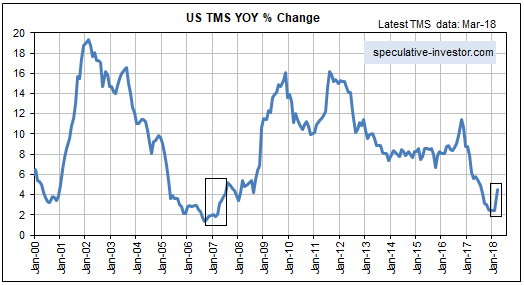
In February of this year the year-over-year rate of growth in the US True Money Supply, a.k.a. the US monetary inflation rate, was only 2.4%. This was its lowest level since March of 2007 and not far from a multi-decade low. In March of this year, however, the monetary inflation rate almost doubled — to around 4.6%. Refer to the following chart for more detail. What caused the reversal and what effect will it have on the economy and the financial markets?

The Fed has been slowly removing money from the economy via its QT program, so March’s money-supply surge wasn’t caused by the central bank. The main cause also wasn’t the commercial banking industry, because although there has been an up-tick in the rate of bank credit expansion over the past month it is nowhere near enough to explain the increase in TMS.

We can’t be certain, but by a process of elimination we conclude that the sharp upward reversal in the US monetary inflation rate was due to money coming into the US from overseas. If so, the most likely driver would be the repatriation of corporate profits due to the tax changes approved near the end of last year.

In other words, it’s likely that March’s TMS surge was due more to the way that the banking system accounts for existing US dollars than an increase in the total supply of US dollars.

If the monetary inflation reversal has more to do with a change in the way existing US dollars are accounted for than a sudden large increase in the pace of new dollar creation, then the effects on the economy and the financial markets will be minimal. In any case, after the monetary inflation rate has moved high enough for long enough to set in motion an artificial boom, a drop to a relatively low inflation level will inevitably lead to a bust (an economic recession and a large decline in the stock market, often accompanied by a banking crisis). For example, the pronounced rebound in the TMS growth rate from Q4-2006 to Q3-2007 did not stop the recession, the equity bear market and the banking crisis of 2007-2009.

This means that as a result of the 2017 decline in the monetary inflation rate to near a 20-year low, the die has been cast.

The big unknown right now is the timing of the bust that will occur in response to last year’s precipitous decline in the monetary inflation rate. Will it get underway during the second half of this year or will it wait until next year?

Bull market correction or bear market?

April 17, 2018

In previous blog posts (e.g. HERE) I explained the limitations of sentiment as a market timing tool. Since the public is invariably wrong at price extremes, it certainly can be helpful to track the public’s sentiment and use it as a contrary indicator. However, whereas price extremes always coincide with sentiment extremes, sentiment extremes often don’t coincide with price extremes. This is especially the case during long-term bull markets, when sentiment is capable of staying very optimistic for years. It’s therefore best to think of a sentiment extreme as a necessary, but not a sufficient, condition for a price extreme.

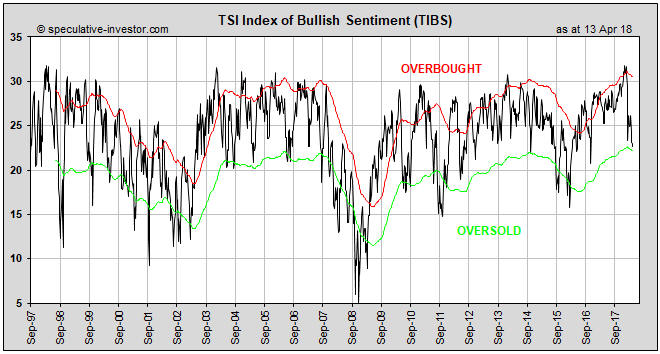
With regard to US stock market sentiment there was an optimistic extreme in January of this year. This is evidenced by the TSI Index of Bullish Sentiment (TIBS) hitting a 20-year high at that time. Refer to the following weekly chart for details. Note that TIBS is a weighted average of four sentiment surveys (Investors Intelligence, Market Vane, Consensus-inc and American Association of Individual Investors), the 5-day moving average of the equity put/call ratio and the 5-day moving average of the VIX.

What is the probability that January’s optimistic extreme coincided with the top of the equity bull market?

TIBS_180418

The answer is: quite low. While sentiment was consistent with a major top and valuations, on average, were definitely high enough to usher in a major top, an end to the long-term upward trend was not signaled by several important indicators. For example, there would normally be a pronounced widening of credit spreads at or before a bull market top, but credit spreads remain near their narrowest levels of the past 10 years. For another example, there is likely to be a reversal in the yield curve from flattening to steepening at or prior to a bull market top, but at the end of last week the US yield curve was at its ‘flattest’ in more than 10 years. For a third example, there has been more strength in market internals over the past two months than there normally would be if we were dealing with the early stage of a bear market.

So, despite the rampant optimism evident in January-2018, the decline that followed the January peak probably will turn out to be a bull-market correction.

The short that keeps on giving?

April 10, 2018

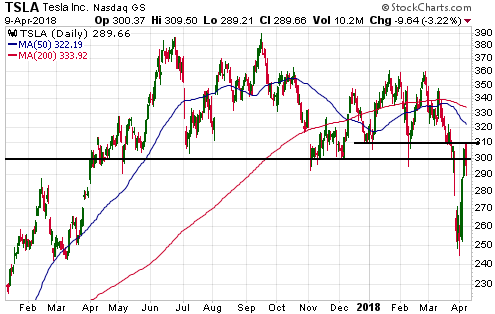
Among the list of stock selection and trading ideas maintained at the TSI web site there was, until the week before last, a Tesla (TSLA) put option position. The position was exited — and a large profit recorded — after the stock’s recent plunge from well above $300 to the $250s. However, this stock could present multiple opportunities over the coming 12 months to profit on the dark (bearish) side as it makes its way along the path to zero. TSLA could become the short that keeps on giving.

In fact, the fast rebound from the 2nd April low in the mid-$240s to the 9th April high of $309.50 may have already created the next such opportunity. The reason is that the rebound appears to have ended near the top of the former major support at $300-$310, the implication being that the stock has completed a successful test of its breakdown.

TSLA_090418

The company is clearly in trouble. It is hemorrhaging cash and running out of money, it is suffering production problems, it has possibly engaged in fraudulent accounting and is under investigation, and it will soon be faced with much greater competition from companies that are far more adept at vehicle manufacturing. And yet, it still sports an extremely high market valuation.

TSLA bears will have to remain on guard, though, because Elon “the carnival barker” Musk is still capable of whipping up enthusiasm.