
The myth of gold-stock leverage

September 10, 2018

A few years ago I wrote a couple of pieces explaining why gold mining is a crappy business. The main reason is the malinvestment that periodically afflicts the industry due to the boom-bust cycle caused by monetary inflation.

To recap, when the financial/banking system appears to be in trouble and/or economic confidence is on the decline, the perceived value of equities and corporate bonds decreases and the perceived value of gold-related investments increases. However, gold to the stock and bond markets is like an ant to an elephant, so the aforementioned shift in investment demand results in far more money making its way towards the gold-mining industry than can be used efficiently. Geology exacerbates the difficulty of putting the money to work efficiently, in that gold mines typically aren’t as scalable as, for example, base-metal mines or oil-sands operations.

In the same way that the malinvestment fostered by the creation of money out of nothing causes entire economies to progress more slowly than they should or go backwards if the inflation is rapid enough, the bad investment decisions fostered by the periodic floods of money towards gold mining have made the industry inefficient. That is, just as the busts that follow the central-bank-sponsored economic booms tend to wipe out all or most of the gains made during the booms, the gold-mining industry experiences a boom-bust cycle of its own with even worse results. The difference is that the booms in gold mining roughly coincide with the busts in the broad economy.

Gold, itself, is not afflicted by the rampant malinvestment that periodically occurs within the gold-mining sector. Regardless of what’s happening in the world, an ounce of gold is always an ounce of gold. It is neither efficient nor inefficient; it just is.

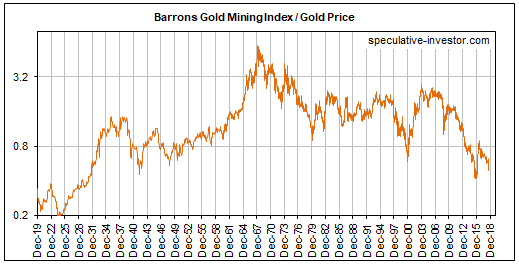
A consequence is that gold bullion increases in value relative to gold-mining stocks over the long term. This is evidenced by the fact that the gold-mining sector, as represented on the following chart by the Barrons Gold Mining Index up to 1996 and the HUI thereafter, has been in a downward trend relative to gold bullion since 1968. 1968!!

Yes, we are talking about a 50-year downward trend in the value of gold-mining stocks relative to gold bullion. For how many more decades will this trend have to continue before analysts stop referring to gold-mining stocks as leveraged plays on the metal?
BGMI_gold_100918

There’s no reason to expect the above trend to end while the current monetary system is in place. This doesn’t mean that gold-mining stocks should be ignored, as these stocks can generate huge profits for traders who remember to sell when the selling is good. It means that if you want long-term exposure to gold then you should own gold, not the stocks of companies that mine gold.
Gold at the Crossroads

August 27, 2018

[This post is a modified excerpt from a TSI commentary published last month]

Although I’m not in total agreement with it, I can highly recommend Erik Norland’s article titled “Gold: At the Crossroads of Fiscal and Monetary Policies.” The article is informative and, unlike the bulk of gold-related commentary, actually deals with fundamental developments that could be important influences on gold’s price trend.

The article was published in early-May and states that the U.S. is in a mid-to-late stage recovery. While that statement was probably correct at the time, evidence has since emerged that the economy has entered the “Late-Expansion” stage.

Note that the “Late-Expansion” stage could extend well into 2019 or perhaps even into 2020 and that the best leading indicators of recession should issue timely warnings when this stage is about to end. By the way, the extension of the Late-Expansion stage is why the industrial metals markets probably will commence new intermediate-term rallies later this year.

My only substantial disagreement with the above-linked article is associated with the relationship between gold and fiscal policy. Parts of the article are based on the premise that expansionary fiscal policy and its ‘ballooning’ effect on federal debt are bullish for gold. This premise is false; expansionary fiscal policy is not, in and of itself, either bullish or bearish for gold.

The effects that fiscal policy and the associated change in government debt have on the gold price will be determined by their effects on economic confidence. Of particular relevance, there’s no good reason to assume that an increase in government debt will bring about a decline in economic confidence, which is what it would have to do to be bullish for gold. In fact, if an increase in government indebtedness is largely the result of reduced taxes then it could lead to increased economic confidence for a considerable time and thus put DOWNWARD pressure on the gold price.

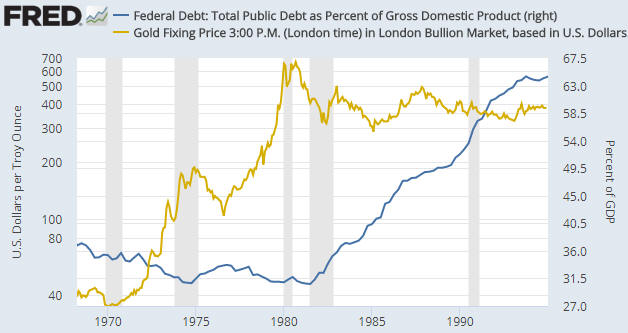
That there should not be a consistent positive correlation between the gold price and the extent of US government indebtedness is borne out by the empirical evidence. In particular, the following chart shows that there was a NEGATIVE correlation between the US$ gold price and the US government-debt/GDP ratio between 1970 and 1995, with debt/GDP drifting lower during the long-term gold bull market of the 1970s and then trending upward during the first 15 years of gold’s long-term bear market.

The wrong assertion that an increase in the government’s debt burden is necessarily bullish for gold appears to rely on what happened during 1995-2011, in that during this 17-year period there was a positive correlation between the gold price and the US government-debt/GDP ratio. You must take a wider-angle view to realise that this 17-year period is an example of correlation not implying causation. The fact is that over the past 50 years the overarching correlation between the gold price and the debt/GDP ratio has been negative for more time than it has been positive.

The steadfast belief that rising US government debt is bullish for the US$ gold price is similar to the steadfast belief that geopolitical conflict is bullish for the gold price. They are both superstitions. The gold price has never made sustainable gains in reaction to international military conflict or the threat of the same, and the gold price is just as likely to fall as it is to rise in parallel with increasing government indebtedness.

The lagged response of the economy to the central bank’s monetary machinations is the key to long-term trends in the gold price. Therefore, it isn’t correct to say that gold is at the crossroads of fiscal and monetary policies (the theme of the above-linked article). It is correct, however, to say that gold is at the crossroads of bubble activities and the reduction of monetary fuel to support such activities.

The current US economic boom is like the cartoon character that has run over the edge of a cliff, but hasn’t looked down yet. The character can continue running without any support as long as it doesn’t look down. At this stage, investors in stocks, bonds and other assets that have been propelled to sky-high valuations by monetary inflation are acting as if the temporary props put in place by the central bank still exist, so they don’t yet perceive the need for the support that gold can offer. Unfortunately, unlike in the cartoons when the time from running over the cliff to the point of recognition is always a few seconds or less, there’s no way to know in advance how long an artificial economic boom will persist after the monetary support is removed.

Sentiment pitfalls, the gold edition

August 20, 2018

In a couple of blog posts last year I discussed the limitations of sentiment as a market timing tool. With the most reliable sentiment indicators now revealing extreme negativity towards gold, it’s timely to revisit this topic using the current gold market situation as an example.

There are two sentiment pitfalls that I mentioned in the earlier posts that are especially relevant to the current gold-market situation. The first is linked to the fact that sentiment generally follows price, making it a near certainty that the overall mood will be at an optimistic extreme near an important price top and a pessimistic extreme near an important price bottom. Putting it another way, there is nothing like a strongly-rising price to get the speculating community and the general public bullish and there is nothing like a steep price decline to get them bearish, so it’s perfectly natural that price-tops will be associated with optimism and price-bottoms will be associated with pessimism. The problem is that while an important price extreme will always be associated with a sentiment extreme, a sentiment extreme doesn’t necessarily imply an important price extreme.

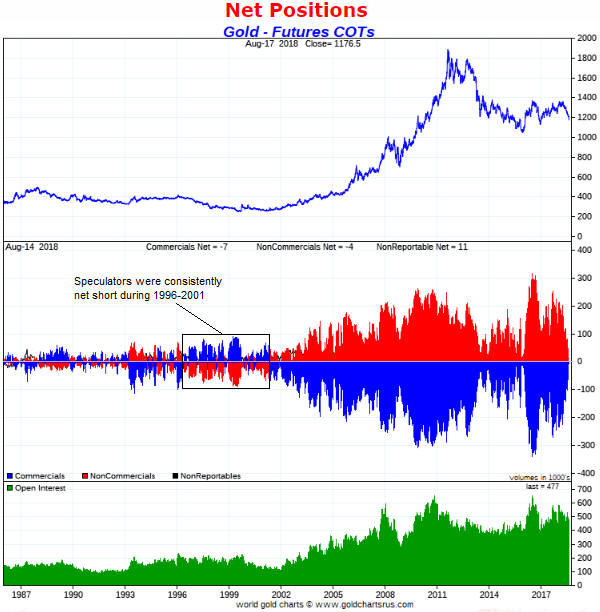
Gold’s current Commitments of Traders (COT) situation shows that relative to the past 15 years, speculative sentiment is now at a pessimistic extreme. This implies that there is now plenty of sentiment-related fuel to propel the gold price upward over the months ahead, but it doesn’t imply that the price is close to a sustainable low. If the price continues to trend downward then speculators, as a group, will continue to lose interest in being long and gain interest in being short. Of course, when a sustainable price bottom is reached it WILL coincide with very negative sentiment, because, as I said, sentiment follows price.

The second potential pitfall is that what constitutes a sentiment extreme will vary over time, meaning that there are no absolute benchmarks. In particular, what constitutes dangerous optimism in a bear market will often not be a problem in a bull market and what constitutes extreme fear/pessimism in a bull market will often not signal a good buying opportunity in a bear market.

At the moment, gold is not in a bull market. It is either still immersed in the bear market that began in 2011 or immersed in a long-term basing pattern. Either way, it isn’t reasonable to blindly assume that what constituted a sentiment extreme during the period since 2001, the bulk of which involved a gold bull market, constitutes a sentiment extreme today.

If we look back further than 2001 we see that the current speculative positioning in gold futures is not necessarily indicative of an extreme. For example, the following chart from goldchartsrus.com shows that speculators in Comex gold futures were consistently net-short during 1996-2001.

goldCOT_200818

My guess is that the gold price will rebound strongly from whatever low it makes during August-September. However, unless the fundamentals make a sustainable turn in gold’s favour (right now the fundamental backdrop is unequivocally bearish for gold) it’s likely that at some future point the COT data for gold will reveal much greater negativity on the part of the speculating community than exists today.

The next major gold rally

August 17, 2018

[This post is a brief excerpt from a recent TSI commentary]

During the first three quarters of 2016 we were open to the possibility that a new cyclical gold bull market got underway in December of 2015, but over the past 18 months we have been consistent in our opinion that the December-2015 upward reversal in the US$ gold price did NOT mark the start of a bull market. Since late-2016 there have been some interesting rallies in the gold price, but at no time has there been a good reason to believe that we were dealing with a bull market. That’s still the case. The question is: what will it take to set a new cyclical gold bull market in motion?

The simple answer is that it will take a US equity bear market. However, this is not a practical answer because in real time there often will be no way of differentiating the first 6-9 months of an equity bear market from an intermediate-term bull-market correction. The most practical answer we can come up with is that it will take an upward reversal in the yield curve.

It has become popular to argue that due to extraordinary monetary policy the yield curve is not as important as it was in the past, but we strongly disagree. In our opinion the yield curve is, if anything, more important now — in the face of extraordinary monetary policy — than it has ever been.

The potential for the US yield curve to invert in the not-too-distant future is a red herring. Except to the extent that it influences the psychology of senior Fed officials, whether or not the curve inverts is neither here nor there. It’s the reversal from ‘flattening’ to ‘steepening’ that matters, regardless of whether the reversal happens before or after the curve inverts.

If the next major reversal of the yield curve is driven primarily by falling short-term interest rates then it will signal the onset of an economic bust. An economic bust would naturally coincide with an equity bear market and the start of a gold bull market. On the other hand, if the next major reversal of the yield curve is driven primarily by rising long-term interest rates then it will signal the onset of an inflationary blow-off that likely would go hand-in-hand with a powerful 1-2 year rally in the gold price and the prices of most other commodities.

Last week the 10yr-2yr yield spread, a proxy for the US yield curve, fell to within 2 basis points of the 10-year low reached in mid-July. Therefore, at this time there is no sign of an upward reversal.