Misconceptions about US bank reserves

February 4, 2019

Bank reserves are a throwback to a time when the amount of receipts for money (gold) that could be issued by a bank was limited by the amount of money (gold) the bank held in reserve. Under the current monetary system bank reserves have no real meaning, since it isn’t possible for a dollar in a bank deposit to be genuinely backed by a dollar held somewhere else. The dollar can’t back itself! However, it is still important to understand what today’s bank reserves are/aren’t and how changes in the reserves quantity are linked to changes in the economy-wide money supply. Remarkably, these bank-reserve basics are misunderstood by almost everyone who comments on the topic.

The simplest way for me to deal with the common misunderstandings about bank reserves is in point form, so that’s how I’ll do it. Here goes:

1) Bank reserves aren’t money, that is, they are not considered to be general media of exchange and are not counted in the True Money Supply (TMS). Instead, they provide ‘backing’ for part of the money supply.

2) A corollary of the above is that banks can’t use their reserves to buy things outside the Federal Reserve system.

3) Banks can lend their reserves to other banks, but the banking industry as a whole cannot expand or shrink its reserves. In other words, the banking industry has no control over its collective reserves. The central bank has total control.

4) Bank reserves can be shifted around within accounts at the Fed, but the only way that reserves can leave the Fed and enter the economy is via the withdrawal, by the public, of physical currency from banks. For example, when $100 is withdrawn from an ATM, $100 is converted from deposit currency to physical currency. This doesn’t alter the money supply, but it causes the bank to lose a $100 liability (the bank customer’s deposit) and a $100 asset (the physical currency held in the bank’s vault). When the quantity of physical currency held in a bank’s vault gets too small, the bank will replenish its supply by withdrawing reserves from the Fed in the form of new paper dollars. Although it may appear that this imposes some sort of limit on the supply of physical dollars, the Fed stands ready, willing and able to meet any increase in demand. This is further discussed in point 5).

5) Under the current monetary system, reserves effectively are created out of nothing. To be more precise, the Fed creates reserves when it purchases bonds and other assets. Since there is no limit to the dollar value of assets that can be purchased by the Fed, the banking system will never run short of the reserves it needs to meet the public’s demand for physical currency. Also, the Fed can remove reserves whenever it wants by selling bonds and other assets.

6) Except for the siphoning of reserves in response to the public’s increasing demand for physical currency, it is accurate to say that reserves at the Fed stay at the Fed until they are removed by the Fed. A corollary — as already mentioned in point 3) — is that the commercial banking industry cannot draw-down its reserves.

7) The Fed pays interest on ALL reserves, not just so-called “excess reserves”. In any case and as outlined below, for all intents and purposes all US bank reserves, with the exception of the relatively small portion required to meet any increase in the demand for physical currency, are now excess and have been for the past few decades.

8) The way the US monetary system now works it is fair to say that all reserves are excess. The reason is that the quantity of bank reserves has no bearing on the amount by which banks expand/contract credit. In effect, the US now has a zero-reserve fractional reserve banking system. That’s why it was possible for the greatest expansion of bank credit in modern US history, which took place during 1990-2007, to happen while the commercial banking industry had almost no reserves. During this period total bank credit rose by $6 trillion, from $2.5T to $8.5T, while bank reserves at the Fed dwindled from $64B to $40B.

9) Further to point 8), bank lending doesn’t ‘piggy-back’ on bank reserves. It possibly did 40 years ago, but it hasn’t for at least the past 25 years. Hopefully, economics textbooks eventually will be updated to reflect this reality.

10) An implication of points 7) and 8) is that interest payments on reserves are neither an incentive nor a disincentive to bank lending. When a bank makes a loan to a customer it doesn’t lose any reserves and therefore continues to collect the same interest-on-reserves payment from the Fed.

11) The sole purpose of paying interest on reserves is to enable the Fed to hike the Fed Funds Rate during a period when the banks are inundated with reserves, without having to massively reduce the quantity of reserves. This was discussed in previous blog posts, for example HERE.

12) When the Fed was ‘quantitatively easing’ many pundits wrote that it was adding to bank reserves but not the money supply. This is wrong. When the Fed buys X$ of securities as part of a QE program it adds X$ to bank reserves AND it adds X$ to the economy-wide money supply. I previously described the process HERE.

13) By the same token, now that the Fed is ‘quantitatively tightening’ it is not just removing bank reserves. When the Fed sells X$ of securities as part of what it refers to as its balance-sheet normalisation program it removes X$ from bank reserves AND it removes X$ from the economy-wide money supply. In essence, it’s the process I described in the above-linked post (point 12) in reverse. That’s why the balance-sheet normalisation program is vastly more important, as far as monetary conditions are concerned, than the rate-hiking program.
Random Predictions For 2019

January 28, 2019

[This blog post is an excerpt from a TSI commentary published about three weeks ago and covers a few general thoughts about what will happen in the financial world this year. Specific thoughts about what I expect this year from the stock, gold, bond, currency and commodity markets have also been included in TSI commentaries over the past three weeks.]

1) Early last year we predicted that the US stock market would experience greater-than-average volatility over the year ahead. This obviously happened, as there were more 2%+ single-day moves in the SPX during 2018 than in an average year.

We expect the same for this year, that is, we expect price volatility to remain elevated. The reason is that the two most likely scenarios involve abnormally-high price volatility. One of these scenarios is that a cyclical bear market began last October, and bear markets are characterised by periods of substantial weakness followed by rapid rebounds. The other scenario is that a very long-in-the-tooth cyclical bull market is about to embark on its final fling to the upside.

2) When attempting to predict when a period of economic growth will end it is futile to look more than 6-12 months into the future, because there are no leading recession indicators that can predict that far ahead with acceptable reliability. There are, however, leading indicators that can be used to determine the probability of a recession beginning within the next few quarters.

Early last year these indicators told us that a US recession would not begin during the first half of the year. They currently tell us that the US economy stands a good chance of commencing a recession this year, most likely during the second half of the year. Note, though, that if a recession does get underway this year it won’t become official until 2020, because recessions usually aren’t confirmed by the National Bureau of Economic Research until about 12 months after they start.

3) Regarding ‘cryptoassets’, at around this time last year we wrote:

…it’s a good bet that the Bitcoin bubble reached its maximum level of inflation late last year. Also, the broader bubble in cryptoassets is set to burst during the first quarter of this year.

And:

By the end of 2018 it will be apparent that the public’s enthusiasm for Bitcoin and the “alt-coins” was one of history’s great speculative manias.

This assessment looks correct.

We don’t have a strong opinion about what will happen to ‘cryptoassets’ in 2019. This is partly because there is no reasonable way to determine the fair value of these assets. For Bitcoin, for example, a price of $3,000 is no more or less sensible than a price of $30,000 or a price of $300.

Distributed ledgers can be very useful, but there should be ways to implement them without consuming a lot of resources. If so, the price of Bitcoin eventually will drop to almost zero.

A year ago we also predicted:

Despite spectacular collapses in the prices of the popular ‘cryptoassets’ during 2018, central banks including the Fed and the ECB will firm-up plans to introduce their own blockchain-based currencies. This will be driven by a desire to eliminate physical cash, the thinking being that if there is no physical money it will be more difficult for the average person to make/receive unreported payments and escape a negative interest rate.

As far as we know the major central banks didn’t firm-up plans to introduce their own blockchain-based currencies last year, but we continue to expect that they will — for the reasons mentioned above.

4) Regarding the Fed’s expected actions in 2018, early last year we wrote:

Due to rising commodity prices it’s a good bet that “price inflation” will become a higher-profile issue during the first half of 2018, prompting the Fed to move ahead with its quantitative tightening (QT) and make two more rate hikes. However, both the QT and the rate-hiking will be put on hold during the second half of the year in reaction to increasing downside volatility in the stock market.

We got the anticipated rate hikes during the first half and the increasing downside stock-market volatility during the second half of last year, but the Fed stuck to its guns. However, over the past three weeks the Fed Chairman has made it clear that the Fed will be quick to change direction if the stock market continues to decline and/or the economic numbers point to significant weakness.

For 2019 we expect one Fed rate hike, most likely in June. Also, we expect that people ‘in the know’ will explain to senior Fed members that it’s the balance-sheet reduction program (QT) that really counts, prompting the Fed to slow the pace of QT during the first half and conclude the QT program before year-end.

5) The ECB has just ended its QE program and has a tentative plan to implement its first rate hike during the third quarter of 2019. Given that nothing has been learned from the failed monetary experiments of the past few years, it’s a good bet that evidence of declining economic activity in the future will be met by the ramping-up or reintroduction of policies that failed in the past. Therefore, we predict that the ECB will not increase its targeted interest rates this year and will restart QE during the second half of the year.

6) This is not a prediction for 2019, but rather an observation that could apply for decades to come. We suspect that the age of real estate has ended.

We don’t mean that from now on it will be impossible to achieve good returns by investing in real estate, but that gone are the days when anyone could buy a house almost anywhere and likely end up with a sizable profit as long as they held for 10 years or more. From now on only astute investors will consistently make good returns from real estate, where “astute” means able to time the cyclical swings in the broad market or able to correctly anticipate future supply-demand imbalances in specific areas.

For the average person, residential property will transition from an investment to what it was prior to the 1970s: a consumer good (something bought solely for its use value).

The reason for the change is the interest-rate trend. The 3-4 decade downward trend in interest rates resulted in a 3-4 decade upward trend in housing affordability for buyers using debt-based leverage (that is, for the vast majority of buyers). There were corrections along the way, but provided that long-term interest rates continued to make lower lows there would eventually be a pool of new debt-financed buyers able to pay a much higher price.

There’s a good chance that the secular interest-rate trend reversed from down to up during 2016-2018. If so, future house buyers that don’t have good timing and/or substantial area-specific knowledge generally won’t make long-term capital gains on their residential property purchases.

No confirmation of a gold bull market, yet

January 14, 2019

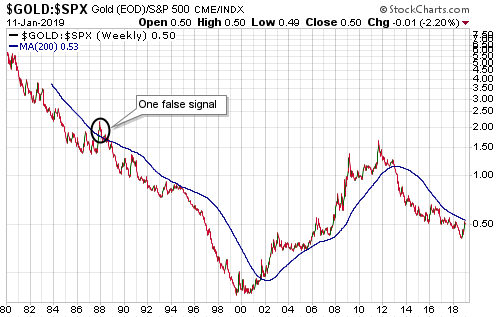
The ‘true fundamentals’ began shifting in gold’s favour in October of last year and by early-December the fundamental backdrop was gold-bullish for the first time in almost a year. However, there is not yet confirmation of a new gold bull market from the most reliable indicator of gold’s major trend. I’m referring to the fact that the gold/SPX ratio is yet to achieve a weekly close above its 200-week MA. Here’s the relevant chart:

gold_SPX_LT_140119

The significance of the gold/SPX ratio is based on the concept that the measuring stick is critical when determining whether something is in a bull market. If a measuring stick is losing value at a fast pace then almost everything will appear to be in a bull market relative to it. For example, pretty much everything in the world has been rising in value rapidly over the past few years when measured in terms of the Venezuelan bolivar. It should be obvious, though, that not everything can be simultaneously in a bull market. To determine which assets/investments are in a bull market we can’t only go by performance relative to any national currency; we must also look at the performances of assets/investments relative to each other.

That’s where the gold/SPX ratio comes in. Gold and the world’s most important equity index are effectively at opposite ends of the ‘investment seesaw’. Due to their respective natures, if one is in a long-term bull market then the other must be in a long-term bear market. In multi-year periods when they are both trending upward in dollar terms it means that the dollar is in a powerful bear market, not that gold and the SPX are simultaneously in bull markets.

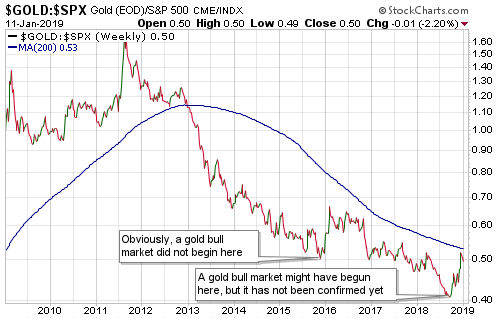
An implication — as noted on the following chart — is that a gold bull market did not begin in December-2015. Gold cannot be in a bull market and at the same time be making new 10-year lows relative to the SPX, which is what it was doing until as recently as August-2018. At least, it can’t do that if a practical and sensible definition of “bull market” is used.

It’s possible that a gold bull market got underway in August-2018, but as mentioned above this has not yet been confirmed.

gold_SPX_10yr_140119

The Japanese government is still pegging the gold price

January 8, 2019

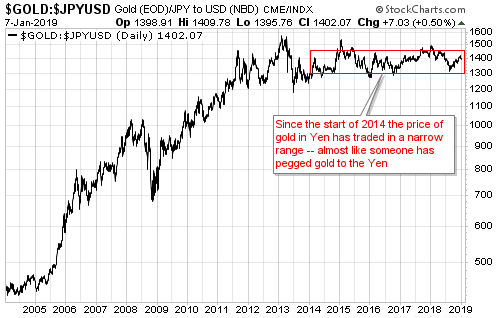
About five months ago I posted an article in response to stories that the Chinese government had pegged either the SDR-denominated gold price or the Yuan-denominated gold price. These stories were based on gold’s narrow trading range relative to the currency in question over the preceding two years, as if government manipulation were the only or the most plausible explanation for a narrow trading range in a global market. To illustrate the silliness of these stories I came up with my own story — that it was actually the Japanese government that was pegging the gold price. My story had, and still has, the advantage of being a better fit with the price data.

Just to recap, my story was that the Japanese government took control of the gold market in early-2014 and subsequently kept the Yen-denominated gold price at 137,000 +/- 5%. They lost control in early-2015 and again in early-2018, but in both cases they quickly brought the market back into line.

The following chart shows that they remain in control.

gold_Yenpeg_080119

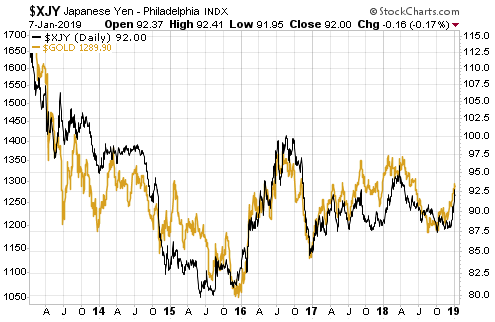
The narrow sideways range of the Yen gold price over the past 5 years is due to the Yen being the major currency to which gold has been most strongly correlated. The correlation is positive, meaning that the prices of gold and the Yen have a strong tendency to trend in the same direction. This is evidenced by the following daily chart, which compares the US$ price of gold with the US$ price of the Yen.

gold_Yen_080119

Moving from the fantasy world to the real world, the relationship depicted above doesn’t exist because the Japanese government is pegging gold to the Yen. It exists because both gold and the Yen trade like safe havens, meaning that they tend to do relatively well when economic growth expectations and the general desire to take-on risk are on the decline, and relatively poorly when economic growth expectations and the general desire to take-on risk are on the rise.

Gold trades like a safe haven because in part that’s what it is. The Yen is a piece of crap, but it trades like a safe haven due to the relentless popularity of Yen carry trades. These carry trades involve borrowing/shorting the Yen to finance long positions in higher-yielding currencies, and are a form of yield-chasing speculation. Periodically they have to be exited in a hurry to mitigate the losses caused by declining prices in the aforementioned high-yielding speculations. When this happens the Yen rallies, and sometimes the rallies are dramatic. Last week, for example.

Divergences or non-confirmations between gold and the Yen can create trading opportunities. However, the two markets are in line with each other at the moment, meaning that there is currently no divergence or non-confirmation worth trading.