December 1, 2015
The following charts from www.sharelynx.com are referenced in an email that will soon be sent to TSI subscribers.
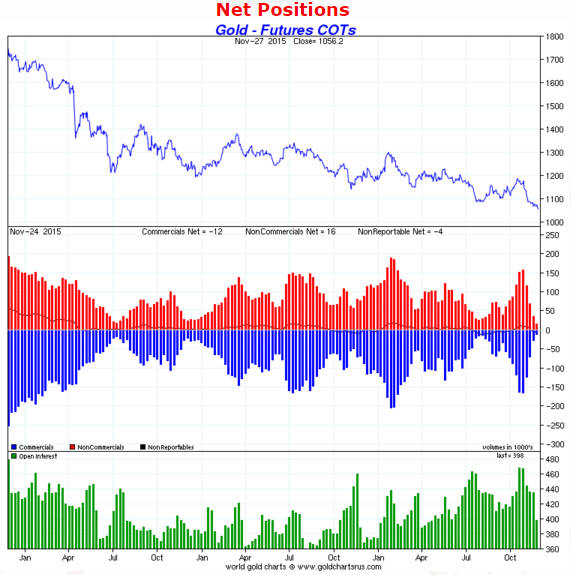
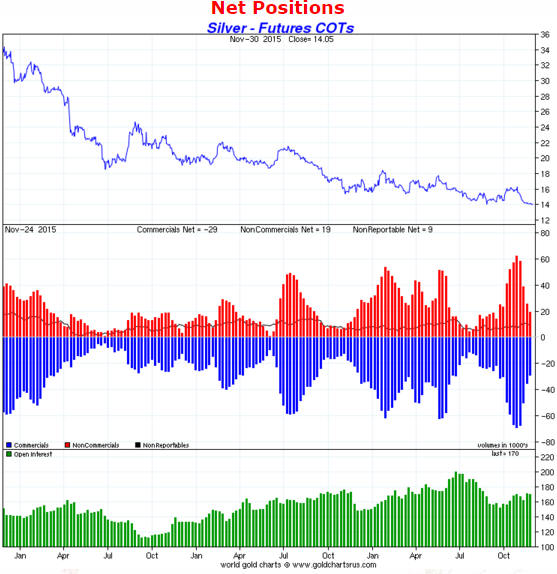

The following charts from www.sharelynx.com are referenced in an email that will soon be sent to TSI subscribers.
This post is a slightly-modified excerpt from a recent TSI commentary.
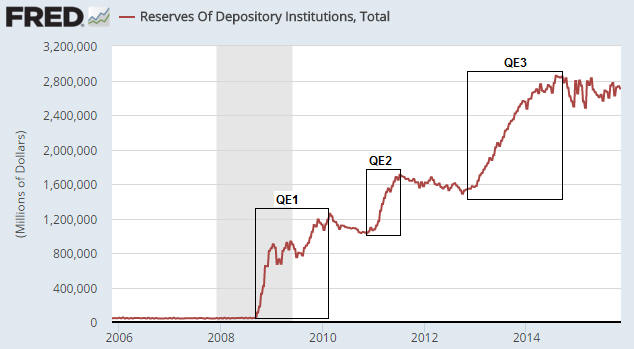
In the US, the commercial banks can create money and the Fed can create money. A chart showing the change in the US money supply therefore won’t directly tell us if the Fed was a creator of new money during the period covered by the chart. However, unlike the commercial banks, when the Fed monetises debt it boosts bank reserves as well as the money supply, which means that we can quickly identify the periods during which the Fed was a direct creator of new money by looking at a chart of the total quantity of US bank reserves. Such a chart is displayed below.
With reference to this chart, notice the huge rises in bank reserves during the periods labeled “QE1”, “QE2” and “QE3”. These are the times when the Fed was directly creating new money. The downward/sideways drifts in bank reserves prior to the start of “QE1”, between the QE programs and since the end of “QE3” are times when the Fed was not directly creating new money. The US money supply still increased during these ‘non-QE’ periods, but it increased due to the actions of commercial banks rather than the direct intervention of the Fed.
To put the 2008-2015 period into perspective, here is a chart showing the total quantity of US bank reserves going back to 1959. Notice that for decades prior to 2008, total bank reserves hovered just above zero. There was a lot of monetary inflation during this period, but almost none of it was due to the direct creation of money by the Fed.
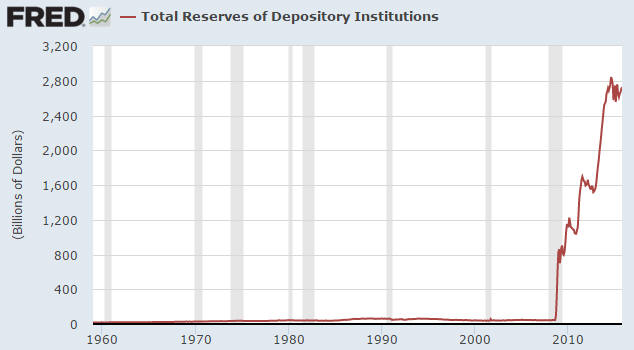
As an aside, if you compare the above chart of bank reserves with a chart of commercial bank credit you will see that over the past few decades there has been no relationship between bank reserves and the quantity of money loaned into existence by US commercial banks. That’s why, as I wrote in a recent blog post (https://tsi-blog.com/2015/10/the-zero-reserve-banking-system/), it’s more realistic to think of the US as now having a zero-reserve banking system as opposed to a fractional-reserve banking system. Bank reserves are a throw-back to an earlier monetary system, when gold was held in reserve and receipts for gold circulated within the economy. It makes no sense to have dollars backed by dollars, especially since the quantity of dollars held in reserve in no way determines/limits the quantity of dollars loaned into existence or held in bank deposits.
An extraordinary situation can start to seem ordinary if it persists for long enough, so the main point I wanted to reiterate with the help of the above charts is that the past several years constitute a massive and unprecedented departure from the Fed’s traditional mode of operation. An implication is that the Fed’s next monetary tightening program, which may or may not tentatively begin with a tiny rate hike in December, will not look like any previous monetary tightening program. The “uncharted waters” cliche is now very appropriate.
If you listen to the top central bankers of the world talk for long enough you will come away with the impression that central banks are attempting to give us “price inflation”, as if rising prices were beneficial. However, nobody wants to pay more for stuff. In fact, rational people prefer to pay less, not more. Therefore, when central banks claim to be giving us “price inflation” what they are really doing is stealing the “price deflation” from which we would otherwise benefit.
We are told that a general expectation of rising prices is important, because if people start expecting prices to be lower in the future then they will curtail their spending in the present. This, apparently, will lead to an economically-disastrous downward spiral in which the general expectation of lower prices leads to reduced spending and reduced spending leads to even lower prices.
The economic ‘logic’ contained in the idea that expectations of higher prices are needed to promote present-day spending explains why companies like Apple can never sell anything. After all, who in their right mind would buy an Apple product today when they can be sure that a better product will be available at a lower price by this time next year?
And just imagine how bad it would be if prices trended lower throughout the entire economy the way they do in the computing and mobile communications industries. There would be almost no spending anywhere! That operation to save your life that you have scheduled for next week could be postponed until healthcare charges have declined to much lower levels. And all of the eating you were planning on doing over the next few months could be delayed indefinitely in anticipation of more attractive food prices. And there would never be a good reason to buy a house or a car because each year you did without these things, the more of a bargain they would become and the better off you would be for not having bought earlier.
Also, try to imagine how bad it must have been before there were central banks to guarantee a continuous rise in the general price level. If expectations of rising prices are needed to promote spending and growth, then in pre-central-bank days, when money often increased in purchasing-power from one year to the next, there must have been almost no spending anywhere in the economy. That is, there must have been relentless economic contraction. Thankfully, we now have people like Ben Bernanke, Janet Yellen, Mario Draghi and Haruhiko Kuroda to save us from such a predicament.
The point that hopefully hasn’t been totally obscured by my sarcasm is that central bankers are thieves. They are stealing our deflation. It isn’t fair to compare them with common burglars, though, because common burglars don’t claim to be doing you a favour while they make off with your valuables.
With the US$ gold price near a 5-year low, the above question probably seems strange. However, the US$ isn’t the only measure of price.
It is also reasonable to measure gold’s price in terms of other commodities. This is because although gold isn’t just a commodity, under the current monetary system its price should never become divorced from the prices of other commodities. Short-term divergences between gold and the broad-based commodity indices will occur in response to macro-economic developments, but, for example, there isn’t going to be a major upward trend in the gold price while the prices of most other commodities are in major downward trends.
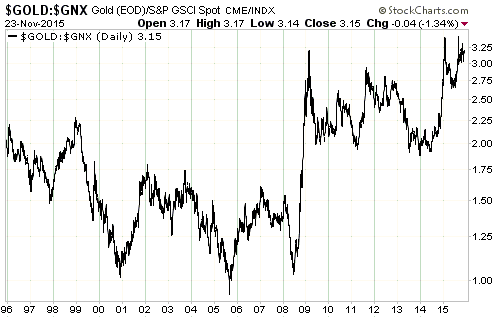
When measured in terms of other commodities, gold’s current price is high. For example, the following chart shows that gold made a new 20-year high relative to the Goldman Sachs Spot Commodity Index (GNX) in January and has recently moved back to near its high.
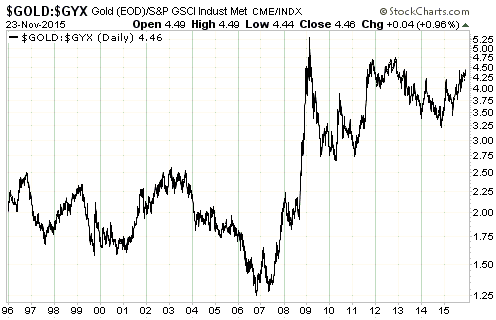
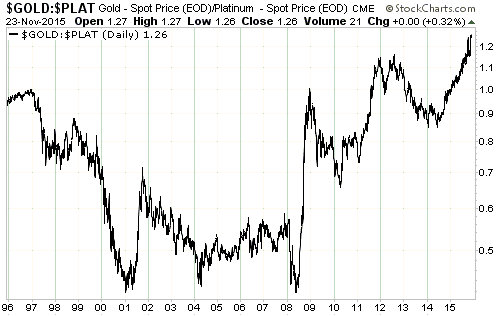
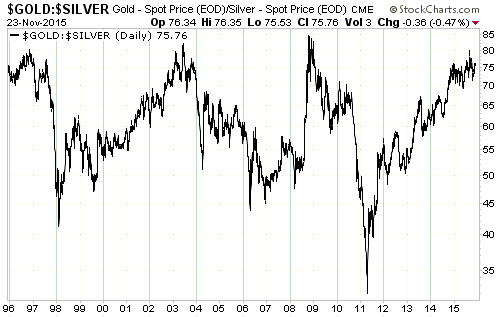
And if we measure gold in terms of other metals rather than commodities in general, it’s a similar story. In particular, the following charts show that a) relative to the Industrial Metals Index (GYX) gold is only 6% below its 2011-2012 highs and within 15% of the 20-year high that was reached at the crescendo of the 2008-2009 global financial crisis, b) gold is at a 20-year high relative to platinum, and c) gold is close to the top of its 20-year range relative to silver.
Gold normally performs relatively poorly during economic booms and relatively well during economic busts. Gold’s current relatively high price is therefore indicative of a weak global economic situation.
If the global economic backdrop becomes superficially better over the months/quarters ahead and the Fed hikes interest rates as per its current tentative plan, then even if the gold price rises in US$ terms next year it will probably fall in terms of the broad-based commodity indices and most other metals. That, of course, is a big if.