More Tariff Turmoil

February 24, 2026

[This blog post is an abbreviated excerpt from a recent commentary published at www.speculative.investor.com]

On Friday of last week the Supreme Court of the United States (SCOTUS) ruled against the tariffs imposed by Trump under the International Emergency Economic Powers Act (IEEPA). What will be the financial-market and economic effects?

Based on the financial world’s initial reaction, the effects will be relatively minor. For example, the following weekly chart shows that the iShares 20+ Year Treasury ETF (TLT) consolidated last week but held the preceding week’s upside breakout. Also, the currency market did very little in response to the news.

The small initial market reaction probably stems from the fact that the Trump Administration intends to replace the tariff revenues lost through the inability to use the IEEPA with tariff revenues gained through other avenues, such as “Section 122”. In fact, Trump already has stated that he will use Section 122 to impose a global 15% (initially 10% but raised to 15% one day later) tariff on US imports. This would keep total tariff revenue at around the same level, but it would change substantially the distribution of the tariffs. For example, the average tariff on imports from China would be reduced, but the average tariff applied to imports from Canada would increase.

The single biggest problem associated with Trump’s use of tariffs has been the uncertainty resulting from the sudden changes. The uncertainty remains, because there will be many changes to product tariff rates in response to last Friday’s SCOTUS ruling, necessitating changes to many business plans. Furthermore, the President’s authority under Section 122 only enables the imposition of tariffs for up to 150 days. What happens after that?

Trump has been fortunate in that the business investment that has been curtailed/delayed by his many tariff-related threats and policy flip-flops has coincided with a massive increase in investment associated with AI — investment that would have happened regardless of who was in the White House. As illustrated by the following quarterly chart, Real Gross Private Domestic Investment (RGPDI) in the US has dropped from its Q1-2025 all-time high, but not by much. Moreover, with at least US$1 trillion of AI-related investment slated to occur during 2026 in an economy with a current RGPDI run-rate of about US$4.4 trillion, there’s a good chance that RGPDI will make a new all-time high within the next three quarters despite the uncertainty caused by the tariffs.

Unfortunately, this AI-related investment binge won’t do anything for average Americans other than increase their electricity costs and make their jobs less secure.

Summing up, last Friday’s ruling on Trump’s tariffs has removed a ‘known unknown’, but it has created new unknowns and hasn’t prompted a change to our outlook for any market. Currently, the ‘known unknown’ with the largest potential short-term market impact is the US-Iran situation.

REE prices are making new highs

February 9, 2026

[This blog post is an excerpt from a recent commentary at www.speculative-investor.com]

The stock prices of companies focussed on Rare Earth Elements (REEs) rallied well in advance of the underlying commodities during May-October of last year, but recently the prices of the commodities have gone up a lot while the REE sector of the stock market has been in correction mode. This actually is normal for some commodity sectors, chief among them being REEs and lithium, during cyclical bull markets. First the equities make big up-moves while the commodities do very little, after which the equities correct/consolidate while commodity prices catch up. Then the cycle repeats, with the equities rallying anew.

The following daily charts illustrate what we just described. The first chart shows that there was a massive rally in the stock price of MP Materials (MP), a proxy for the REE equity sector, from a low in May to a peak in October of last year, at which point a substantial correction began. The second chart shows that during May-October there was only a moderate advance in the price of Neodymium (Nd), a proxy for REEs, but that over the past two months there has been a parabolic rise to well above the October high.

Based on the historical pattern, we expect that the Nd price will level off within the coming month or so and that at around the same time the REE equities will commence new intermediate-term upward trends.

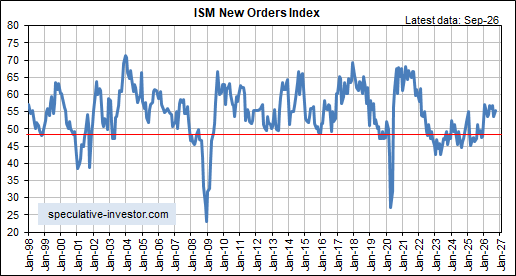
Upward pressure on the prices of many industrial commodities, including REEs, lithium, copper, tin, nickel and natural gas, will be maintained for at least another 12 months due to the on-going datacentre buildout, which not only is continuing but accelerating. Just four companies (Alphabet, Amazon, Meta and Microsoft) are together anticipating capital spending of around US$650B this year, up from the already-substantial amount of US$360B in 2025. These spending plans could explain January’s large rise in the ISM Manufacturing New Orders Index.

Is an official US gold revaluation coming?

January 28, 2026

[This blog post is an excerpt from a commentary published about two weeks ago at www.speculative-investor.com]

During February-March of last year there was talk of the US government revaluing the gold bullion that currently is an asset on the balance sheet of the Fed. The asset was being valued at $11B, or only US$42.22/ounce, whereas the market value of the asset at that time was around US$770B. The situation today is that the asset is still being valued at only US$11B, whereas its market value is now around US$1.2 trillion. This means that bringing the asset’s official valuation in line with its market value would now result in the addition of more than $1 trillion to the Treasury’s account at the Fed (the Treasury General Account, or TGA). Is this likely to happen anytime soon?

When we addressed this topic in February of last year, our answer to the above question was “no”. The reason, in a nutshell, was that while the monetary injection would give the economy a short-term boost, it would have longer-term negative effects including higher price inflation. We concluded that due to the short-term nature of any positive effect on the economy, from a purely political perspective it would make more sense to implement the revaluation during the final year of the Presidential term than during the first year.

Due to the looming importance to Trump of the November-2026 mid-term elections, we now think that the revaluation could happen within the next few months.

If the mid-term elections result in the Democratic Party gaining control of the House, the path ahead for Trump would become far more difficult. Not only would it be harder for him to pursue his policy agenda, but also he probably would be impeached for a third time. Creating the impression that the economy was strong or at least improving during the months leading up to the election would reduce the risk of this happening. In this respect, we can’t think of anything realistic that would be as effective as a $1 trillion monetary injection that did not have to be financed via debt.

Adding a trillion new dollars to the TGA would be short-term bullish for almost everything except the US$. It would be bullish for the stock market, gold, commodities, bitcoin, and economic statistics such as GDP. It even would be bullish for the Treasury market, because it would enable the US government to spend a lot of money without issuing new debt. In fact, it’s possible that some of the money would be used to repurchase existing Treasury debt, thus lowering interest rates across the economy for a while.

Beyond the short-term it would be bullish for gold and commodities, but very bearish for Treasury bonds and the economy. However, that would be a 2027 story.

Commodity price surges: Unique, but linked

January 22, 2026

[This blog post is an excerpt from a recent commentary at www.speculative-investor.com]

Whether it is war or accidents at major mines or weather or trade disputes or political upheaval or power shortages, every large rise in the price of any commodity will have its own unique drivers. However, there are periods when many commodities experience large price rises. Even though each of these price rises will have its own fundamental reasons and will seem special when viewed in isolation, a broader view will indicate that they are related.

One reason for the existence of periods during which many commodities experience large price rises, each for a seemingly unique reason, is that long periods of under-investment in commodity production due to low prices make the markets far more vulnerable to supply disruptions. Consequently, an issue (for example, a drought, a mine collapse, a civil war) in one part of the world that during some periods would be taken in stride and result in a relatively small rise in the international price, can lead to a globally important shortage and a huge price rise.

A second reason is the macroeconomic/monetary backdrop and a feedback loop involving commodities and conflict. Monetary inflation eventually leads to economic hardship by raising the cost of living and getting in the way of economic progress. As the inflation problem becomes more obvious, commodities are hoarded both for insurance and speculation purposes, putting additional upward pressure on prices throughout the economy and exacerbating the hardship. This leads to conflict within countries and between countries. If the conflict involves countries that are important in the global supply chain for any commodity, which it often does, then the price of that commodity will rise in dramatic fashion.

The current situation in the tin market is a relevant example. Over the past year there have been supply disruptions due to decisions to curtail production in Myanmar, where 10%-15% of the world’s tin supply originates, and conflict between government and rebel forces in the Democratic Republic of the Congo (DRC), where about 6% of the world’s tin supply originates. These supply issues have led to the price surge illustrated below. While a short-term price peak probably will be set soon, this market will remain acutely vulnerable to supply disruptions due to the combination of additional demand from the building of datacentres and long-term under-investment in mining.

There have been several dramatic price rises in commodity markets over the past six months and we expect to see many more over the next two years. Each will have its own unique drivers, but almost all of them will be related to the underlying influences outlined above.

The metals rally continues

January 13, 2026

[This blog post is an excerpt from a recent commentary at www.speculative-investor.com]

The broad rally in the world of metals has continued during the first full week of 2026. During December the upward price momentum in the white metals (silver and the PGMs) became extreme, but now we are seeing dramatic upward price acceleration elsewhere. In particular, the rises in the prices of copper and lithium have become parabolic.

During the first half of this week the copper price in the US traded above US$6/pound for the first time ever, and the following chart shows that the price of copper on the London Metal Exchange (LME), which is less affected by tariff stupidity than the price in the US, is now above US$13,000/tonne. Prior to the past two months it had never been above US$11,000/tonne.

For its part, lithium carbonate priced in Chinese Yuan per tonne (CNY/t) has gained about 120% since June-2025 and about 45% over just the past month. Refer to the following chart for the details. Furthermore, since the Yuan has strengthened relative to the US$ the performance in US$ terms has been even better.

We wrote numerous times over the past two years that the gold bull market would broaden to encompass almost all commodities, starting with the white metals and then moving to other industrial metals and lastly to oil. We noted soon after it happened that the tariff-related panic in April-2025 had marked a turning point for the white metals relative to gold, while industrial metals in general have been strengthening relative to gold since October-2025. Therefore, it is fair to say that the broad strength that we are seeing across the metals markets was anticipated.

At this point in the cycle, it’s very unlikely that industrial metals such as copper and lithium are close to major price tops. On the contrary, the rallies from last year’s lows probably are just the initial rallies — the first of two or three bull-market legs. However, like the price action in silver and the PGMs, the price action in the copper and lithium markets is setting the stage for multi-month corrections. It also will be increasing costs in many industries, which is a related issue because there will be demand destruction if prices continue to rise rapidly. For example, in response to the huge recent price rise in silver, solar cell manufacturers, the largest industrial consumers of silver, are finding ways to substitute base metals for silver in their products.

So, don’t forget to take some profits!

AI Commodities

December 15, 2025

[This blog post is an excerpt from a commentary published at www.speculative-investor.com within the past fortnight]

It has become clear to many analysts that the amount of money being poured into AI-related investment doesn’t make sense. The numbers just don’t add up, meaning that there appears to be little chance that many of the individual investments will achieve reasonable returns and no chance that the investment, in the aggregate, will achieve a reasonable return. This is true, but the rapid rate of spending probably will continue. Fortunately, there is a way to profit that doesn’t involve trying to pick winners in the technology race and doesn’t rely on the AI-related spending being profitable for the companies making the investments.

The rapid rate of spending on AI probably will continue, for two main reasons. The first is that although concerns regarding the magnitude of capital spending by formerly capital-light companies such as Oracle (ORCL) are beginning to appear in both the stock market and the bond market, it’s likely that the senior managers of the mega-cap tech companies view falling behind in the AI race as an existential threat. In other words, the current rate of spending creates a big risk, but failing to spend enough and thus falling behind one’s competitors could be an even bigger risk.

The second is that political leaders in both the US and China clearly believe that for both military and economic purposes, AI-related development in their country must at least keep up with the AI-related development in the country perceived to be their main adversary. Therefore, it’s reasonable to expect that there will be government pressure and incentives to ensure that the private sector continues to invest massive sums in AI and the associated infrastructure.

We think that the safest way to participate in this on-going investment boom is to own the shares of the companies that produce the raw materials that are needed to 1) build datacentres and the equipment that goes into them, and 2) build and fuel the systems that supply power to datacentres. Examples include the producers of natural gas, uranium, copper, tin, REEs and lithium.

The strategy of owning the stocks of companies that produce the raw materials required for the AI boom has worked well for us over the past 12 months and probably will work well for at least another 1-2 years, with — naturally — the occasional gut-wrenching correction along the way. Moreover, this strategy not only obviates any need to pick the AI winners, but also meshes with the fact that we have entered the phase of the economic cycle in which industrial commodities would likely perform well even without the additional impetus provided by the AI spending binge.

A final related point is that while the commodities mentioned above probably have all commenced cyclical bull markets, they tend to rally and correct at different times within these overarching cyclical upward trends. For example, the stocks of REE- and uranium-focussed companies were star performers during the second and third quarters of this year, but during September-November the focus shifted to lithium stocks and over the past few weeks the focus shifted again — to natural gas stocks. This means that it is not uncommon for a short-term selling opportunity in the stocks of companies focussed on one commodity to coincide with a short-term buying opportunity in the stocks of companies focussed on a different commodity.

Statistical aggregates have never been less useful

December 3, 2025

[This blog post is an excerpt from a recent commentary at www.speculative-investor.com]

Aggregates such as Gross Domestic Product (GDP) and Consumer Price Index (CPI) always have been fatally flawed. For example, the GDP calculation treats a dollar of wasteful spending as if it were the same as a dollar of productive spending, and the concept that a single number (the CPI) could represent the economy-wide price of money has never made sense. However, over the past several years some of the highest-profile economic aggregates have become more misleading than ever, prompting economists and politicians to wonder: “Why is the average person so concerned about his/her financial situation when the economy is doing so well?”

In the US, the Bureau of Economic Analysis probably will report that real GDP grew at the annualised rate of 3%-4% during the third quarter of this year, which is suggestive of a strong economy. At the same time, however, President Trump’s approval rating on the economy is very low and measures of consumer confidence are in the dumps. For example, the following chart shows that US Consumer Sentiment as measured by the University of Michigan is near a 10-year low.

The discrepancy between the economic aggregates and the perception of the average person was explained in a recent FT article. Here’s an excerpt:

The American economy is deeply split, with those at the top enjoying unparalleled prosperity and the rest of the country struggling to make ends meet. The top 10 per cent of earners now account for almost half of all spending, up from about a third in the 1990s. Many are feeling particularly flush as they enjoy the fruits of a strong stock market — the S&P is up more than 15 per cent this year, despite a few wobbles. For everyone else, the picture is gloomy. Lay-offs are surging, consumer sentiment has fallen by 30 per cent year on year to near-record lows, and three out of four Americans tell pollsters that the economy is in fair or poor shape.

And:

The share of Americans who describe themselves as middle class has dropped from 85 per cent a decade ago to 54 per cent. Over 40 per cent of Americans consider themselves lower or working class, suggesting that many of the finer things feel completely out of reach.

In short, the aggregates reflect a large increase in spending on the part of the wealthy, while most people are struggling financially. This has political consequences and probably is the main reason for Trump’s success in November-2024 despite the strong — according to high-profile statistics — economy of the time. Moreover, the economic trends of 2022-2024 and their effects on the political realm have continued this year, with the recent election of Zohran Mamdani, a so-called “democratic socialist”, as the New York City Mayor being one of the consequences.

All economic trends affect the financial markets in some way and economic trends that bring about political upheaval tend to have big effects on the financial markets. Although the “inflation” resulting from simultaneously creating a supply shock and showering the populace with money during 2020-2021 is the main cause of the current malaise, it’s a good bet that additional inflationary policies will be part of the official solution to the problem. For example, Trump is talking about sending a $2,000 “tariff dividend check” to almost everyone next year and cutting income tax*, while the Federal Reserve almost certainly will be taking actions to ease monetary conditions. We expect that these policies will extend the gold bull market and fuel even bigger price gains within the ranks of industrial commodities.

*Trump is saying that the income tax cut will be funded by tariff revenue, but you only need rudimentary understanding of the size of the federal budget relative to projected tariff revenue to know that this is nonsense. Any significant cut in US income taxes will be funded by an increase in government indebtedness.

Something changed in October

November 16, 2025

We have never come across a satisfactory way of quantifying overall financial market liquidity, but major trend changes in liquidity can be observed in the price action. In this regard, the price action in several markets points to a major downward reversal in the liquidity trend having occurred during the first half of October.

To further explain, too many markets reversed course during the first half of October for it to be a random coincidence. Therefore, during this period there must have been an underlying shift in something with the ability to pressure prices in diverse markets upward or downward. A shift in the liquidity trend is the most logical explanation.

A shift in the liquidity trend could explain why all the following happened within a 2-week period:

1) There were spectacular downward reversals in the prices of stocks focussed on Rare Earth Elements (REEs), indicating that the REE bubble — a bubble that was extremely profitable for us — has burst.

2) The prices of gold and silver rocketed upward and then reversed downward.

3) The gold mining indices/ETFs peaked in mid-October, two days after breaking above their 2011 highs, and then plunged.

4) The prices of platinum and palladium rocketed upward and then plunged.

5) After peaking during the second week of October, US Antimony Corp. (UAMY), a proxy for the antimony speculation, quickly lost about two-thirds of its value.

6) Bitcoin made a new all-time high and then reversed downward.

7) The German stock market, as represented on the following chart by the DAX, made a marginal new all-time high and then reversed course. The chart indicates that the DAX may be about to complete an intermediate-term topping pattern.

The most important market that is yet to show evidence of declining liquidity is the one that is being supported to the greatest extent by passive money flows: the US stock market as represented by the SPX. However, if a major liquidity trend reversal is underway then its effects should start to become apparent in the senior US equity indices by early next year at the latest. More generally, if a major liquidity trend reversal is underway then no market will be spared and the next several months will be a period in which to ‘play defence’.

The Rare Earth Element (REE) Bubble Bursts

November 12, 2025

[This blog post is a brief excerpt from a commentary published at www.speculative-investor.com on 9th November]

In the 15th October Interim Update, under the heading “The REE Bubble”, we wrote that all the REE-related stocks that we track except for Neo Performance Materials (NEO.TO) were now in bubble territory. This was not only because equity prices had gone parabolic, but also because the price gains in the stock market were not supported by price gains in the underlying commodities. We went on to write that the bull market possibly had years to run, but the risk of an intervening crash had become high. Therefore, we recommended that anyone with significant exposure to REE-related stocks who had not yet harvested meaningful profits, should do so right away. Our warning was well timed, because a crash began almost immediately.

The first of the following daily charts shows that MP Materials (MP), the largest (in terms of market capitalisation) stock in the REE sector and a stock that we use as a sector proxy, fell by 50% from its October high to last week’s low. The second chart shows the performance of USA Rare Earth (USAR), a stock that looked very expensive in early-September — BEFORE it tripled in price on the way to a blow-off top in October. USAR lost two-thirds of its value from its October high to last week’s low.

On average, the prices of the REE stocks on our radar screen fell by around 50% from last month’s high to last week’s low. The stock price of Neo Performance Materials (NEO.TO) held up relatively well and suffered a peak-to-trough decline of ‘only’ 32%, because it didn’t rise by as much in the lead-up to the top and because its current valuation is underpinned by current revenue and earnings.

The way these things usually go, the initial phase of the crash will be followed by a rebound to a lower high, a decline that tests or breaches the initial low, and then several months of base-building. After that, the next leg of the bull market possibly will begin. Note that last Friday’s price action suggests that the initial phase of the crash is complete, so over the weeks ahead there probably will be a rebound.

With commodity-related stocks, we like to do most of our buying during base-building periods and to scale-out during the parabolic rallies.

Is the gold mining boom over?

October 31, 2025

[This blog post is an excerpt from a commentary published at www.speculative-investor.com on 26th October]

After the close of trading last Thursday, Newmont Mining (NEM), the first senior gold producer to report quarterly financial results, released its results for Q3-2025. As expected, given the high average gold price and gold/oil ratio during the quarter, the results were extremely good and included record-high quarterly cash-flow. The company earned US$1.71/share during the quarter, which is US$6.84/share annualised. This means that despite this year’s large gain in its share price, NEM is being valued by the stock market at only about 12-times trailing earnings. We expect that it will be a similar story for most senior and mid-tier gold producers.

Further to comments in our lithium discussion earlier in today’s report, the fact that earnings are high and P/E ratios are low in the gold mining sector does not preclude the possibility that a long-term price top is forming. On the contrary, in the commodity realm, financial results and valuations tend to be most inviting near the ends of bull markets. However, the signs that normally are seen near the end of a gold-mining bull market are not currently evident. Before we get to that, the long-term underperformance of gold mining stocks relative to gold bullion is worth a brief revisit.

The main reason that gold mining stocks, as a group, underperform gold bullion over the long-term is that just as monetary inflation and the associated interest-rate manipulation promote malinvestment in the broad economy, they do the same in the gold mining sector. The difference is that booms in the gold mining sector generally coincide with busts in the broad economy, and vice versa.

As an aside, don’t be misled by the performances of equity indices such as the SPX into thinking that the US economy is in the boom phase of the economic cycle. Due to the domination of passive investing, the performance of the stock market now has very little to do with the performance of the broad economy. In the US economy over the past few years there have been booms in a small number of sectors, chief among them being AI and the related infrastructure, but the economy as a whole has been in the bust phase. Busts usually, but not always, culminate in a recession, with a surge in monetary inflation associated with the official response to the recession sowing the seeds of the next boom.

In the gold mining sector, the malinvestment that eventually stems from a boom involves ill-conceived acquisitions and project developments, the costs of which get written-off years later during the bust phase. The result is wealth destruction over the long-term.

A point we want to make today is that at this stage of the gold sector’s boom there are no signs of widespread malinvestment. On the contrary, NEM and other large-scale gold producers still appear to be more focussed on cost reduction and cash-flow maximisation than on growth, especially ‘growth at any price’. This suggests to us that the end of the boom phase is not imminent.

The end of the boom is not imminent, but the intermediate-term upward trend that began late last year is almost certainly over.