How the fundamental backdrop could turn bullish for gold

December 16, 2016

Here is an excerpt from a TSI commentary that was published about a week ago.

A cottage industry has developed around manipulation-focused gold commentary. In this industry, gold’s price changes are portrayed as the outcome of a never-ending battle between the forces of good and evil, with the evil side constantly trying to beat the price down and the good side constantly buying or holding. Also, in the world imagined by this industry the fundamental backdrop is always gold-bullish. The implication is that all price rises are in accordance with the fundamentals and all price declines are contrary to the fundamentals and likely the result of manipulation by the forces of evil.

In the real world, however, the fundamentals are always in a state of flux — sometimes bullish, sometimes bearish, and sometimes mixed/neutral. Furthermore, our experience has been that gold tracks fundamental developments more closely/accurately than any other market.

When the gold price was topping in July-August of this year, the fundamental backdrop wasn’t gold-bearish; it was neutral. The ‘fundamentals’ therefore didn’t signal a top, but they did indicate that additional gains in the gold price would not have been fundamentally-supported and would therefore have required a further ramp-up in speculative buying.

From early-July through to early-November the ‘true fundamentals’ shifted between being neutral to being slightly-bearish for gold and then back again (we thought they were slightly bearish from mid-September through to mid-October and otherwise neutral). They turned bearish, however, a couple of days after the US Presidential Election and since around mid-November have been their most bearish in at least three years.

The fundamental backdrop is now definitively gold-bearish because we have a) real interest rates in an upward trend and at a 6-month high in the US, b) US credit spreads immersed in a major contraction (indicating rising economic confidence), c) dramatic relative strength in bank stocks (indicating sharply-rising confidence in the banking/financial system), and d) the Dollar Index in a strong upward trend and near a multi-year high. Given these conditions, any analyst/commentator who is now claiming that the ‘fundamentals’ are bullish for gold is either clueless about gold’s true fundamentals or is trying to promote an agenda.

That’s the situation today, but the situation will change. In broad-brushed terms, here are the two most likely ways that the situation could change to become supportive of an intermediate-term gold rally:

1) Rising inflation expectations

US inflation expectations have been rising since 11th February and have been rising at a quickened pace since late-September, but since Trump’s election victory the rate of increase in nominal interest rates has exceeded the rate of increase in inflation expectations. This has brought about a rise in REAL interest rates.

In effect, over the past month economic growth expectations have risen faster than inflation expectations. This doesn’t make a lot of sense considering the plans of the Trump Administration, but when speculating in the financial markets we must deal with ‘what is’ rather than ‘what should be’.

It’s certainly possible that at some point over the next few months the markets will figure out that the combined plans of the US government and the Fed will lead to more “price inflation” than economic growth, resulting in a relatively fast increase in inflation expectations. As well as causing real interest rates to fall, this would result in a weaker US$ and a further steepening of the yield curve. All told, it would result in the fundamental backdrop becoming gold-bullish.

2) A banking crisis in Europe

The major banks around the world are intimately and intricately connected via their massive derivative books, so a banking crisis that began in Europe would not remain confined to Europe. It would lead to concerns about the profitability of US banks, which, in turn, would lead to relative weakness in bank stocks and a general shift towards safety. Interest rates on Treasury debt would fall faster than inflation expectations, resulting in a lower real interest rate in the US. Also, short-term interest rates would fall relative to long-term interest rates due to a flight to liquidity and the market beginning to anticipate a shift in the Fed’s stance, resulting in a steepening of the yield curve. The overall effect would be a fundamental backdrop that was gold-bullish.

Either of the above could happen within the next few months, but neither is happening now.
The second most overbought market since 1980

December 13, 2016

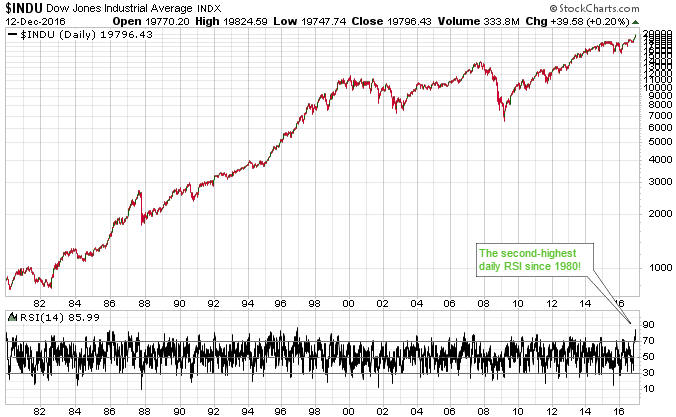
By one measure, the Dow Industrials Index is now at its second-most ‘overbought’ level since 1980. The measure I’m referring to is the 14-day RSI (Relative Strength Index), a short-term momentum oscillator shown in the bottom section of the following Dow chart.

Dow_LT_121216

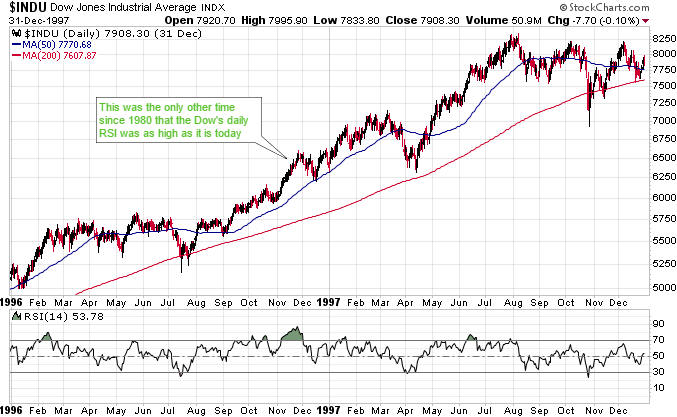
Being the most something-or-other (the most overbought/oversold, optimistic/pessimistic, etc.) since a distant past time often isn’t as important as it sounds. For instance, the only time since 1980 that the Dow’s daily RSI(14) was as high as it is today was in November of 1996 (interestingly, almost exactly 20 years ago), but nothing dramatic happened during the days, weeks or months that followed the November-1996 momentum extreme.

As illustrated below, a pullback to the 50-day moving average (MA) got underway within a few days of the momentum extreme, after which the Dow resumed its long-term advance. There was a more significant short-term pullback (to the 200-day MA) a few months later and an intermediate-term correction a few months after that (more than 8 months after the momentum extreme), but the bull market continued for another 3 years.

Dow_1996_121216

A short-term momentum extreme occurred at the price peak that was followed by the October-1987 stock market crash, but it is a lot more common for such extremes to be followed by nothing more serious than a routine multi-week correction. With measures of market breadth pointing to a 6-12 month extension of the bull market we probably won’t get anything more bearish than a routine multi-week correction within the next couple of months, although I admit that the near-vertical rally since the Presidential Election has me ‘on edge’.

An Australian gold producer sells high and buys low

December 9, 2016

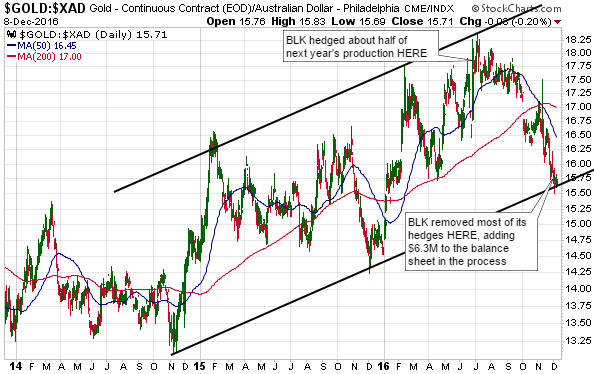
Blackham Resources (BLK.AX), a junior gold producer that has just begun to ramp-up production at a newly-commissioned mine in Western Australia, reported something interesting earlier this week. Having forward-sold about half of next year’s expected gold production a few months ago when the gold price was near its highs for the year, the company recently took advantage of gold’s price decline by closing-out the bulk of its forward sales. It did so by purchasing gold and delivering it into the forward sales contracts, thus realising a cash profit of A$6.3M.

In other words, having sold high during May-September, BLK’s management turned around and bought low over the past couple of weeks. Sell high, buy low. Sounds like a good strategy to me. More gold producers should try it.

gold_A$_081216

The problem is a single central bank, not a single currency

December 5, 2016

The euro-zone appears to be on target for another banking crisis during 2017. Also, the stage is set for political upheaval in some European countries, a general worsening of economic conditions throughout Europe and widening of the already-large gaps between the performances of the relatively-strong and relatively-weak European economies. It’s a virtual certainty that as was the case in reaction to earlier crises/recessions, blame for the bad situation will wrongly be heaped on Europe’s experiment with a common currency.

The idea that economically and/or politically disparate countries can’t use a common currency without sowing the seeds for major problems is just plain silly. It is loosely based on the fallacy that economic problems can be solved by currency depreciation. According to this line of thinking, countries such as Italy and Greece could recover if only they were using a currency that they could devalue at will. (Note: The destructiveness of the currency devaluation ‘solution’ was covered in a previous blog post.)

The fact is that economically and politically disparate countries throughout the world successfully used a common currency for centuries up to quite recently (in the grand scheme of things). The currency was called gold.

The problem isn’t the euro; it’s the European Central Bank (ECB). To put it another way, the problem isn’t that a bunch of different countries are using a common currency; it’s that a central planning agency is attempting to impose the same monetary policy across a bunch of different countries.

A central planning agency imposing monetary policy within a single country is bad enough, in that it generates false price signals, foments investment bubbles that inevitably end painfully, and reduces the rate of long-term economic progress. The Federal Reserve, for example, has wreaked havoc in the US over the past 15 years, first setting the scene for the collapse of 2007-2009 and then both getting in the way of a genuine recovery and setting the scene for the next collapse. However, when monetary policy (the combination of interest-rate and money-supply manipulations) is implemented across several economically-diverse countries, the resulting imbalances grow and become troublesome more quickly. That’s why Europe is destined to suffer a monetary collapse well ahead of the US.

It should be kept in mind that money is supposed to be neutral — a medium of exchange and a yardstick, not a tool for economic manipulation. It is inherently no more problematic for totally disparate countries to use a common currency than it is for totally disparate countries to use common measures of length or weight. On the contrary, a common currency makes international trading and investing more efficient. In particular, eliminating foreign-exchange commissions, hedging costs and the losses that are incurred due to unpredictable exchange-rate fluctuations would free-up resources that could be put to more productive uses.

In conclusion, the problem is the central planning of money and interest rates, not the fact that different countries use the same money. It’s a problem that exists everywhere; it’s just that it is more obvious in the euro-zone.