
China’s Incredible Smog

January 7, 2017

Global Warming, or Climate Change as it is now called, is not a problem. Earth’s climate has always been changing and will continue to do so, regardless of what anyone does. Pollution, however, is often a problem and in China the pollution problem has grown to the point where it could collapse the economy.

Here are a couple of Youtube videos that show the horrendous smog that engulfed Beijing over the past week. The commentary is in Chinese, but you don’t need to understand Chinese to understand what’s going on.

The first video shows several vehicle collisions caused by the near total lack of visibility on the road.

https://www.youtube.com/watch?v=FAuGMwV9hPA

In the second video, a couple of guys stop their cars on the road due to the lack of visibility. They get out, walk a short distance and are then unable to find their way back to the cars. The video is obviously staged, but it does a good job of showing the absurdly-bad air quality.

https://www.youtube.com/watch?v=-DIinNx5xzY

How are China’s policy-makers going to deal with this without shutting down a lot of power plants and refineries and without substantially curtailing the use of cars, that is, without crashing the economy? I have no idea.
Market manipulation is not price suppression

January 3, 2017

One of the most annoying claims made by manipulation-focused gold-market commentators is that evidence of market manipulation constitutes evidence of long-term price suppression. The claim is annoying not so much because it is obviously false, but because many people get fooled by it even though it is obviously false.

Experienced traders are well aware that banks and other large-scale operators regularly attempt to shift prices one way or the other in most financial markets to benefit their own bottom-lines. It has always been this way and it always will be this way. As I mentioned in previous blog posts (HERE, HERE and HERE, for example), when news emerges that banks have been caught manipulating prices in a market it isn’t really news at all.

Sometimes the manipulation is unethical and/or illegal (what’s illegal and what’s unethical aren’t always the same), but a lot of the price manipulation attempted by private operators in the financial markets is neither illegal nor unethical. A lot of the time it is a legitimate business practice.

From the perspective of manipulation-focused pontificators about gold, the big story over the past two years was the evidence that major banks had been scalping profits by manipulating the London Gold Fix. Deutsche Bank even settled lawsuits over allegations it manipulated gold and silver prices via the London Fix, thus providing plenty of grist for the conspiracy mill.

Assuming that banks were indeed using the twice-daily London Fix to manipulate gold prices, then in this case the manipulation was probably illegal and almost certainly unethical. If nothing else, it involved a breach of trust. However, as noted in a previous post on this topic the price manipulation that potentially occurred via the London Fix could only have affected prices by small amounts for very brief periods. Furthermore, the small effects would have been to both the upside and the downside.

The ‘news’ that banks used the London Gold Fix to illegitimately increase their profits is therefore completely irrelevant to the claim that there has been a successful price suppression scheme in operation in the gold market over a great many years. And yet, it has been portrayed as if it were the veritable “smoking gun” evidence of such a scheme.

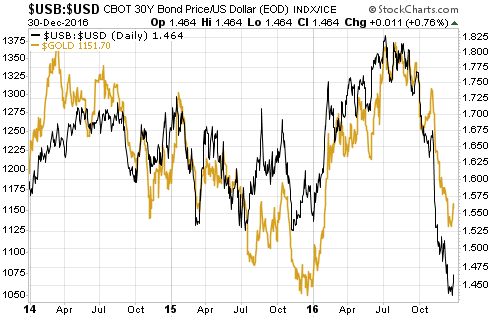
If the gold market had really been subject to price suppression over a long period then gold’s performance would be totally ‘out of whack’ with related financial markets. However, that is not the case. For example, the following chart shows the close relationship over the past three years between the US$ gold price and the bond/dollar ratio (the T-Bond price divided by the Dollar Index).

gold_USBUSD_020117

All of that being said, you are allowed to make money in the financial markets by doing something other than buying/owning gold. Therefore, if you truly believe that a powerful group has both the means and the motive to suppress the gold price then the solution is obvious: don’t buy gold.

“Gold has peaked for the year”, revisited

December 30, 2016

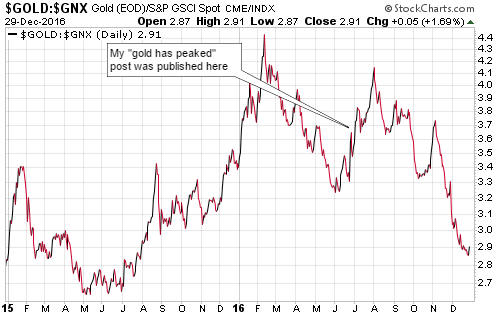
I published a blog post in late-June titled “Gold has peaked for the year“. In this post I argued that relative to other commodities (as represented by the Goldman Sachs Spot Commodity Index – GNX) gold’s peak for 2016 most likely happened in February. As evidenced by the following chart, I was correct.

gold_GNX_291216

The reason for this follow-up post is not to give myself a public ‘pat on the back’. I’ve made my share of mistakes in the past and I will make mistakes in the future. The sole reason for this post is the vitriolic response that my earlier article received.

My earlier article should not have been controversial. After all, the February-2016 peak for the gold/GNX ratio wasn’t just any old high, it was an all-time high. In other words, at that time gold was more expensive than it had ever been relative to commodities in general. Furthermore, it is typical for gold to turn upward ahead of the commodity indices and to subsequently relinquish its leadership.

With gold having outperformed to the point where it was at its highest price ever relative to the prices of other commodities and with other commodities likely to recover, saying that gold had probably peaked for the year in commodity terms should have been viewed as a statement of the bleeding obvious. It would have taken a financial crisis of at least 2008 proportions during the second half of 2016, that is, it would have taken an extremely low-probability financial-market outcome, to propel the gold/GNX ratio to new highs during the second half of the year. That some readers took my “Gold has peaked” article as an affront was therefore remarkable.

Remarkable, but not really surprising given that in the minds of some gold devotees the gold price is always too low. It doesn’t matter how high the price is or what’s happening in the world, the price is always about to skyrocket. The only obstacle in the way is a cabal of evil market manipulators that will soon be overwhelmed by the forces of good. And in any case, a financial crisis of at least 2008 proportions is always about to happen.

Gold’s poor performance during the second half of 2016 was consistent with what I refer to as the true fundamentals*. This means that it wasn’t the result of downward manipulation. That being said, the great thing about believing that market trends have almost nothing to do with “fundamentals” and almost everything to do with manipulation is that you never have to be wrong. If any market goes against you it was due to the distortive effects of manipulation rather than a fatal flaw in your analysis.

*The true fundamental drivers of the US$ gold price are, in no particular order: US credit spreads, the US yield curve, the real US interest rate, the relative strength of the US banking sector, the US dollar’s exchange rate and the general trend in commodity prices.

Why the Trump Presidency will go down in history as a disaster

December 27, 2016

[This post is an excerpt from a recent TSI commentary]

There are three reasons that the Trump Presidency will very likely go down in history as a disaster for the US, only the last of which has anything to do with Trump. The first two reasons are inter-related in that they are primarily the consequences of distortions/imbalances created by the Federal Reserve.

Due largely to the aggressive interventions of the Fed, including the creation of trillions of dollars via QE programs and keeping interest rates pegged near zero for eight years, the mal-investment problem in the US economy today is more serious than the mal-investment problem that led to the “great recession” of 2007-2009. This means that the next recession will probably be even more severe than the previous episode. It is possible that the extension of ultra-easy monetary conditions combined with fiscal ‘stimulus’ in the form of tax cuts will delay the start of the next recession by another 6-12 months, but for no fault of Trump it will almost certainly happen on his watch.

Also due to the aggressive interventions of the Fed, the US stock, bond and real-estate markets are now valued at levels that all but guarantee terrible performance over the coming few years. As is the case with an economic recession, it is possible that the extension of ultra-easy monetary conditions combined with fiscal ‘stimulus’ in the form of tax cuts will delay the start of the coming period of terrible performance; however, for no fault of Trump there will very likely be bear markets in the major US asset classes during his first — and almost certainly only — Presidential term.

While the coming severe recession and the bearish trends in asset prices were bound to occur and clearly have nothing to do with Trump, it looks like Trump is unwittingly setting himself up to take the blame.

His one chance of avoiding blame and paving the way for a genuine recovery to be in progress by the time of the next Presidential election would have been to stay out of the way and allow a major liquidation of the mal-investments to happen during the first half of 2017. This would have enabled the blame for the debacle to be appropriately placed at the feet of the Fed and the preceding Administration. However, having previously (and correctly) chided the Fed for having created a “big, fat, ugly bubble”, it seems that the deadly combination of hubris and ignorance has convinced Trump that he can set in motion a long period of strong growth with no intervening painful purgation.

In summary, certain bad economic and financial-market outcomes are currently set in stone. What’s not set in stone is who gets the blame. Unfortunately, Trump appears to be positioning himself to take the blame for the economic damage caused by others.