Investing in bubbles

November 3, 2017

[This post is an excerpt from a recent TSI commentary]

Many assets show signs of being immersed in bubbles right now. The most obvious example is the cryptocurrency speculation, which includes Bitcoin, the numerous and rapidly-multiplying Bitcoin alternatives and, more recently, the stocks that are involved in cryptocurrency ‘mining’. Other examples are the broad US stock market, the stocks of companies involved in social media and/or e-commerce, the market for junk bonds, and a group of junior mining stocks where just the hint of a possible discovery has led to spectacular price gains and market capitalisations that bear no resemblance to current reality.

The most enthusiastic participants in each bubble believe that although bubbles exist elsewhere, there is a special set of circumstances that justifies the seemingly high valuations in the asset that they happen to like. For example, many of the cryptocurrency enthusiasts believe that the US stock market’s valuation doesn’t make sense but that Bitcoin’s valuation does, and many stock-market bulls believe that the S&P500’s current level is justified whereas Bitcoin’s valuation is ridiculous. However, the bubbles are all related in that they all stem from the returns on conservative investments having been driven to near zero by the actions of central banks.

Now, just because an asset is immersed in an investment bubble doesn’t mean that it should be avoided. Buying something after it enters bubble territory can be very profitable, because huge gains will often occur AFTER valuation reaches a point where it no longer makes sense to a level-headed investor. The problem is, if you ‘know’ that a particular asset is immersed in a bubble then you will be constantly on the lookout for evidence that the bubble has ended and that the inevitable implosion has begun. In effect, you will constantly have one foot out the door and will be acutely vulnerable to being shaken out of your position in response to a normal correction.

A related problem is that once something has entered bubble territory the normal corrections tend to be vicious. Each correction will look like the start of the ultimate collapse, so unless you are a true believer (someone who believes so strongly in the story that they are oblivious to the absurdity of the valuation) you will be unable to hold through. For example, during the first half of September the Bitcoin price had a peak-to-trough decline of about 40%. This looked at the time as if it could be the first leg of a total collapse, but it turned out to be just a short-term correction. Only a true believer in the cryptocurrency story could have held through this correction.

Eventually, of course, a vicious price decline turns out to be the start of a bubble implosion. The true believers will naturally hold, thinking that it’s just another bump on the road to a much higher price. They will continue holding while all the gains made during the bubble are given back.

An implication is that you need to be a true believer to do phenomenally well from an investment bubble, but if you are a true believer then you will be wiped out after the bubble collapses.

Alternatively, you may decide to participate in an investment bubble while knowing it’s a bubble. In doing so you may be able to generate some good profits, but in general you will be too quick to sell. Therefore, while the bubble is in progress your profits will pale in comparison to those achieved by the true believers, although you will stand a better chance of retaining your profits over the long haul.

The worst-case scenario is to be a non-believer and non-participant in a bubble, but to eventually get persuaded by the relentless rise in price that special circumstances/fundamentals justify the valuation and that a large commitment is warranted. That is, to become a true believer late in the game. This worst-case scenario is what happens to most members of the general public.
An attempt to quantify the immeasurable

November 1, 2017

To paraphrase Einstein, not everything worth measuring is measurable and not everything measurable is worth measuring. The purchasing power of money falls into the former category. It is worth measuring, in that it would be useful to have a single number that consistently reflected the economy-wide purchasing power of money. However, such a number doesn’t exist.

Such a number doesn’t exist because a sensible result cannot be arrived at by summing or averaging the prices of disparate items. For example, it makes no sense to average the prices of a car, a haircut, electricity, a house, an apple, a dental checkup, a gallon of gasoline and an airline ticket. And yet, that is effectively what the government does — in a complicated way designed to make the end result lower than it otherwise would be — when it determines the CPI.

The government concocts economic statistics for propaganda purposes, but even the most honest and rigorous attempt to use price data to determine a single number that consistently paints an accurate picture of money purchasing power will fail. It must fail because it is an attempt to do the impossible.

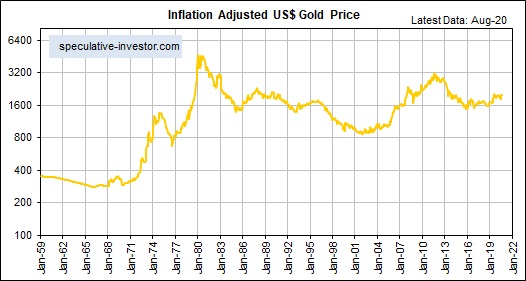
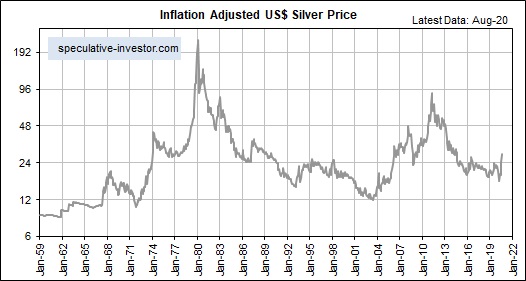
The goal of determining real (inflation-adjusted) performance is not completely hopeless, though, because we know what causes long-term changes in money purchasing power and we can roughly estimate the long-term effects of these causes. In particular, we know that over the long term the purchasing power of money falls due to increased money supply and rises due to increased population and productivity.

By using the known rates of increase in the money supply and the population and a ‘guesstimate’ of the rate of increase in labour productivity we can arrive at a theoretical rate of change for the purchasing power of money. Due to potentially-large oscillations in the desire to hold cash and to the fact that changes in the money supply can take years to impact the cost of living, this theoretical rate of purchasing-power change will tend to be inaccurate over periods of two years or less but should approximate the actual rate of purchasing-power change over periods of five years or more.

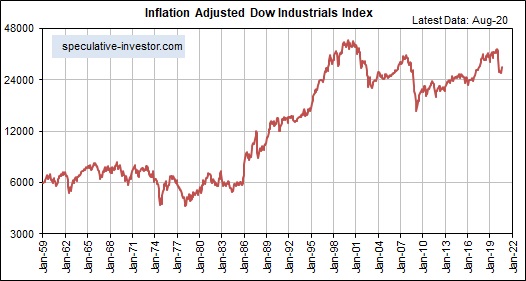
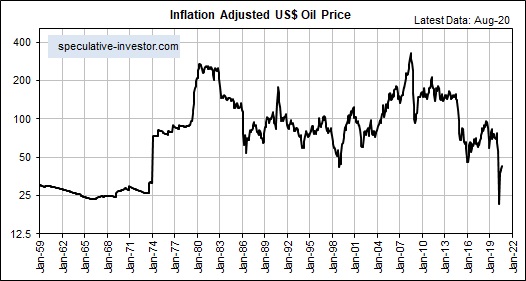
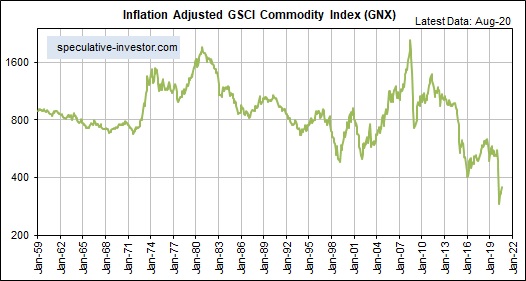
I’ve been using the theoretical rate of purchasing power change, calculated as outlined above, to construct long-term inflation-adjusted (IA) charts for about eight years now. Here are the updated versions of some of these charts, based on data as at the end of October-2017.


Motive, means and opportunity, but no crime

October 23, 2017

When a prosecutor is trying to establish guilt in a murder trial in most cases he will try to show that the accused had the motive, the means and the opportunity. However, prior to analysing motive, means and opportunity (MMO) there must first be evidence that an actual murder occurred. One of the most basic mistakes made by those who tout gold-price suppression stories is that they focus on the MMO without first establishing that a crime has taken place. The crime in this case would be causing the gold price to behave consistently in a way that was contrary to the underlying fundamentals.

Before getting to the absence of evidence that a crime has occurred let’s first deal with the MMO-focused argument, because even this argument has many holes in it. There is no question that the banking cartel that encompasses central banks and commercial banks has the opportunity to manipulate prices, given that it is a big player in the financial markets. However, it is not clear that “the cartel” has the means to manipulate the gold price beyond minor fluctuations over very short time periods.

One popular story is that the price is suppressed over the long-term via the “naked” short selling of gold futures, but you don’t need to go to the lengths to which the Monetary Metals team recently went to see that this story is fictitious. The bogus nature of the story can be seen by looking at the Commitments of Traders (COT) data. For example, if price declines were driven by the naked short selling of futures then the open interest (OI) in the futures market should rise as the price trends downward (as new short positions are added), but more often than not the opposite is the case. For another example, the COT data show that the “Commercial” traders, the supposed architects of the price suppression, are typically net buyers during price declines.

Another popular story is that the price is suppressed by creating paper supply in the London market. This story is based on the fact that there are a lot more claims to physical gold traded via the London Bullion Market Association (LBMA) than there is physical gold in LBMA vaults. This story is more difficult to refute, not because it is more likely to be true but because there is less transparency with LBMA gold trading than there is with Comex gold trading. However, for the sake of argument let’s make a huge leap of faith and assume that the LBMA provides the means to suppress the gold price beyond the very short-term.

We now turn to motive. The idea is that gold is a barometer of the monetary system’s health, with a rising gold price being indicative of failing health, and that the banking cartel wants us to believe that the monetary system is healthy even when it’s not. As part of the cartel’s efforts to create a false impression of monetary-system health, the gold price is prevented from rising to the great heights that would be reached if the market were left alone.

This line of thinking is on the right track, in that the gold price does reflect financial-system and economic confidence. The problem is that these days it is a very low-profile barometer — so low-profile that even when the gold price rocketed up to near $2000/oz in 2011 it generally wasn’t viewed as a sign that the US$-based monetary system was in danger of falling apart.

The reality is that the senior members of the banking cartel couldn’t care less whether gold was priced at $1100/oz, $1300/oz, $1500/oz or some other number. It’s likely that they care deeply about the currency, bond and stock markets, but rarely give the gold price more than a passing glance. However, for the sake of argument let’s again make a leap of faith and assume that the banking cartel has a strong motive to suppress the gold price.

In other words, despite the weakness of the supporting arguments let’s assume that the banking cartel has the motive, means and opportunity to suppress the gold price. This gets us back to the point made at the start, which is that establishing the MMO would be meaningless without evidence that the gold price has performed significantly worse than it should have performed.

Of course, to know how the gold price should have performed you must have some way of quantifying the fundamental backdrop and how it relates to gold. A rational analyst cannot do what most manipulation-centric commentators appear to do, which is blindly assume that the fundamental backdrop is always bullish for gold.

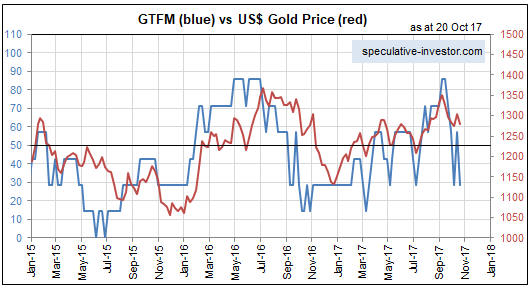
I developed a model that quantifies the extent that the fundamental backdrop is bullish for gold. The model was described in a June blog post and is based on the concept that gold’s value moves in the opposite direction to confidence in the financial system and/or the economy. The following chart compares the output of this model with the US$ gold price since the beginning of 2015.

Given that in addition to being affected by changes in the fundamental backdrop the gold price is also affected in the short-term by sentiment shifts, technical trading and knee-jerk reactions to random news events, the positive correlation evident on the following chart is as strong as reasonably could be expected. Furthermore, a positive correlation between the true fundamentals and the gold price is clearly evident back to 2002, which due to data limitations is as far back as I’ve been able to calculate the model.

In other words, the US$ gold price has done what it should have done over the years considering the shifts in the fundamental backdrop. This suggests that the effects of downward and upward manipulation (price manipulation happens in both directions) have been short-lived. It also suggests that there has been no EFFECTIVE price-suppression scheme.

I’ll end with an analogy. Bill Jones is accused of murdering Fred Smith and the prosecutor does a wonderful job of showing that Bill had the motive, means and opportunity to kill Fred. The problem is that Fred Smith is walking around, perfectly healthy.

Gold, the stock market and the yield curve

October 16, 2017

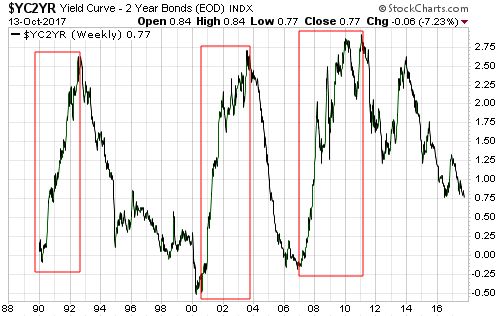
The yield curve is a remarkably useful leading indicator of major economic and financial-market events. For example, its long-term trend can be relied on to shift from flattening to steepening ahead of economic recessions and equity bear markets. Also, usually it will remain in a flattening trend while a monetary-inflation-fueled boom is in progress. That’s why I consider the yield curve’s trend to be one of the true fundamental drivers of both the stock market and the gold market. Not surprisingly, when the yield curve’s trend is bullish for the stock market it is bearish for the gold market, and vice versa.

A major steepening of the yield curve will have one of two causes. If the steepening is primarily the result of rising long-term interest rates then the root cause will be rising inflation expectations, whereas if the steepening is primarily the result of falling short-term interest rates then the root cause will be increasing risk aversion linked to declining confidence in the economy and/or financial system. The latter invariably begins to occur during the transition from boom to bust.

A major flattening of the yield curve will have the opposite causes, meaning that it could be the result of either falling inflation expectations or a general increase in economic confidence and the willingness to take risk.

On a related matter, the conventional wisdom is that a steepening yield curve is bullish for the banking system because it results in the expansion of banks’ profit margins. While superficially correct, this ‘wisdom’ ignores the reality that one of the two main reasons for a major steepening of the yield curve is widespread, life-threatening problems within the banking system. For example, the following chart shows that over the past three decades the US yield curve experienced three major steepening trends: the late-1980s to early-1990s, the early-2000s and 2007-2011. All three of these trends were associated with economic recessions, while the first and third got underway when balance-sheet problems started to appear within the banking system and accelerated when it became apparent that most of the large banks were effectively bankrupt.

Here’s an analogy that hopefully helps explain the relationship (under the current monetary system) between major yield-curve trends and the economic/financial backdrop: Saying that a steepening of the yield curve is bullish because it eventually leads to a stronger economy and generally-higher bank profitability is like saying that bear markets are bullish because they eventually lead to bull markets; and saying that a flattening of the yield curve is bearish because it eventually — after many years — is followed by a period of severe economic weakness is like saying that bull markets are bearish because they always precede bear markets.

yieldcurve_161017

Both rising inflation expectations and increasing risk aversion tend to boost the general desire to own gold, whereas gold ownership becomes less desirable when inflation expectations are falling or economic/financial-system confidence is on the rise. Consequently, a steepening yield curve is bullish for gold and a flattening yield curve is bearish for gold.

The US yield curve’s trend has not yet reversed from flattening to steepening, meaning that its present situation is bullish for the stock market and bearish for the gold market. However, the yield curve is just one of seven fundamentals that factor into my gold model and one of five fundamentals that factor into my stock market model.