No currency manipulation by China’s government, yet

July 18, 2018

[This is a brief excerpt from a commentary posted at TSI last week]

In the 2nd July Weekly Update we discussed the risk posed by the recent weakening of China’s currency (the Yuan), and commented: “We won’t know for sure until China’s central bank publishes its international currency reserve figure for June, but the recent weakening of the Yuan does not appear to be the result of a deliberate move by China’s government.” We now know for sure — the Yuan’s pronounced weakness during the month of June was NOT the result of government manipulation. In fact, it can be more aptly described as the result of an absence of manipulation.

We know that this is so because of what happened to China’s currency reserves in June. As indicated by the final column on the following chart, almost nothing happened (there was no significant change). This means that China’s government made no attempt to either strengthen or weaken its currency last month.
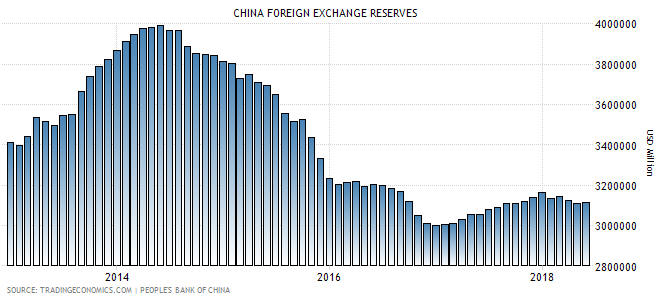
To further explain, for China’s government to engineer weakness in the Yuan’s foreign exchange value it must add to its international currency reserves by exchanging its own currency (that it creates ‘out of thin air’) for foreign currency. By the same token, for China’s government to increase the Yuan’s relative value it must use its international currency reserves to purchase Yuan. Consequently, periods when China’s currency reserve is increasing are periods when China’s government is attempting to weaken the Yuan and periods when China’s currency reserve is decreasing are periods when China’s government is attempting to strengthen the Yuan.

The above chart therefore tells us that China’s government was trying to weaken the Yuan up to mid-2014 and strengthen the Yuan from mid-2014 until the end of 2016. The chart also seems to indicate that there was a tentative attempt to weaken the Yuan during 2017, but 2017’s gradual increase in China’s foreign currency stash was most likely driven by changing market valuation. We are referring to the fact that because reserves are reported in US dollars and held as debt securities, the reported value of the reserves can be altered by a change in exchange rates or bond prices. In particular, the reported reserve figure will have an upward bias during periods when the US$ is weak relative to other major currencies, as it was throughout 2017.

The bottom line is that China’s government has not yet weaponised the Yuan’s FX value in its economic war with the US government, but it is also not standing in the way when the Yuan weakens in response to market forces.
The current message from the most useful sentiment indicator

July 10, 2018

As I’ve noted in the past, the Commitments of Traders (COT) information is nothing other than a sentiment indicator. Moreover, for some markets, including gold, silver, copper, the major currencies and Treasury bonds, the COT reports are by far the best indicators of sentiment. This is because they reflect how the broad category known as speculators is betting. Sentiment surveys, on the other hand, focus on a relatively small sample and are, by definition, based on what people say rather than what they are doing. That’s why for some markets, including the ones mentioned above, I put far more emphasis on the COT data than on sentiment surveys.

In this post I’ll summarise the COT situations for five markets with the help of charts from “Gold Charts ‘R’ Us“. I’ll be focusing on the net positioning of speculators in the futures markets, although useful information can also be gleaned from gross positioning and open interest.

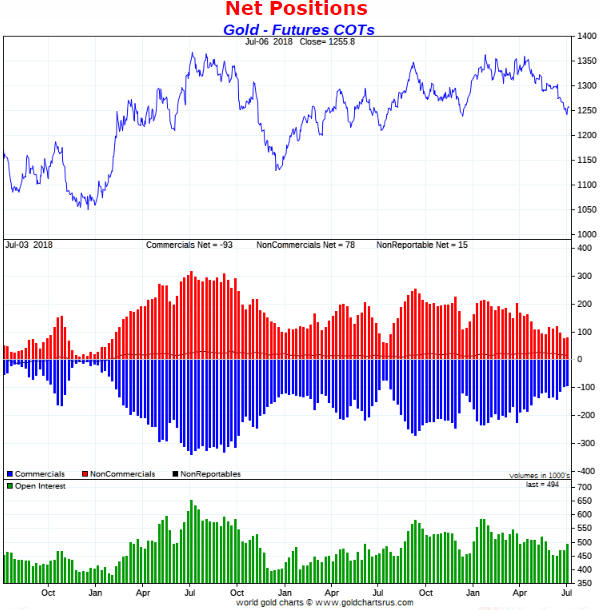
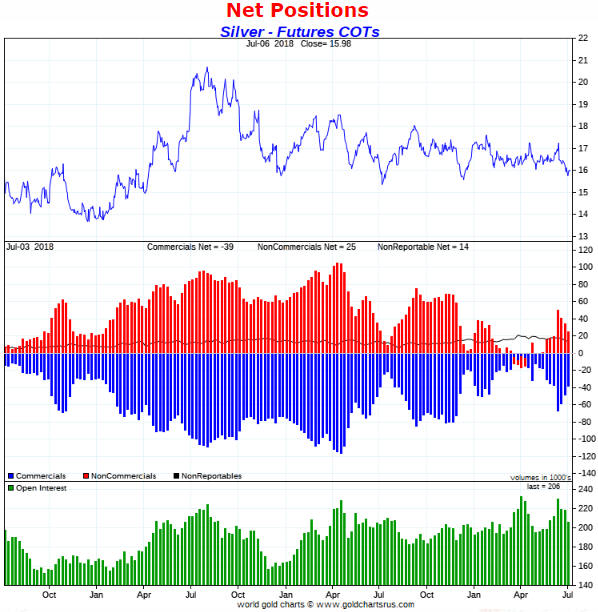
Note that what I refer to as the total speculative net position takes into account the net positions of large speculators (non-commercials) and small traders (the ‘non-reportables’) and is the inverse of the commercial net position. The blue bars in the middle sections of the charts that follow indicate the commercial net position, so the inverse of each of these bars is considered to be the total speculative net position.

I’ll start with gold.

Gold’s COT situation was almost unchanged over the latest week. Ignoring everything except sentiment (as indicated by the COT data), gold is in a similar position now to where it was in early-July and early-December of last year. This suggests the potential for a 2-month rally to the $1350-$1400 range, but not much more than that.

goldCOT_100718

Silver’s COT situation has been a source of controversy over the past four months. Some analysts argued that it was extremely bullish, whereas I argued (for example: HERE) that at no point over this period was the COT situation conducive to a significant silver rally. I’m therefore not surprised that there hasn’t been a significant silver rally.

Four weeks ago silver’s COT situation became slightly bearish, but it has since improved and I now view it as neither a tail-wind nor a head-wind for the silver price. However, silver will rally if gold rallies. It’s that simple.

silverCOT_100718

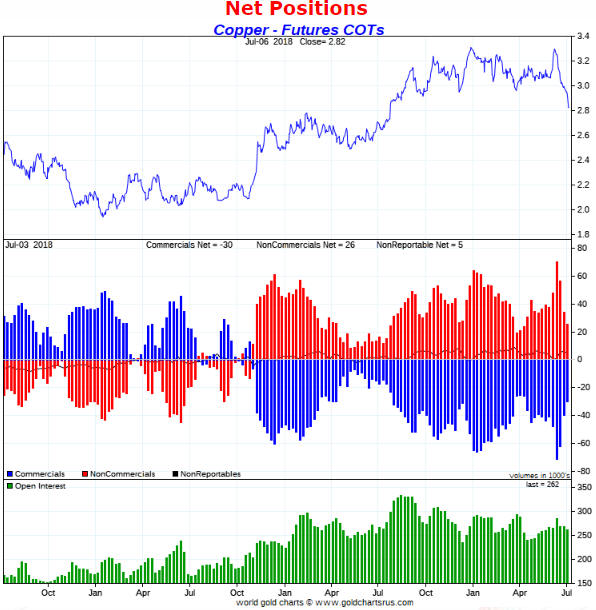
Four weeks ago the speculative net-long position in Comex copper futures became extreme. This didn’t guarantee that a large price decline was in store, but it pointed to substantial downside risk in the price.

Copper’s COT situation is now similar to what it was near short-term price bottoms in July and December of last year, so there’s a decent chance of a multi-week price rebound.

copperCOT_100718

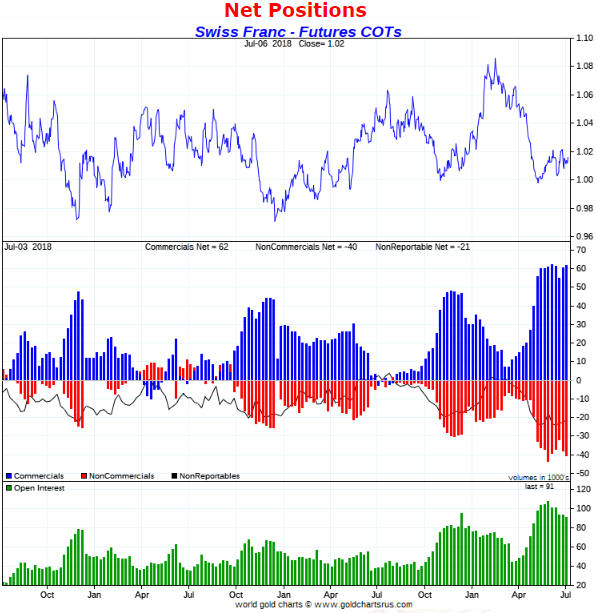
Of the major currencies, the Swiss franc (SF) has the most bullish COT situation. The COT information certainly doesn’t preclude one more decline in the SF to a new low for the year, but it suggests that the SF will trade significantly higher within the next three months.

SFCOT_100718

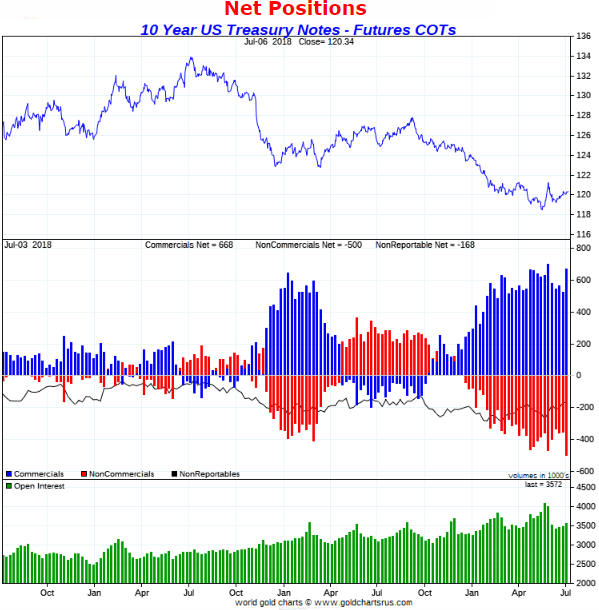
I expect that long-dated US Treasury securities will trade at much lower prices (much higher yields) within the next 2 years, but during April-May of this year I began to anticipate a multi-month price rebound (yield pullback) in this market. This was mainly due to sentiment as indicated by the COT situation. Of particular relevance, the total speculative net-short position in 10-year T-Note futures had risen to an all-time high.

Despite a price rebound from the May low, the speculative net-short position in 10-year T-Note futures remains near the all-time high reached in late-May. Therefore, it’s a good bet that the T-Note/T-Bond price rebound is not close to being complete.

TNoteCOT_100718

Gold’s true fundamentals turn bullish

July 5, 2018

I update gold’s true fundamentals* every week in commentaries and charts at the TSI web site, but my most recent blog post on the topic was on 30th April. At that time the fundamental backdrop was gold-bearish, but there has since been a change.

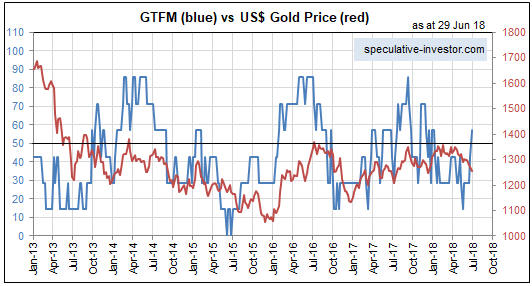
My Gold True Fundamentals Model (GTFM) turned bearish in mid-January 2018 and was still bearish at the end of the week before last (22nd June). There were fluctuations along the way, but at no time between mid-January and late-June was the fundamental backdrop supportive of the gold price. However, at the end of last week (29th June) the GTFM turned bullish. The deciding factor was a small, but significant, widening of credit spreads.

Here is a chart comparing the GTFM (in blue) with the US$ gold price (in red).

The upshot is that for the first time in more than 5 months the gold market has a ‘fundamental’ tail-wind, which is a prerequisite for a substantial rally. For reasons that I’ve mentioned in TSI commentaries I’m expecting a tradable 2-month rally from a July low rather than a substantial rally, but my expectations will change if the evidence changes.

*Note that I use the word “true” to distinguish the actual fundamental drivers of the gold price from the drivers that are regularly cited by gold-market analysts and commentators. According to many pontificators on the gold market, gold’s fundamentals include the volume of metal flowing into the inventories of gold ETFs, China’s gold imports, the volume of gold being transferred out of the Shanghai Futures Exchange inventory, the amount of “registered” gold at the COMEX, India’s monsoon and wedding seasons, jewellery demand, the amount of gold being bought/sold by various central banks, changes in mine production and scrap supply, and wild guesses regarding JP Morgan’s exposure to gold. These aren’t true fundamental price drivers. At best, they are distractions.

Can silver rally without gold?

June 29, 2018

[This blog post is an excerpt from a recent TSI commentary]

The article titled “Silver’s Critical Role In Electrification May Fuel Its Rise” contains some interesting comments about the silver market, but with one minor exception the information presented in this article has no bearing on silver’s risk/reward as a speculation or investment. The minor exception is the high (by historical standards) gold/silver ratio, which suggests that the silver price is likely to rise relative to the gold price over the next few years. However, none of the information about silver ‘fundamentals’ presented in the article is relevant to the silver price.

It isn’t relevant for the same reasons that most of the information presented by the ‘experts’ about gold fundamentals is also not relevant: It treats the annual output of the mining sector as if it were the total supply (annual mine production is a small fraction of the total supply) and it confuses flows from one part of the market to another with changes in total demand (every ‘flow’ involves an increase in demand on the part of the buyer and an exactly offsetting decrease in demand on the part of the seller). Furthermore, it isn’t relevant for another reason that can be illuminated by asking the question: within the past 80 years, when was there a major silver rally in the absence of a gold rally?

The answer is that over the past 80 years there hasn’t been a single major silver rally in the absence of a gold rally. The best rally in silver without a concurrent rally in gold was the 6-month price spike that began in Q3-1997. This rally resulted from an attempt to manipulate the price upward on the back of Warren Buffett’s silver accumulation; it did not result from any of the ‘fundamental’ drivers cited by commentators trying to make the case that silver can rally strongly without gold.

The historical record persuasively argues that large silver rallies don’t happen in the absence of large gold rallies. This tells us that either economic/financial-system confidence drives the silver market in the same way that it drives the gold market or that the big trends in silver simply follow the big trends in gold.

The bottom line is that there does not appear to be a good reason to expect the silver price to move substantially higher independently of the gold price.