Gold: Bearish fundamentals, bullish sentiment

August 13, 2018

For the first time this year, about two weeks ago the sentiment backdrop became decisively supportive of the gold price and remains so. At the same time, the fundamental backdrop is unequivocally bearish for gold. What will be the net effect of these counteracting forces?

Before attempting to answer the above question let’s briefly review the most important sentiment and fundamental indicators.

The following chart from goldchartsrus.com shows that at Tuesday 7th August (the date of the latest COT data) the net positioning of traders in gold futures was similar to what it was in December-2015, which is when a powerful 7-month rally was about to begin. Therefore, in terms of net positioning the COT situation (the most useful of all the gold-market sentiment indicators) is as bullish as it has been in many years.

The one concern is that while the open interest (the green bars in the bottom section of the following chart) is well down from where it was a month ago, it is still more than 50K contracts above where it was at the December-2015 and December-2016 price lows (the two most important price lows of the past five years). The open interest may have to drop to 400K contracts or lower before there is a strong, multi-month rally.
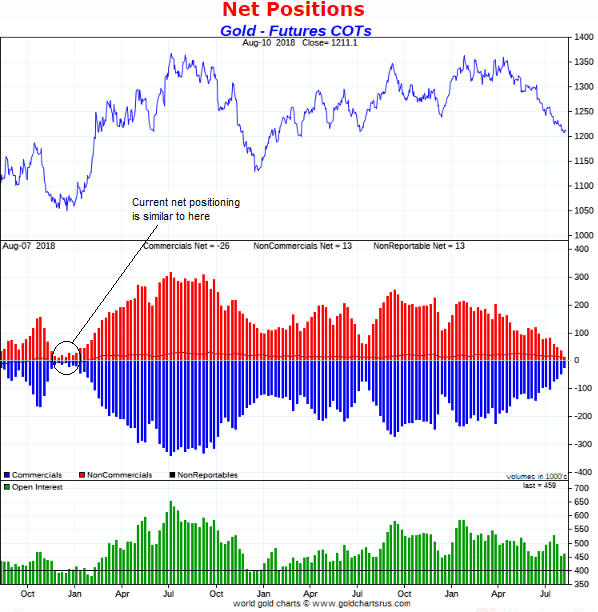
goldCOT_130818

There are a number of important fundamental drivers of the US$ gold price, including credit spreads, the yield curve, the real interest rate (the TIPS yield), the relative strength of the banking sector and the US dollar’s exchange rate. The most important seven gold-market fundamentals are incorporated into our Gold True Fundamentals Model (GTFM), a chart of which is displayed below.

The GTFM was ‘whipsawed’ between late-June and mid-July, in that during this short period it shifted from bearish to bullish and then back to bearish. Apart from this 2-3 week period it has been continuously bearish since mid-January.
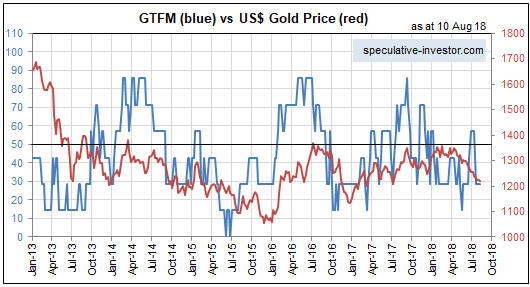
GTFM_130818

Returning to the question posed in the opening paragraph, regardless of what happens on the sentiment front there will not be an intermediate-term upward trend in the gold market until the fundamental backdrop turns gold-bullish. The fundamentals are constantly in flux and potentially will turn bullish within the next few weeks, but at this time there is no good reason to expect that an intermediate-term gold rally is about to begin.

However, with the right sentiment situation a strong short-term rally can occur in the face of bearish fundamentals. This is what happened between late-June and early-September of 2013. During this roughly 2-month period there was a $200 increase in the gold price in the face of a gold-bearish fundamental backdrop.

The gold market was far more ‘oversold’ in late-June of 2013 than it is today, but it is sufficiently depressed today to enable a short-term rebound of at least $100 even without a significant improvement (from gold’s perspective) in the fundamentals.

That doesn’t mean that we should expect a $100+ rebound to get underway in the near future, only that — thanks to the depressed sentiment — the potential is there. Before the potential starts being realised the price action will have to signal a reversal.
A different look at the US yield curve

August 6, 2018

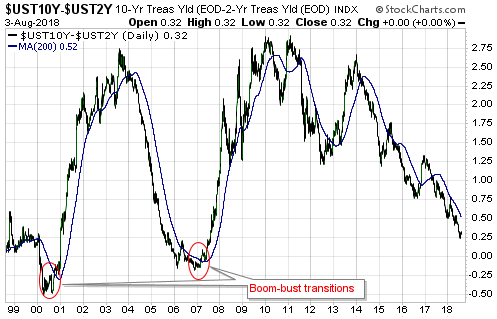
The US yield curve, as indicated by the spread between the 10-year and 2-year T-Note yields, made a new 10-year extreme over the past fortnight, meaning that it recently became the ‘flattest’ it has been in more than 10 years. While this may indicate that the boom is nearing its end, it definitely indicates that the transition from boom to bust has not yet begun.

As explained numerous times in the past, the ‘flattening’ of the yield curve (short-term interest rates rising relative to long-term interest rates) is a characteristic of a monetary-inflation-fueled economic boom. It doesn’t matter how flat the yield curve becomes or even if it becomes inverted, the signal that the boom has ended and that a bust encompassing a recession is about to begin is the reversal of the curve’s major trend from flattening to steepening. To put it another way, the signal that the proverbial chickens are coming home to roost is short-term interest rates peaking RELATIVE TO long-term interest rates and then beginning to decline relative to long-term interest rates. This generally will happen well before the Fed sees a problem and begins to cut its targeted short-term interest rate.

The following chart highlights the last two major reversals of the US yield curve from flattening to steepening. These reversals were confirmed about 6 months prior to the recessions that began in March-2001 and December-2007.

The fact that the yield curve is still hitting new extremes in terms of ‘flatness’ suggests that the next US recession will not begin before 2019.

yieldcurve_060818

The above is essentially a repeat of what I’ve written in the past, but an additional point warrants a mention. The additional point is that while it would be almost impossible for the US economy to transition from boom to bust without a timely reversal in the yield curve from flattening to steepening, there is a realistic chance that the next yield-curve trend reversal from flattening to steepening will NOT signal the onset of an economic bust/recession. That’s why I do not depend solely on the yield curve when determining recession probabilities.

The reason that the next yield-curve trend reversal from flattening to steepening will not necessarily signal the onset of an economic bust/recession is that there are two potential drivers of such a reversal. The reversal could be driven by falling short-term interest rates or rising long-term interest rates. If it’s the former it signals a boom-bust transition, but if it’s the latter it signals rising inflation expectations.

As an aside, regardless of whether a major yield-curve reversal from flattening to steepening is driven by the unravelling of an artificial boom or rising inflation expectations, it is bullish for gold. By the same token, a major reversal in the yield curve from steepening to flattening is always bearish for gold.

With the T-Bond likely to strengthen for at least the next two months there is little chance that rising long-term interest rates will drive a yield curve reversal during the third quarter of this year, but it’s something that could happen late this year or during the first half of next year.

Have the Chinese pegged the gold price?

July 30, 2018

Governments and central banks lost interest in the gold price decades ago, but stories about how governments are supposedly controlling the gold price never lose their appeal. One of the latest stories is that since the inclusion of the Yuan in the IMF’s SDR (Standard Drawing Rights) basket in October-2016, the Chinese government has pegged the SDR-denominated gold price to 900 +/- a few percent. According to The Macro Tourist’s 25th July blog post, this story has been told by Jim Rickards. The Macro Tourist suggests a different story*, which involves the Chinese government (or someone else) having pegged the Yuan-denominated gold price. Both stories are based on gold’s narrow trading range relative to the currency in question over the past two years.

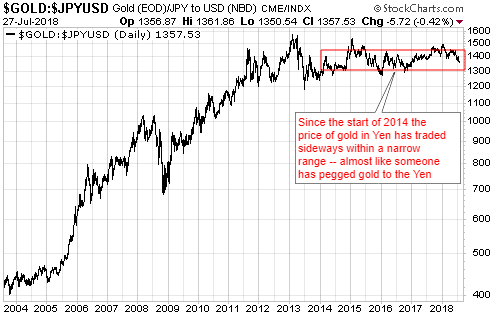
If we are going to play this game then I can tell an even better story. My story is that the Japanese government took control of the gold market in early-2014 and has since been keeping the Yen-denominated gold price at 137,000 +/- 5%. They lost control in early-2015 and again in early-2018, but in both cases they quickly brought the market back into line.

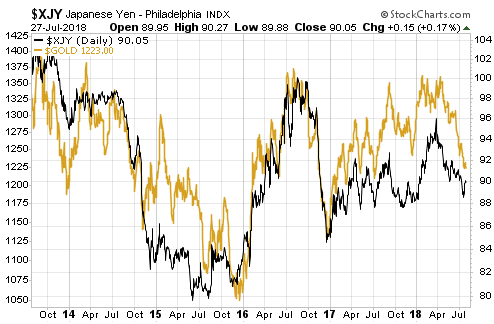
Here’s the chart that ‘proves’ my version of events:

gold_Yen_300718

The narrow sideways range of the Yen gold price over the past 4.5 years is due to the Yen being the major currency to which gold has been most strongly correlated. Here’s a chart that illustrates the strong positive correlation between Yen/US$ and gold/US$:

goldvsYen_300718

My story about the Japanese government pegging the gold price makes as much sense as the stories about the Chinese government pegging the gold price. That is, my story makes no sense.

It will be possible to find price data to substantiate almost any manipulation story. Also, with sufficient imagination there is no limit to the manipulation stories that can be concocted to explain any price action. For example, you can always look at a period of range-trading in the gold market and conclude that a government (the same organisation that makes a mess of everything else it tries to do) is adeptly managing the price. Alternatively, you can look for a more plausible explanation or perhaps just acknowledge that not all price action has a single, simple explanation.

Like all financial markets the gold market is, of course, manipulated, but even if there were a desire to do so (there isn’t) it would not be possible under today’s monetary system for any government to directly control the gold price over a period of years or alter major trends in the gold price.

*In general the Macro Tourist blog provides level-headed commentary on the financial markets and doesn’t plunge into the murky world of gold-manipulation story-telling. Even in this case I think the main point of the post is to show that gold is stretched to the downside and may be good for a short-term trade, but some people will take the post as more evidence that the gold market is dominated by nefarious forces.

The “Productivity of Debt” Myth

July 23, 2018

Page 4 in Hoisington Investment Management’s latest Quarterly Review and Outlook contains a discussion about the falling productivity of debt problem. According to Hoisington and many other analysts, the problem is encapsulated by the falling trend in the amount of GDP generated by each additional dollar of debt, or, looking from a different angle, by the rising trend in the amount of additional debt required to generate an additional unit of GDP. However, there are some serious flaws in the “Productivity of Debt” concept.

There are three big problems with the whole “it takes X$ of debt to generate Y$ of GDP” concept, the first being that GDP is not a good indicator of the economy’s size or progress.

For one thing, GDP is a measure of spending, not a measure of wealth creation. It’s possible, for example, for GDP to grow rapidly during a period when wealth is being destroyed on a grand scale. This could happen during war-time and it could also happen as the result of massive government spending on make-work projects. It’s also possible for GDP to grow slowly at a time when the rate of economic progress is high. This can happen because GDP is dominated by consumption. It omits all business-to-business expenditure and misses a lot of value-adding investment.

For another thing, GDP is strongly influenced by changes in the money supply. Of particular concern, even though an increase in the money supply cannot possibly cause a sustainable increase in economy-wide wealth, it will usually boost GDP.

Therefore, comparing anything with GDP is problematic.

The second flaw in the “it takes X$ of debt to generate Y$ of GDP” concept is that it involves comparing a flow (annual GDP) to a stock (the cumulative total of debt). There are times when it can make sense to compare a stock to a flow, but care must be taken when doing so. I’ll use a hypothetical example to show one of the pitfalls.

Assume that over the course of a year an economy goes from a GDP of $10T and a total debt of $50T to a GDP of $10.4T and a total debt of $52T. This could prompt the claim that it took $2T of additional debt to boost GDP by $0.4T, or that $5 of additional debt was needed for every $1 of additional GDP. However, it could also be said that a 4% increase in debt was associated with a 4% increase in GDP. The second way of expressing the same change seems far less worrisome.

In any case, the above two flaws in the typical productivity-of-debt analysis pale in comparison with the third flaw, which is that the entire concept of debt productivity is meaningless. The fact is that debt doesn’t cause economic growth and ‘excessive debt’ (whatever that is) doesn’t inhibit economic growth.

An economy can grow with or without an increase in debt, because per-capita economic growth is caused by savings and capital investment. An increase in debt can accelerate the pace of real growth by acting as a means by which savings are channeled to where they can be invested to the best effect, but the transfer of savings can also occur via the exchange of money for equity. For example, most exploration-stage mining companies and most technology start-ups are equity-financed not debt-financed. There is, of course, debt that is used to finance consumption rather than investment, but that type of debt can’t grow the economy over the long term because it necessarily involves a present-future trade-off — more spending in the present leads to less spending in the future.

The central problem is unsound money, not excessive debt. More specifically, the problem is that when banks make loans they create money out of nothing. It’s this creation of money out of nothing and the subsequent exchange of nothing for something, not the build-up of debt, that leads to reduced productivity. If all debt involved the lending/borrowing of real savings then no amount of debt could ever make the overall economy less efficient. Of course, if all debt involved the lending/borrowing of real savings then the total amount of debt would be a small fraction of what it is today.