Gold Inflation

November 12, 2018

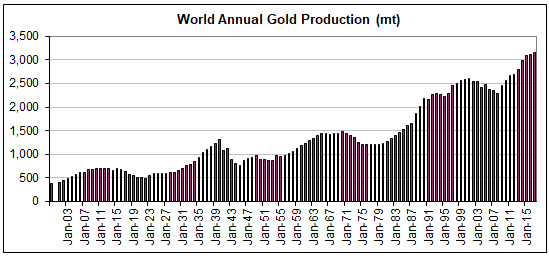
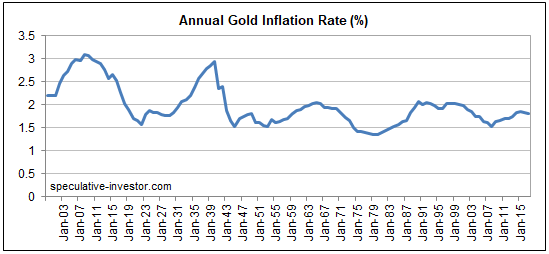
Here are two long-term charts illustrating the annual rate at which gold is extracted from the ground. The second of these charts shows why mine production can be ignored when trying to understand what happened to the gold price over the preceding few years or figure out what’s likely to happen to the gold price over the next few years.

The first chart shows the amount of gold produced by the global mining industry during each year from 1900 through to 2017 (data sourced from the US Geological Survey). The second chart shows the percentage increase in the world’s above-ground gold supply during each year (1900-2017) resulting from that year’s new mine production. In effect, the second chart shows the gold inflation rate.

Notice that over the past 70 years the annual rate of gold inflation has almost always been between 1.5% and 2.0% and has never strayed far from the 1.5%-2.0% range. In other words, regardless of what’s happening in the world, the total supply of gold increases by approximately the same tiny amount each year.

Over the past 60 years, trend changes in the annual rate of gold inflation appear to be lagged reactions to major price changes, with the 7-10 year lag being due to the time it takes from a major price-related incentive to appear and new mines to be brought into production. For example, the upward trend in the gold inflation rate that began in the early-1980s was probably a reaction to the major price advance that began in the early-1970s.
goldprodn_121118

goldinflation_121118

The stocks-bonds interplay

November 2, 2018

It’s normal for the stock market to ignore a rising interest-rate trend for a long time. The reason is that while the interest rate is a major determinant of the value of most corporations, the interest rate that matters for equity valuation isn’t the current one. What matters is the level of interest rates for a great many years to come. Therefore, a rise in interest rates only affects the stock market to the extent that it affects the general perception of where interest rates will be over the next decade or longer.

To further explain, the value of a company is the sum of the present values of all its future cash flows, with the present value of each future cash flow determined via the application of a discount rate (interest rate). Nobody knows what these cash flows will be or what the appropriate discount rate should be, but guesses, also known as forecasts, are made. Clearly, when discounting a set of cash flows spanning, say, the next 30 years, it won’t make sense to simply use the current interest rate. Instead, the analyst doing the calculation will have to make a stab at what will happen to interest rates in the future.

The analyst’s ‘stab’ naturally will be influenced by what is happening in the present, but the future interest rate levels that are plugged into valuation models won’t be adjusted in response to what are considered to be normal fluctuations in the current interest rate. It’s only when the current interest rate breaks out of an established range that it affects expectations in a big way.

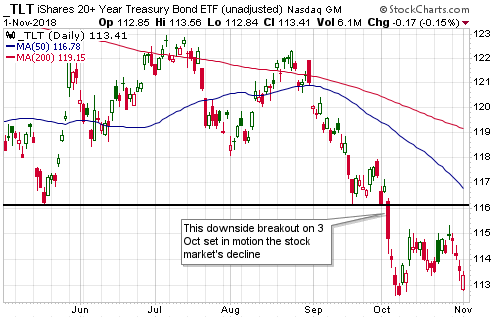
That, in a nutshell, is why it isn’t a fluke that the 3rd October downside breakout in the bond market (represented by TLT in the following chart) coincided with the start of a rapid downward re-pricing in the stock market.

TLT_011118

In addition to stocks being influenced by big moves (breakouts from ranges) in bonds, bonds are influenced by big moves in stocks. That’s especially so when important stock-market support levels are breached with little warning. For example, within a few days of the 3rd October downside breakout in the bond market setting in motion a sharp decline in the stock market, the stock market’s weakness was helping to prop-up the bond market. Interestingly, though, the quick 10% decline in the S&P500 Index from its peak led to only a minor rebound in the bond market, despite there being a record-high speculative net-short position in bond futures. As illustrated above, TLT didn’t even manage to rebound by enough to test its 3rd October downside breakout and has dropped back to near its early-October low in response to this week’s recovery in the stock market.

The bond market’s lacklustre response to the recent equity weakness suggests that equities will have to weaken further before the interest-rate trend transforms from a stock-market head-wind to a stock-market tail-wind. Also, the fact that the bond market has already dropped back to near its October low suggests that the stock market will be unable to make significant additional gains without pushing interest rates to new multi-year highs. This, in turn, suggests that there is minimal scope for additional short-term strength in the stock market.

Revisiting the age-old relationship between interest rates and prices

October 22, 2018

There is an age-old relationship between prices and interest rates that Keynesian economists have called a paradox (“Gibson’s Paradox”). The relationship was clearer during the Gold Standard era, but as I explained in a previous post it is still apparent if prices are measured in gold.

To understand “Gibson’s Paradox” and why it actually isn’t a paradox, refer to the earlier post linked above. Suffice to say that when money is sound or at least a lot sounder than it is today, interest rates don’t drive prices and prices don’t drive interest rates; instead, on an economy-wide basis both prices (in general) and risk-free interest rates are driven by changes in societal time preference. Moreover, as mentioned above and explained in my earlier post, even with today’s massive, continuous manipulation of interest rates by central banks the relationship is still evident, but only when interest rates are compared to a wholesale price index denominated in gold.

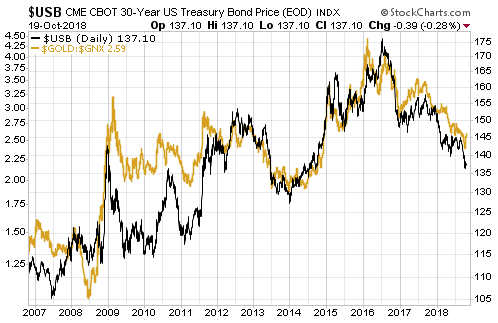
The commodity/gold ratio is the price of a broad-based basket of commodities in gold terms. In essence, it is a wholesale price index using gold as the monetary measuring stick. Also, the risk-free US interest rate that is least affected by the direct manipulation of the Fed is the yield on the 30-year T-Bond, so if the age-old relationship still works then what we should see is a positive correlation between the commodity/gold ratio and the T-Bond yield. Or, looking at it from a different angle, what we should see is a positive correlation between the gold/commodity ratio and the T-Bond price. That’s exactly what we do see.

Using the Goldman Sachs Spot Commodity Index (GNX) to represent commodities, the following chart shows that the age-old relationship has worked over the past 12 years when gold is the monetary measuring stick.

gold_USB_LT_221018

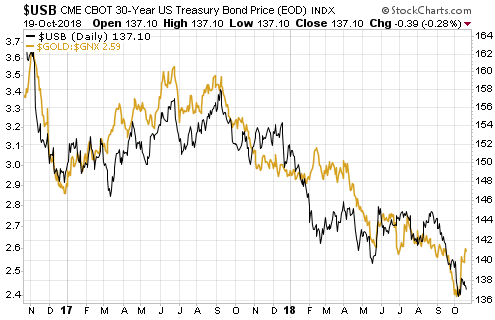
The next chart zooms in on the most recent 2 years and shows that over the past three weeks there has been a significant divergence, with the gold/commodity ratio turning upward and the T-Bond price staying on a downward path. It’s a good bet that this divergence will be eliminated within the next two months via either a decline in the gold/commodity ratio to a new multi-year low or a rebound in the T-Bond. My money is on the latter.

gold_USB_221018

Credit spreads and the stock market

October 16, 2018

This post was prompted by a recent article authored by the always thought-provoking Pater Tenebrarum (a pseudonym) at acting-man.com. The article looks at the relationship between credit spreads and the stock market, in particular the historical tendency for credit spreads to begin widening prior to substantial stock market declines and thus to act as timely warning signals of impending stock market trouble. The conclusion is: “…it seems…more likely that a stock market decline will put pressure on junk bonds, instead of weakness in junk bonds providing advance warning of an impending stock market decline. The stock market sell-off in the past week did in fact very slightly lead a surge in high yield spreads.” I don’t know that this conclusion is wrong, but at this time the evidence to support it is not persuasive.

It first should be understood that credit spreads generally begin widening ahead of bear markets, but they generally DON’T lead short-term stock-market corrections. Therefore, the fact that they didn’t warn of the October-2018 sell-off is not meaningful at this time. It will become meaningful only if the October-2018 sell-off proves to be the first decline in a bear market, which is unlikely.

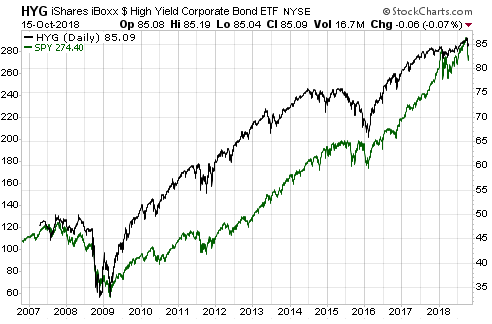
The fact that the most recent stock market sell-off appeared to slightly lead an up-tick (not a surge) in high yield spreads is also not meaningful. The following chart shows that junk bonds often trend with equities (the chart compares the iShares High Yield Corporate Bond ETF with the S&P500 ETF), so actually it is normal for short-term stock market corrections to go hand-in-hand with minor expansions of credit spreads. That’s what happened over the past 2 weeks, what happened in January-February of this year and what happened on numerous other occasions in the past.

HYG_SPY_161018

The above-linked article makes the interesting point that credit spreads in the euro-zone and the US have diverged over the past year, with the former embarking on a widening trend in late-October of last year while the latter continued to contract. If credit spreads were still useful leading indicators of major stock-market trends then this divergence should have been accompanied by dramatic relative weakness in European equities. Since it was accompanied by dramatic relative weakness in European equities this is hardly evidence that credit spreads have lost their usefulness.

Could the influence of QE prevent credit spreads from signaling a trend reversal ahead of the next equity bear market?

I don’t see how. QE led to yield-chasing behaviour, which, in turn, caused credit spreads to become a lot narrower than they would have been. Having been compressed to artificially small quantities, credit spreads should if anything be more sensitive than usual to changes in the financial and economic backdrops.

Summing up, credit spreads have a strong tendency to widen ahead of equity bear markets. It could be different this time, but right now I can’t think of a good reason why it should be different. In any case, there is no need to rely on just one leading indicator.