The Ultimate Weapon

July 28, 2025

[This blog post is a slightly modified excerpt (including updated charts) from a commentary published during the week before last at www.speculative-investor.com]

US President Trump threatened on 14th July that if a Russia-Ukraine peace agreement didn’t happen within 50 days, then very high secondary tariffs would be imposed on Russia’s trading partners. As explained below, this is an empty threat.

China is Russia’s most important trading partner, so this is a threat to again impose extremely high tariffs on US imports from China. Now, the probability of a Russia-Ukraine peace agreement within the next 50 days is low and the probability that China will stop trading with Russia in response to this threat is zero, so the likely outcome 50 days from now is that Trump will be forced to either carry out his threat or back down. If he doesn’t back down and makes good on his threat, we know what will happen because we watched the same scenario play out within the past few months.

The unilateral imposition of higher tariffs on Chinese imports to the US would cause China’s government to stop exporting Rare Earth Elements (REEs) and other critical metals to the US. Within a couple of months this would bring the US auto industry as well as US-based production of batteries, turbines, a lot of military equipment and anything that uses an electric motor to a virtual standstill, prompting the US government to strike a deal that substantially reduced the tariffs.

It turns out that the ultimate weapon in the ‘trade war’ is the Chinese government’s control of global REE supply, because the economic impact of stopping exports of these minerals is low for China and extremely high for the US and many other developed nations. This was proved over the past few months and will be proved again if the US government imposes hefty additional tariffs on China after 50 days.

Moreover, due to growing demand associated with high-tech applications, the extent to which REEs are critical will increase as time goes by. This is why we have had a strong focus on REEs over the past five years and why we expect REE mines and processing facilities outside China to become far more valuable over the years ahead.

One of the unintended consequences of Trump’s trade war has been to highlight the risk presented by the Chinese government’s influence on REE supply. This prompted the stock market to start pricing-in the increasingly urgent need to diversify in this area, which has involved some rapid valuation changes. For example, the stock prices of Energy Fuels (UUUU) and Neo Performance Materials (NEO.TO), two of the TSI stock selections that provide exposure to REEs, have more than doubled from their lows of the past four months.

A chart of UUUU is included below. The recent frenetic price action suggests that we are nearing the end of the first leg of a cyclical bull market.

However, there haven’t yet been large increases in the prices of the underlying commodities.

Regarding the prices of the underlying commodities, the following chart shows the performance of Neodymium (Nd), one of the most widely used REEs. The chart reveals that although there has been a steady upward trend in the Nd price since March of 2024, the price remains very low relative to where it traded during the bulk of 2021-2023. Nd is a “light” REE and is not one of the REEs over which China’s government has a stranglehold on supply (heavy REEs such as Dysprosium (Dy) and Terbium (Tb) are more vulnerable to Chinese export restrictions), but as far as we can tell its price performance is representative.

The risk that the stock market has gone part of the way towards discounting is that REE prices are about to accelerate upward as the users of these metals around the world scramble to secure supply. In other words, the risk is that for REE prices we are at the equivalent of mid-2020.

The economic cycle and the commodity/gold ratio

July 21, 2025

[This blog post is an excerpt from a recent commentary at www.speculative-investor.com]

To our surprise, the US economy has not entered a recession over the past two years. This is not because a recession has been avoided altogether but because the current economic cycle has been elongated.

We use the commodity/gold ratio (the Spot Commodity Index (GNX) or the CRB Index (CRB) divided by the US$ gold price) to define booms and busts, with booms being multi-year periods during which the ratio trends upward and busts being multi-year periods during which the ratio trends downward. The vertical lines drawn on the following GNX/gold chart mark the trend changes (shifts from boom to bust or vice versa) that have occurred since 2000.

It’s not essential that the bust phase of the cycle contains a recession, but it’s rare for a bust to end until a recession has occurred. Usually, the sequence is:

1) The commodity/gold ratio begins trending downward, marking the start of the economic bust phase.

2) The economic weakness eventually becomes sufficiently pervasive and severe to qualify as a recession.

3) Near the end of the recession the commodity/gold ratio reverses upward, thus signalling the start of a boom.

It is not unusual for the stock market to continue trending upward after the bust begins, but in the past the stock market always has peaked prior to a recession getting underway. For example, an economic bust began in October-2018 but the SPX continued to make new highs until early-2020. For another example, during the first half of the 1970s the stock market continued to trend upward for about three years after the start of a bust.

By the way, due to the change in the structure of the US stock market it’s possible that the next cyclical peak in the SPX will occur AFTER the start of a recession. This is because, thanks to the domination of passive investing, the stock market no longer forecasts cyclical trends in corporate earnings, interest rates or economic growth; it simply responds to passive money flows.

In the current cycle the commodity/gold ratio has been trending downward since the first half of 2022, meaning that the US economy now has been in the bust phase of the cycle for about three years without entering recession. This is unprecedented within the context of the past 30 years, but it is comparable to what happened during the 1970s.

A much longer-term view of the commodity/gold ratio is provided by the monthly chart displayed below. This chart uses the CRB prior to 1993 and the GNX thereafter.

There were two long bust phases during the 1970s, the first starting in Q1-1970 and the second starting in Q3-1976. The time from the start of the first bust to the start of a recession (November-1973) was about 3.5 years, and the time from the start of the second bust to the start of a recession (January-1980) also was about 3.5 years. Late this year will be about 3.5 years from the start of the current bust.

Consequently, although the current economic cycle has been elongated to an unusual extent relative to the cycles of the past few decades, it currently is in line with the cycles of the previous period during which inflation generally was viewed as the major economic issue.

The next inflation wave

July 13, 2025

[This blog most is a slightly modified excerpt from a commentary published at www.speculative-investor.com about three weeks ago]

We consistently have been predicting lower price inflation for almost three years now, but we also have been predicting that the downward inflation trend would be followed by another major inflation wave. It’s likely that the next major inflation wave will begin this year and continue for at least two years. It’s also likely that it will be driven more by government actions than by the creation of new money (monetary inflation). We’ll now explain why.

Despite the famous Milton Friedman comment to the contrary, price inflation (a rise in the cost of living for the average person) is not always a monetary phenomenon. It also can be a government phenomenon. The reason, in a nutshell, is that government interventionism and deficit-spending can distort the economy in a way that reduces productivity, leading to lower production and therefore to higher prices even in the absence of monetary inflation. In very simple terms, government actions can result in the same amount of money chasing less goods and services, causing prices to be higher on average.

Going deeper and focussing on the US, by its deeds and words it is reasonable to conclude that the US government will be 1) increasing its already-massive deficits over the years ahead, 2) driving up the costs of manufacturing in the US through tariffs on imported materials, and 3) using tariffs as a negotiating tool, thus ensuring that many business leaders remain uncertain about the costs that they will face in the future. There also is a risk that the US government will take actions that discourage foreign investment in the US.

An effect of the above-mentioned government actions will be reduced investment in productive enterprises. We note, for instance, that unless the additional debt issued by the government to finance its increased deficit spending is monetised by the Fed, it will crowd out investment in private businesses (the productive part of the economy). Furthermore, as well as driving up manufacturing costs, tariffs imposed on commodity imports probably will lead to shortages of some important commodities. While this could prompt efforts to increase local supply, due to the time, energy and materials it takes to bring new mines into production this additional building activity would, for at least a few years, have the effect of applying additional upward pressure to commodity prices and popular measures of inflation.

With the government putting upward pressure on many prices by making the economy less efficient, the Fed will not be able to justify the sort of monetary interventions it conducted during 1998-2021. The following chart shows that during this earlier period the year-over-year growth rate of the Core PCE (the Fed’s favourite inflation gauge) never went above 2.7% and spent most of its time in the 1%-2% range, effectively giving the Fed cover to ‘print’ as much new money as it deemed necessary to support the stock market and stimulate economic activity. That cover will not exist over the years ahead.

In addition, with it being obvious to almost everyone that the Fed contributed in a big way to the inflation problem of 2021-2023, from now on the Fed will tread far more carefully with regard to inflationary measures.

Consequently, we expect that for at least the next couple of years the Fed will be unwilling to mitigate the crowding-out effect of the government’s expanding indebtedness.

On a related matter, periodically in the past there would be a ‘deflation scare’ — a set of circumstances during which the Fed and other central banks effectively had carte blanche to ramp up the supply of money. Due to government-created shortages and price distortions, it’s unlikely that there will be a deflation scare within the next few years.

Summing up, the world has changed. For more than two decades every economic downturn or financial crisis was met with a new round of aggressive money creation, each of which set in motion a boom that ended in the bursting of an investment bubble, a deflation scare and another round of aggressive money creation. That won’t happen in the future, because government actions will maintain sufficient upward pressure on the prices of commodities, goods and services to limit the central bank’s ability to inflate the money supply.

The future engine of monetary inflation

July 7, 2025

[This blog post is an excerpt from a commentary published about two weeks ago at www.speculative-investor.com]

In the latest Weekly Update we wrote that government actions would maintain sufficient upward pressure on the prices of commodities, goods and services to limit the central bank’s ability to inflate the money supply. What we meant is that for the foreseeable future there would not be the “deflation scares” that periodically led to large-scale money creation (QE) by the central bank during 2008-2021. However, we expect that the money supply will continue to grow.

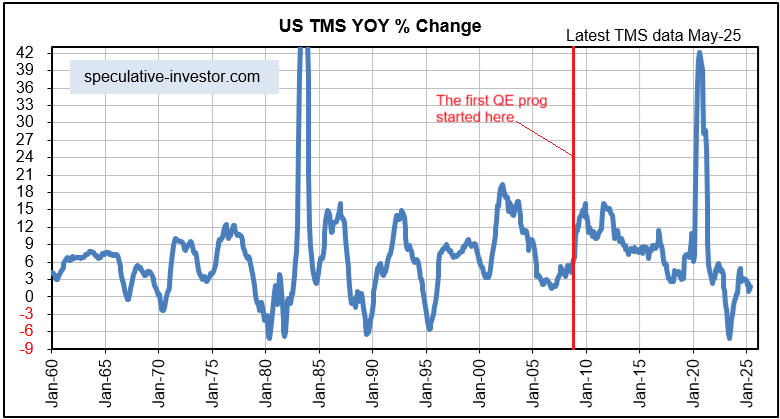
In the US, prior to 2008 there was plenty of monetary inflation but no QE programs. Prior to 2008 the monetary inflation was driven by the commercial banks, which create new money (bank deposits) when they make loans and purchase securities.

The following monthly chart shows the year-over-year growth rate of US True Money Supply (TMS), with a vertical red line drawn to mark the start of the Fed’s first QE program in September-2008. Clearly, there were many waves of monetary inflation prior to the introduction of QE, all of which were due to deposit creation by commercial banks. We expect that there will be waves of monetary inflation in the future, again due to deposit creation by commercial banks. Commercial banks have the legal ability to create money out of nothing, so naturally that’s what they will do in the future just like they did in the past.

A problem will arise when the economy becomes very weak and commercial banks stop expanding credit due to a contraction in the pool of qualified private borrowers. We suspect that this problem will be mitigated by incentivising or forcing the commercial banks to purchase more government debt, which they would do by creating new money that the government would inject into the economy via its spending. What we don’t expect is large-scale asset monetisation (QE) by the Fed in response to future economic weakness, because “price inflation” statistics won’t provide the necessary cover.

Anyway, the point we wanted to make is that there probably will be ‘ample’ monetary inflation in the future, it’s just that the money creation won’t be driven directly by the Fed. Due to the popular inflation indices spending most of their time well above the Fed’s target, monetary inflation will become the purview of the commercial banks — just like it was prior to 2008.